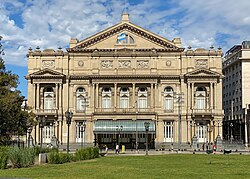
La Plaza Lavalle ou Place Lavalle est une des places principales de la ville de Buenos Aires, capitale de l'Argentine.

1. Situation

Elle se trouve dans le quartier de San Nicolás (Buenos Aires), excepté son bord nord, qui fait partie du quartier de Retiro. Elle a la forme d'un rectangle allongé, dont l'axe est orienté sud-nord. Elle est entourée par les artères Calle Lavalle (au sud), Avenida Córdoba (au nord), Calle Talcahuano (à l'ouest) et Calle Libertad (à l'est). La place est constituée de 3 pâtés de maisons, ou manzanas (îlots) de plus d'un hectare. Sa superficie, de façade à façade dépasse les 40 000 mètres carrés (4 hectares). Dans les environs de la place se trouvent plusieurs sites historiques, administratifs ou culturels de la ville. La Plaza Lavalle est traversée d'est en ouest par deux rues importantes ; la Calle Viamonte au nord et la Calle Tucumán au sud.

1. Histoire

Jadis, au XVIIIe siècle la place était un terrain en friche où il existait une lagune. Un des ruisseaux de la ville y passait, l'arroyo Tercero del Medio. Son lit suivait la Calle Libertad, et tournait vers l'est à la calle Viamonte. On y avait construit un pont pour le traverser. Après l'indépendance en 1822, on y installa un parc d'artillerie, avec fabrique d'armes et depôt de poudre. Ce parc fut le théâtre principal de la révolution du Parc, en juillet 1890, où les opposants à la gestion du président Miguel Juárez Celman s'affrontèrent.

1. Description

Il y a sur la place plusieurs statues et monuments ainsi que des arbres centenaires. Parmi les monuments, il y en a un en l'honneur de Juan Lavalle, et d'autres encore, dont l'un fut édifié à la mémoire des victimes de l'accident d'aviation de 1971 qui coûta la vie à plusieurs ballerines du Teatro Colón. Parmi les arbres centenaires, on trouve des agathis australianus de plus de 120 ans et un Ceibo de Jujuy planté en 1878 par l'intendant de la ville Torcuato de Alvear. Sur le domaine de l'ancien parc d'artillerie, face à la Plaza Lavalle (au sud-ouest), se trouve le Palais de Justice (Palacio de Justicia de la Nación). Ce grand bâtiment qui recouvre la totalité d'un îlot (un hectare) est le siège du pouvoir judiciaire d'Argentine ainsi que de la Cour Suprême de Justice. C'était un projet de l'architecte Norbert Maillart, qui dessina aussi les plans du Colegio Nacional de Buenos Aires. L'édifice fut inauguré en 1942. Face à la place, mais du côté opposé (à l'est), se trouve l'entrée principale du Teatro Colón, une des scènes lyriques les plus importantes du monde. Sa construction commença en 1889, sur base d'un projet de Victor Meano. Il fut inauguré le 25 mai 1908. La salle principale a une capacité de 2 478 spectateurs, et compte sept étages. L'édifice occupe pas moins de 6 000 m².

1. Métro

La station "Tribunales" de la ligne est située au carrefour de la Calle Tucumán et de la Calle Talcahuano, à deux pas de la Cour Suprême.

1. Liens externes

Portail de l’architecture et de l’urbanisme Portail de Buenos Aires

Nearby Places View Menu
Location Image
46 m

Tribunales (Buenos Aires Underground)

Tribunales is a station on Line D of the Buenos Aires Underground.
Location Image
79 m

Instituto Libre de Segunda Enseñanza

The Instituto Libre de Segunda Enseñanza, also known for its acronym ILSE, is a semi-private high school depending on the University of Buenos Aires (UBA). With an approximate 1000 students population , it is located in the San Nicolás neighbourhood in Buenos Aires, Argentina. As part of its affiliation with the UBA, its students are required to meet certain academic standards to join the school. Students willing to enroll have to undergo an admission process and pass for their application to be approved. This process consists of a one-year course, involving multiple exams on Mathematics, History, Language and Geography. Almost all of its faculty is composed by UBA professors, and sports related activities are carried out at University of Buenos Aires campuses and facilities. The school has gained a reputation for its rigorous admission and academic criteria, refusing to admit students who have been held back, or have more than one subject that has not been passed. The school has been repeatedly recognized for its academic excellence.
Location Image
110 m

Palace of Justice of the Argentine Nation

The Palace of Justice of the Argentine Nation (Spanish: Palacio de Justicia de la Nación Argentina, more often referred locally as Palacio de Justicia or Palacio de Tribunales), is a large building complex located in Buenos Aires, Argentina. It is the seat of the Supreme Court and other lower courts. Designed in a monumental Eclectic neoclassical style and constructed between 1905 and 1910, the building is a National Historic Landmark and has a total floor area of 60,100 m2 (647,000 sq ft).
Location Image
143 m

Supreme Court of Argentina

The Supreme Court of Argentina (Spanish: Corte Suprema de Argentina), officially the Supreme Court of Justice of the Nation (Spanish: Corte Suprema de Justicia de la Nación, CSJN), is the highest court of law of the Argentine Nation. It was inaugurated on 15 January 1863. During much of the 20th century, it and the Argentine judicial system in general lacked autonomy from the executive power. It was reformed in 2003 by the decree 222/03. The Supreme Court functions as a last resort tribunal. Its rulings cannot be appealed. It also decides on cases dealing with the interpretation of the constitution (for example, it can overturn a law passed by Congress if deems it unconstitutional). The members of the Supreme Court are appointed by the President with the agreement of at least two-thirds of the present Senate members in a session convened for that purpose, and can only be removed by an impeachment process called juicio político ("political trial"), initiated by the Chamber of Deputies and carried out by the Senate, exclusively on grounds of improper behaviour.
Location Image
175 m

Teatro Colón

The Teatro Colón (English: Colón Theatre) is a historic opera house in Buenos Aires, Argentina. It is considered one of the ten best opera houses in the world by National Geographic. According to a survey carried out by the acoustics expert Leo Beranek among leading international opera and orchestra directors, the Teatro Colón has the room with the best acoustics for opera and the second best for concerts in the world. The present Colón replaced an original theatre which opened in 1857. Towards the end of the century, it became clear that a new theatre was needed, and after a 20-year process, the present theatre opened on 25 May 1908, with Giuseppe Verdi's Aïda. The Teatro Colón was visited by the foremost singers and opera companies of the time, who would sometimes go on to other cities including Montevideo, Rio de Janeiro and São Paulo. After this period of huge international success, the theatre's decline became clear and plans were made for massive renovations. After an initial start of works to restore the landmark in 2005, the theatre was closed for refurbishment from October 2006 to May 2010. It re-opened on 24 May 2010, with a programme for the 2010 season. The theatre was declared a National Historic Monument in 1991. It is home to the Teatro Colón’s Resident Orchestra, Resident Choir, and Resident Ballet, as well as the Buenos Aires Philharmonic Orchestra. The venue also hosts the Teatro Colón’s Center for Experimentation, the Higher Institute of Art with its Orchestral Academy, the Children’s Choir, and the Colón Contemporary music program.