Location Image

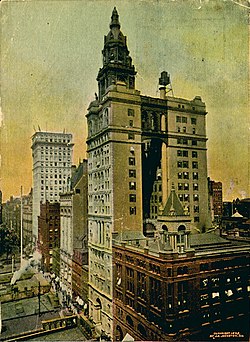
Manhattan Life Insurance Building

Le Manhattan Life Insurance Building fut construit dans l'arrondissement de Manhattan à New York d'après des plans de Kimball & Thompson et sous la direction de l'ingénieur Charles Sooysmith entre 1893 et 1894. Sa construction fut commandée par la Manhattan Life Insurance Company qui désirait construire un gratte-ciel qui pourrait surpasser ceux des concurrents. Cela explique le fait que le bâtiment culmine à 106 mètres, et comporte 18 étages ; il fut en conséquence le premier gratte-ciel à franchir la barre des 100 mètres, et le plus haut bâtiment de New York entre 1894 et 1899, en dépassant le New York World Building, avant d'être à son tour dépassé par le Park Row Building qui culminait à 119 mètres. Il fut démoli en 1963 ou 1964 - selon les sources. Le Manhattan Life Insurance Building fut en outre l'un des premiers buildings à utiliser un système de ventilation électrique pour le chauffage et la climatisation.

1. Voir aussi

Liste des plus hauts gratte-ciel du monde

1. = Articles connexes =

New York World Building Park Row Building

1. = Liens externes =

Informations sur www.skyscraper.org (en) Le Manhattan Life Insurance Building sur fr.structurae.de Le Manhattan Life Insurance Building sur Emporis.com (en)

Portail de New York Portail des gratte-ciel Portail des records

Nearby Places View Menu
Location Image
4 m

Manhattan Life Insurance Building

The Manhattan Life Insurance Building was a 348 ft (106 m) tower on Broadway in the Financial District of Manhattan, New York City.
Location Image
10 m

Wall Street station (IRT Lexington Avenue Line)
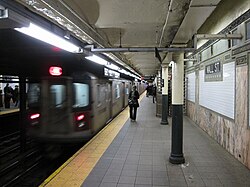
The Wall Street station is a station on the IRT Lexington Avenue Line of the New York City Subway. The station is located at the intersection of Broadway and Wall Street in the Financial District of Lower Manhattan. It is served by the 4 train at all times and the 5 train at all times except late nights. The Wall Street station was constructed for the Interborough Rapid Transit Company (IRT) as part of the city's first subway line, which was approved in 1900. Construction of the tunnel around the Wall Street station was complicated by the shallow foundations of the nearby Trinity Church, as well as the need to avoid disrupting the street surface of Broadway. The station opened on June 12, 1905, as an extension of the original line. The station's platforms were lengthened in the late 1950s, and it was renovated in the 1970s and 2000s. The Wall Street station contains two side platforms and two tracks, and it was built with tile and mosaic decorations. The platforms contain exits to Broadway's intersections with Wall and Rector Streets, outside Trinity Church, and into the basements of several buildings. An additional passageway extends east to an out-of-system connection with the Broad Street station and the basement of 28 Liberty Street. The original station interior is a New York City designated landmark and listed on the National Register of Historic Places.
Location Image
37 m

Lower Manhattan

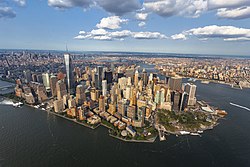
Lower Manhattan, also known as Downtown Manhattan, is the southernmost part of the New York City borough of Manhattan. The area is the historical birthplace of New York City and in the 17th and 18th centuries composed the entirety of the city. Lower Manhattan serves as the seat of government of both Manhattan and the entire City of New York. Because there are no municipally defined boundaries for the area, a precise population cannot be quoted, but several sources have suggested that it was one of the fastest-growing locations in New York City between 2010 and 2020, related to the influx of young adults and significant development of new housing units. Despite various definitions of Lower Manhattan, they generally include all of Manhattan Island south of 14th Street, with the Bowling Green and the Battery near the southern end. Anchored by Wall Street and the Financial District in Lower Manhattan, New York City is the leading global center for finance and fintech. The Financial District houses the New York Stock Exchange, the Federal Reserve Bank of New York, and other major financial institutions. A center of culture and tourism, Lower Manhattan is home to many of New York City's most iconic structures, including New York City Hall, the Woolworth Building, the Stonewall Inn, the Bull of Wall Street, and One World Trade Center, the tallest skyscraper in the Western Hemisphere.
Location Image
39 m

Statue of John Watts

An outdoor bronze sculpture depicting U.S. Congressman John Watts by George Edwin Bissell is installed in the Trinity Church Cemetery outside Manhattan's Trinity Church, in the U.S. state of New York. It was erected by Watt's grandson, John Watts de Peyster, in 1893.
52 m

Trinity Church (Manhattan)

Trinity Church is a historic parish in the Episcopal Diocese of New York. The church is located at 89 Broadway opposite Wall Street, in the Financial District of Lower Manhattan in New York City. Known for its centuries of history, prominent location, distinguished architecture and bountiful endowment, Trinity's congregation is said to be "high church", its activities based on the traditions of the Episcopal Church and the worldwide Anglican Communion in missionary outreach, and fellowship. In addition to its main church, Trinity parish maintains two chapels: St. Paul's Chapel, also in Lower Manhattan, and the Chapel of St. Cornelius the Centurion on Governors Island. The Church of the Intercession, the Trinity Chapel Complex and many other of Manhattan's Episcopal congregations were once part of Trinity parish. Columbia University was founded on the church's grounds as King's College in 1754. The current church building is the third to be constructed for the parish, and was designed by Richard Upjohn in the Gothic Revival style. Trinity's first church was a single-story rectangular structure with tall steeple facing the Hudson River, which was constructed in 1698 and destroyed in the Great New York City Fire of 1776. After using St. Paul's Chapel, the parish's second church was built in the present location facing Wall Street and was consecrated in 1790. The third and current church was erected from 1839 to 1846 and was the tallest building in the United States until 1869, as well as the tallest in New York City until 1890. In 1876–1877 a reredos and altar were erected in memory of William Backhouse Astor Sr., to the designs of architect Frederick Clarke Withers, who extended the rear. The church is adjacent to the Trinity Churchyard, a burial ground, one of three used by the parish. Besides its church and two chapels, Trinity manages real estate properties with a combined worth of over $6 billion as of 2019. Trinity's main church building is a National Historic Landmark as well as a New York City designated landmark. It is also a contributing property to the Wall Street Historic District, a NRHP district created in 2007.