

 English
 Français

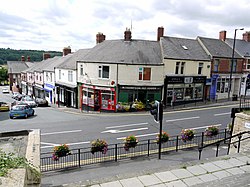
Newburn Town Hall
Newburn Town Hall is a former municipal building in Newburn Road, Newburn, a district of Newcastle upon Tyne, in Tyne and Wear, England. The building, which is currently in mixed commercial and residential use, is a Grade II listed building.
Nearby Places View Menu
164 m
Newburn
Newburn, also known as Newburn-upon-Tyne is a village and district of Newcastle upon Tyne, in Tyne and Wear, England. Situated on the North bank of the River Tyne, it is built rising up the valley from the river. It is situated approximately 5 miles (8 km) from the city centre, 14 miles (23 km) east of Hexham and 13 miles (21 km) south south west of Morpeth. In the 2001 census, the population was given as 9,301, increasing to 9,536 at the 2011 Census. Newburn is in the Newcastle upon Tyne district of Tyne and Wear and is part of the parliamentary constituency of Newcastle upon Tyne North.
Historically, the area was larger than Newcastle upon Tyne as it was the most eastern fordable point of the River Tyne. The area has Roman remains, and a Norman church dating from 1070 AD. In 1640, the Battle of Newburn took place. The area grew with the Industrial Revolution with the discovery of coal, and in 1822 Spencer's Steelworks was opened. The village's steelworks fell into decline after the First World War, and the area is now home to a country park and various leisure facilities.

268 m
Tyne Rowing Club
Tyne Amateur Rowing Club (TARC) is the longest established rowing club on the River Tyne in Newcastle upon Tyne, England. The club have active squads for men, women, masters, novices and juniors.

378 m
Newburn railway station
Newburn station was a railway station serving the village of Newburn, Newcastle upon Tyne. The station was situated at the bottom of Station Road, near Newburn Bridge, and was on the Scotswood, Newburn and Wylam Railway, a branch line of the Newcastle and Carlisle Railway.

498 m
Battle of Newburn
The Battle of Newburn, took place on 28 August 1640, during the Second Bishops' War, near Newburn in northern England. A Scottish Covenanter army of 20,000 under Alexander Leslie defeated an English force of 5,000, led by Viscount Conway.
The only significant military action of the war, victory enabled the Scots to take Newcastle upon Tyne, which provided the bulk of London's coal supplies, and allowed them to put pressure on Charles I of England. The October 1640 Treaty of Ripon required him to recall Parliament to ratify the peace settlement. He did so in November 1640, a key element in the events leading to the outbreak of the First English Civil War in August 1642.