
Location Image

Synagogue d'Édimbourg

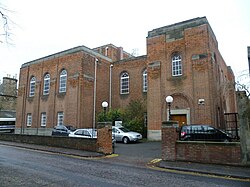
La synagogue d'Édimbourg est une synagogue juive orthodoxe, située dans le quartier de Newington à Édimbourg, en Écosse. Créée en 1816 sous le nom de Congrégation hébraïque d'Édimbourg, la congrégation pratique le rite ashkénaze. Le bâtiment actuel de la synagogue a été ouvert en 1932 et a remplacé une chapelle reconvertie sur Graham Street qui lui servait de synagogue depuis 1898. La Congrégation hébraïque d'Édimbourg est une congrégation orthodoxe traditionnelle placée sous les auspices du grand rabbin de United Synagogue. David Rose en est le rabbin depuis 2003.

1. Histoire

La Congrégation hébraïque d'Édimbourg, la première synagogue de la ville, a été fondée en 1817 à Richmond Court pour une congrégation de 20 familles. En 1868, la congrégation s'était agrandie et ils déménagèrent donc la synagogue dans un logement plus grand à Park Place. Ils déménagèrent de nouveau en 1898 sur la rue Graham. Entre 1881 et 1914, les immigrants arrivèrent en grand nombre à Édimbourg. Ils ont apporté avec eux différentes traditions religieuses. En conséquence, d’autres congrégations ont commencé à se former. Certains de ces Juifs venaient de Grande-Bretagne. En 1879, des Juifs hassidiques de Manchester venus travailler dans les Caledonian Rubber Works de Fountainbridge fondèrent une synagogue dans le quartier de Dalry, elle desservait environ 35 familles. Cependant, la majorité de la population migrante venait d'Europe de l'Est. En 1890, les migrants d'Europe de l'Est fondèrent la nouvelle congrégation hébraïque d'Édimbourg à Richmond Court, déplacée ensuite à Roxburgh Place en 1916.

1. Bâtiment actuel

La construction a commencé le 3 mai 1931 lorsque Walter Samuel, 2e vicomte Bearsted, a posé la première pierre. La synagogue a été ouverte le 11 septembre 1932 par le grand rabbin Joseph Hertz. Elle a été conçue par le célèbre architecte de Glasgow James Miller, surtout connu pour ses bâtiments commerciaux dans les gares de Glasgow et d'Écosse ; la synagogue est l'un des deux seuls bâtiments qu'il a conçus à Édimbourg. On lui a demandé de construire un bâtiment prestigieux qui contribuerait à l'architecture d'Édimbourg et constituerait un point central de la vie juive locale. La synagogue construite à cet effet pouvait accueillir 1 000 personnes et disposait également d'un mikvé sur place. Revêtu de briques rouges, il est construit dans un style néo-byzantin simplifié avec un grand dôme central. L'Arche contenant les rouleaux de la Torah est en noyer français et porte une inscription du Livre des Proverbes : (3:6) « Dans toutes tes voies, reconnais-le, et il dirigera tes sentiers ». La synagogue est depuis 1996 un monument classé de catégorie B.

1. Célébrités

Salis Daiches

1. Voir également

Histoire des Juifs en Écosse

1. Références

(en) Cet article est partiellement ou en totalité issu de l’article de Wikipédia en anglais intitulé « Edinburgh Synagogue » (voir la liste des auteurs).

1. Liens externes

Site officiel Edinburgh Jewish history Edinburgh Synagogue: Jewish Small Communities Network Portail du judaïsme Portail de l’architecture et de l’urbanisme Portail de l’Écosse Portail du XIXe siècle Portail des monuments classés au Royaume-Uni

Nearby Places View Menu
Location Image
34 m

Edinburgh Synagogue

The Edinburgh Synagogue is an Orthodox Jewish congregation and synagogue, located at 4a Salisbury Road in the Newington area of Edinburgh, Scotland, in the United Kingdom. Established in 1816 as the Edinburgh Hebrew Congregation, the congregation worships in the Ashkenazi rite, under the auspices of the Chief Rabbi of the United Hebrew Congregations of the Commonwealth. The current synagogue building was opened in 1932, replacing a converted chapel on Graham Street which had served as the synagogue since 1898.
Location Image
114 m

East Preston Street Burial Ground

East Preston Street Burial Ground is a burial ground in south Edinburgh holding graves from the 19th and 20th century. The graveyard is in the care of the City of Edinburgh Council. It stands at the junction of East Preston Street and Dalkeith Road. The property is a listed building.
Location Image
190 m

Royal Commonwealth Pool

The Royal Commonwealth Pool is a category-A-listed building in St Leonard's, Edinburgh, Scotland that houses one of Scotland's main swimming pools. It is usually referred to simply as the Commonwealth Pool and known colloquially as the 'Commie'.
Location Image
221 m

Newington, Edinburgh

Newington is a neighbourhood of southern Edinburgh, Scotland. Developed from the early 19th century, it is an affluent, predominantly residential area. Located between 1 and 2+1⁄2 miles (1.5 and 4 kilometres) south of Edinburgh city centre, Newington is bounded to the east by St Leonard's and Prestonfield; to the south by Cameron Toll and Nether Liberton; to the west by Blackford, the Grange, and Sciennes; and to the north by the Southside, Edinburgh. Historically part of the parishes of St Cuthbert's and Liberton in the county of Midlothian, Newington was incorporated into the city of Edinburgh between 1832 and 1896. Originally part of the ancient forest of Drumselch, the lands of Newington were feued by the town council of Edinburgh from 1586. Aside from small developments, the area was predominantly rural until Benjamin Bell purchased the lands in 1805 and began to develop them as a suburb. Around this time, the construction of a new route from Edinburgh's New Town to Liberton via Newington was accelerating the southward development of the city. From the 1850s, bus services connected Newington to the city centre while trams arrived in 1871. Newington station opened to passengers in 1884. By this time, the area was almost entirely developed. In the latter half of the 19th century, institutions including the Longmore Hospital, the Royal Blind Asylum, and St Margaret's School set up in Newington. Newington station closed to passengers in 1962. Northern Newington consists of dense early Victorian tenements and Georgian terraces. South of Salisbury Road, these give way to sparser, late Georgian and early Victorian developments, some of which were founded as gated communities. Southern Newington includes Victorian villas and terraces as well as some former industrial buildings. With a population of around 11,000, Newington today remains an affluent, primarily residential suburb. The area is also one of the most diverse in Edinburgh. Newington houses Edinburgh's only synagogue as well as the headquarters of Historic Environment Scotland and the Causewayside site of the National Library of Scotland.
Location Image
224 m

St Leonard's, Edinburgh

St Leonard's is a neighbourhood of south-central Edinburgh, Scotland, United Kingdom. Once notable as a centre of industry, it is now primarily residential. The area takes its name from the mediaeval hospital of St Leonard, which stood on St Leonard's Hill on the edge of Holyrood Park. The hospital had fallen out of use by the mid-17th century but, by the middle of the following century, a small village had developed on the east side of the road between Edinburgh and Dalkeith. One prominent house built in this time, Hermits and Termits, survives. In 1831, the Edinburgh and Dalkeith Railway opened its northern terminus at St Leonard's. Later in the 19th century, businesses including Thomas Nelson & Sons publishers and J. & G. Stewart distillers established manufacturing operations in St Leonard's. Industry declined throughout the 20th century with the station and Nelson's Parkside Works closing in 1968. In this period, abortive plans to demolish much of the area in favour of a ring road led to "planning blight" and the destruction of many older properties. Since the 1970s, however, St Leonard's has been redeveloped as a residential neighbourhood. St Leonard's is the site of the University of Edinburgh's Pollock Halls of Residence, including the Confucius Institute of Scotland. The Royal Commonwealth Pool – used in the 1970, 1986 and 2014 Commonwealth Games – is located here, as is St Leonard's Police Station. Until 2020, Scottish Widows was headquartered in St Leonard's.