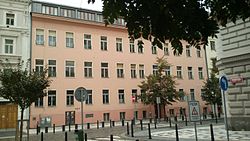
Le théâtre de Vinohrady (en tchèque : Divadlo na Vinohradech), est un théâtre situé dans le quartier de Vinohrady à Prague.

1. Historique

La naissance du théâtre Vinohrady est le résultat d'un projet visant à la création d'une salle théâtrale pour interpréter les œuvres d'auteurs slaves. Un concours d'architectes fut lancé en 1902. La construction de ce théâtre commença le 27 février 1905. Le théâtre fut inauguré le 24 novembre 1907. Ce théâtre a été construit selon le plan du professeur Alois Čenský. Sur la façade principale sont disposées des statues de Milan Havlíček représentant « la vérité » et « le courage ». Le théâtre de Vinohrady est le second théâtre en pierre à avoir été construit après le Théâtre national. En 1907, Ludvík Čelanský fut le premier directeur artistique de ce nouveau théâtre pragois où il créa une scène d'opéra. La première œuvre jouée fut Godiva du poète Jaroslav Vrchlický Entre 1950 et 1966, le théâtre Vinohrady fut utilisé par l'armée tchécoslovaque et prit le nom de théâtre de l'armée tchécoslovaque. En 1967, il retrouva son nom d'origine.

1. Liens externes

(cs) Site du théâtre Vinohrady (cs) Architecture du théâtre Vinohrady Portail du théâtre Portail de la musique classique Portail de l’opéra Portail de Prague

Nearby Places View Menu
Location Image
37 m

Vinohrady Theatre

Vinohrady Theatre (Czech: Divadlo na Vinohradech) is a theatre in Vinohrady, Prague. Construction began on February 27, 1905. It served as the Theatre of the Czechoslovak Army from autumn 1950 to January 1966. It contains a curtain painted by Vladimír Županský depicting a naked muse. Playwrights associated with the theatre include Viktor Dyk who was active around 1915. During the Velvet Revolution, where the Czechoslovak Socialist Republic was overthrown, there was a rally outside the theatre on the night of November 19–20; actress Vlasta Chramostová was quoted as asking the crowd: "If not now, when? If not us, then who?"
Location Image
74 m

Basilica of St. Ludmila

The Basilica of St. Ludmila (Czech: Bazilika svaté Ludmily) is a neo-Gothic Catholic church at Náměstí Míru (Peace Square) in Prague's Vinohrady, built on plans of Josef Mocker in 1888–1892. It is named in honor of St. Ludmila of Bohemia. It is a brick-made three-aisle basilica with a transversal nave in the shape of the cross. The church front features two 60.5m-high towers with bells and the tall gable with portal above the main entrance with sculptures. The interior of the temple excels in a rich color windows, paintings and sculptures on which participated national artists Josef Václav Myslbek, Josef Čapek and František Ženíšek. The church was closed due to Metro construction and later for reconstruction in 1974–1992. In 1980, its major reconstruction started. By December 1984, the restoration of the southern nave was completed, where the service of the Mass was temporarily resumed in improvised setting. On 16 September 1992, the day of veneration of St. Ludmila, the whole temple was reopened in the solemn ceremony of consecration of the new altar, which was held by Cardinal Miloslav Vlk. On 3 September 1993, the bells rang again on the towers of the church. At present, the Christmas and Easter fairs, open-air concerts, and charitable sales are often held in front of the temple. Since 2013, the videomapping has been screened every year in October on the church during the Signal festival. In August 2022, the church was elevated by Pope Francis to the status of basilica minor.
Location Image
102 m

Náměstí Míru (Prague Metro)

Náměstí Míru (Czech pronunciation: [ˈnaːmɲɛsciː ˈmiːru], English: Peace Square) is a Prague Metro station on Line A. It is located in Vinohrady district under Korunní Street and has one exit through an escalator tunnel with a sub-surface vestibule under the plaza of the same name. The exit of the metro station is in the immediate vicinity of the Church of St. Ludmila and Vinohrady Theatre. The station was completed along with the first section of Line A, between Leninova and Náměstí Míru, and opened on 12 August 1978. It served as a terminus until the extension of Line A to Želivského station on 19 December 1980. Náměstí Míru is the deepest station of the Prague Metro, its platform is situated 53 metres below surface. The station has the longest escalators in European Union (length 87 m, vertical span 43.5 m, 533 steps, taking 2 minutes and 21 seconds to ascend or 2 minutes 19 seconds to descend without walking). Náměstí Míru, however, is not the deepest point within the Prague Metro network; this record belongs to the tunnel between Hradčanská and Malostranská stations (68 m below surface). The station is named after the square under which it is located. During the 2002 European floods the station became the western terminus for its line, with trains running to Skalka. Náměstí Míru is intended to be part of the new Line D, with trains running between the station and C-line station Pankrác. The D-line station is intended to be built closer to the surface, meaning the existing station on the A-line will continue to be the deepest on the network.
Location Image
260 m

Lauder Schools of Prague

The Lauder Schools of Prague (Czech: Lauderovy školy v Praze) are the only Jewish schools in Prague and in the entire Czech Republic. The schools consists of an elementary school called The Lauder Gur Arje Jewish Day School and a secondary school called The Lauder Or Chadaš Jewish Community High School. The names of the schools refer to an important figure of the Jewish Ghetto in Prague, Rabbi Judah Loew ben Bezalel, who was also known as the Maharal of Prague and Rabbi Loew. The schools were founded in 1997 by the Prague Jewish Community together with the R. S. Lauder Foundation and the Czech Ministry of Education, they operate on the site of a former orphanage for Jewish children who had lost their families in the Holocaust and man of whom have perished themselves. More than 450 students attend the Lauder Schools of Prague as of 2024. All subjects are taught in Czech, except for foreign languages (Hebrew, English, German and French). Three hours a week of Judaism is also taught. The school operates a kosher kitchen and runs according to the Jewish calendar. Even though there is a kindergarten, an elementary school and a secondary school in the Lauder School of Prague, it only has one principal: Mr. Petr Karas. There are similar schools in other countries. Poland has the Lauder - Morasza School, Hungary the Lauder Javne Jewish Community School, etc.
Location Image
330 m

Battle for Czech Radio

An illicit broadcast from the radio studio in Prague helped spark the Prague uprising during the final days of World War II, but German counterattacks led to a pitched battle breaking out. The conflict became known as the Battle for Czech Radio (Czech: Boj o Český rozhlas). By controlling the radio, the Czech resistance was able to inform and inspire the people of Prague to effective action during the Prague uprising. German forces were unable to prevent the Czechs from broadcasting. However, the attempts to appeal to Russians and Americans for aid were unsuccessful.