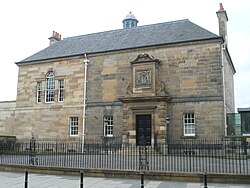
The Archers' Hall is the club house of the Royal Company of Archers, the Sovereign's Bodyguard in Scotland. It is located at 66 Buccleuch Street in the Southside of Edinburgh, and has been used by the company for over 230 years. Building commenced on 15 August 1776, and was completed in 1777 to designs by Alexander Laing. When the foundation stone was laid in 1776, two lines of Latin were inscribed on a plate which was set in the stone. These lines, beginning Nulla Caledoniam, were taken from:

The Royal Company of Archers were granted the motto "Nemo me impune lacessit" by a Royal charter of Queen Anne, 1713.

The building was extended in 1900 by Robert Rowand Anderson and his partner, A. F. Balfour Paul. The principal hall inside measures 40 by 24 feet (12.2 by 7.3 m), and is 18 feet (5.5 m) high. Two other rooms of 18 by 19 feet (5.5 by 5.8 m) are contained in the building, as well as a kitchen, cellars, lobby, and other apartments. The ground behind the house was laid out into a bowling green, maintained by the Edinburgh Bowling Club until its redevelopment in 2008. The hall serves as a venue for various dinners and meetings of the Royal Company of Archers and the club. An external lodge, adjacent to the hall, houses an indoor changing rooms, shooting gallery and a bow workshop. Archers' Hall is a category A listed building, a building "of regional or more than local importance". There is a proposal to demolish the lodge. In 2008 09 the corner lodge, existing archery butts and bowling pavilion were demolished to improve club facilities. Inside, an 8-person lift was installed to connect the basement, principal and main hall levels, and a new access through the north façade was built. The work also included repairs to existing stonework, and replacement of missing sections using natural stone chosen to match. The work was carried out by LDN Architects. Since 9 February 2008 the club's commercial entity is Bowmen Limited, a registered private company. It caused considerable distress when Edinburgh Bowling Club, founded in 1848 and said to be Edinburgh's oldest, was obliged by the Royal Company of Archers to vacate the site. The Edinburgh Bowling Club subsequently disbanded and closed. The Archers’ Hall development involved an extension to house archery practice ranges and the creation of fifteen two and three-storey multiple occupancy residences to provide accommodation for around 75 University of Edinburgh postgraduate students which the university has taken on a long lease. The project makes imaginative use of the space available and is focused around a lawn area where the original bowling green was. Among those organisations involved were Sir Robert McAlpine, Harley Haddow engineers and LDN Architects. Public access to the Archers' Hall is available by appointment.

1. References
Nearby Places View Menu
Location Image
97 m

Institute for Advanced Studies in the Humanities

The Institute for Advanced Studies in the Humanities (IASH, University of Edinburgh) was founded in 1969 at the University of Edinburgh, for visiting fellows to engage in study and research in the arts, humanities and social sciences. The current Director (since 2022) is Lesley McAra. Other Directors have included David Daiches, Susan Manning, Jo Shaw and Steve Yearley. Since 1969, IASH has received visits from over 1,500 fellows. Up to 25 Fellows are in residence at any one time, and visits last between two months and ten months. Each year IASH hosts the University of Edinburgh's annual Fulbright-Scotland Visiting Professorship. Notable former Fellows include Marianne Boruch, William C. Dowling, Sébastien Fath, Ruth Barcan Marcus, Edward Mendelson, Garry Wills, and Charles W.J. Withers. IASH hosts or organises over 100 events per year. The IASH Advisory Board includes Rosi Braidotti and Allan Little. It is chaired by Sarah Prescott. IASH's premises are located in Hope Park Square off Meadow Lane in Edinburgh. The Institute, its Fellows and its building appear in three of Alexander McCall Smith's novels, and a Fellowship named after their heroine Isabel Dalhousie was founded in 2012.
130 m

University of Edinburgh School of Economics

The School of Economics is a department within the College of Arts, Humanities and Social Sciences at the University of Edinburgh in Scotland. The university's first lessons in economics were delivered by Dugald Stewart in 1800, while William Ballantyne Hodgson was appointed as the first actual economics professor in 1871. The subject's development progressed slowly until the subject became a major, then department and finally a separate school. Having initially been titled the Department of Economics under the auspices of the University of Edinburgh's Faculty of Social Sciences, the school was moved to a department of the University of Edinburgh Business School, then known as the University of Edinburgh Management School, in 2002. In 2009, the school was renamed as the School of Economics, operating independently under the College of Humanities and Social Science's umbrella.
Location Image
163 m

St Andrew's Orthodox Church, Edinburgh

St Andrew's Orthodox Church is an Orthodox church located in the Southside, Edinburgh, Scotland. Edinburgh's Orthodox community was founded in 1948 and has, since 2013, occupied the former Buccleuch Parish Church, which was founded as a chapel of ease of St Cuthbert's in 1756 and closed in 1969. In the middle of the 18th century, St Cuthbert's Parish covered a large area around Edinburgh. Its population was growing, especially in the area of the modern Southside. The church opened in January 1756 as St Cuthbert's Chapel of Ease. The church became a parish church in 1834 and founded a parish school on the Meadows in 1839. The Disruption of 1843 greatly affected the church and it was revived with the support of Archibald Charteris and the Edinburgh University Mission Association. By the middle of the 20th century, the congregation was declining as many of its members moved away from the Southside. In 1969, Buccleuch united with Nicolson Street and Charteris-Pleasance. The building was sold to the University of Edinburgh, which used it as a furniture store. The Orthodox Community of St Andrew was founded in 1948 by Archpriest John Sotnikov, a Russian chaplain of the Polish Army. Under Sotnikov's successor, Maitland Moir, the church moved into the former Buccleuch Parish School in 2003 before purchasing the former Buccleuch Parish Church in 2013. The church is a simple, cruciform building, greatly altered in the Gothic style by Daniel MacGibbon in 1866. It has been a category C listed building since 2007. Notable interments in the surrounding churchyard include Thomas Blacklock and Deacon Brodie.
Location Image
174 m

40 George Square

40 George Square is a tower block in Edinburgh, Scotland forming part of the University of Edinburgh. Until September 2020 the tower was named David Hume Tower (often abbreviated as DHT). The building contains lecture theatres, teaching spaces, offices, a café and a shop.