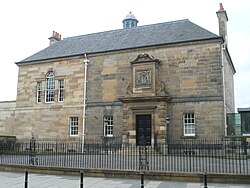
The Archers' Hall is the club house of the Royal Company of Archers, the Sovereign's Bodyguard in Scotland. It is located at 66 Buccleuch Street in the Southside of Edinburgh, and has been used by the company for over 230 years. Building commenced on 15 August 1776, and was completed in 1777 to designs by Alexander Laing. When the foundation stone was laid in 1776, two lines of Latin were inscribed on a plate which was set in the stone. These lines, beginning Nulla Caledoniam, were taken from:

The Royal Company of Archers were granted the motto "Nemo me impune lacessit" by a Royal charter of Queen Anne, 1713.

The building was extended in 1900 by Robert Rowand Anderson and his partner, A. F. Balfour Paul. The principal hall inside measures 40 by 24 feet (12.2 by 7.3 m), and is 18 feet (5.5 m) high. Two other rooms of 18 by 19 feet (5.5 by 5.8 m) are contained in the building, as well as a kitchen, cellars, lobby, and other apartments. The ground behind the house was laid out into a bowling green, maintained by the Edinburgh Bowling Club until its redevelopment in 2008. The hall serves as a venue for various dinners and meetings of the Royal Company of Archers and the club. An external lodge, adjacent to the hall, houses an indoor changing rooms, shooting gallery and a bow workshop. Archers' Hall is a category A listed building, a building "of regional or more than local importance". There is a proposal to demolish the lodge. In 2008 09 the corner lodge, existing archery butts and bowling pavilion were demolished to improve club facilities. Inside, an 8-person lift was installed to connect the basement, principal and main hall levels, and a new access through the north façade was built. The work also included repairs to existing stonework, and replacement of missing sections using natural stone chosen to match. The work was carried out by LDN Architects. Since 9 February 2008 the club's commercial entity is Bowmen Limited, a registered private company. It caused considerable distress when Edinburgh Bowling Club, founded in 1848 and said to be Edinburgh's oldest, was obliged by the Royal Company of Archers to vacate the site. The Edinburgh Bowling Club subsequently disbanded and closed. The Archers’ Hall development involved an extension to house archery practice ranges and the creation of fifteen two and three-storey multiple occupancy residences to provide accommodation for around 75 University of Edinburgh postgraduate students which the university has taken on a long lease. The project makes imaginative use of the space available and is focused around a lawn area where the original bowling green was. Among those organisations involved were Sir Robert McAlpine, Harley Haddow engineers and LDN Architects. Public access to the Archers' Hall is available by appointment.

1. References
Lieux à Proximité Voir Menu
Location Image
204 m

Queen's Hall (Édimbourg)

Le Queen's Hall est une salle de musique d'une capacité de 900 personnes, située sur Clerk Street à Édimbourg, en Écosse. Construite à l'origine en 1823 sous le nom de Hope Park Chapel, elle a été convertie dans son rôle actuel en 1979 et a été officiellement inaugurée par la reine Elisabeth II le 6 juillet 1979. Il accueille désormais tous les types de musique live et présente environ 200 représentations chaque année. C'est le lieu de représentation d'Édimbourg toute l'année du Scottish Chamber Orchestra et joue également un rôle important pour le Festival international d'Édimbourg, le Festival Fringe d'Édimbourg et le Festival de jazz et de blues d'Édimbourg.
Location Image
297 m

University of Edinburgh School of Informatics

La faculté d'informatique de l'université d'Édimbourg (University of Edinburgh School of Informatics) est née en 1998 de la fusion des départements d'intelligence artificielle, de science informatique et de science cognitive de l'université d'Édimbourg. La recherche à l'école d'informatique se base sur des composantes de ces disciplines et est de nature interdisciplinaire. L'école est particulièrement connue pour la recherche dans les domaines de l'intelligence artificielle, de l'informatique linguistique et de l'informatique théorique, mais elle est aussi impliquée dans d'autres secteurs. En 2023, l'école a un personnel académique de 740 individus, et forme plus de 2 000 étudiants. L'école s'est vu attribuer un 5*A à l'exercice d'évaluation des recherches du HEFC du gouvernement britannique, la note la plus élevée parmi tous les départements de science informatique du pays. Elle est généralement considérée comme un chef de file mondial en science informatique, rivalisant avec les instituts les plus prestigieux des États-Unis. L'incendie de la Cowgate en décembre 2002 a détruit un de ses bâtiments, et la renommée bibliothèque AI. Un espace a été rapidement rendu disponible dans la tour d'Appleton de l'université à titre de remplacement. En juin 2008, la majorité de l'école s'est installée dans l'Informatics Forum, construit à cet effet.
302 m

Centre international pour les sciences mathématiques

Le Centre international pour les sciences mathématiques (International Centre for Mathematical Sciences, ICMS) est un centre de recherche mathématique basé à Édimbourg. Selon son site web, le centre est « conçu pour rassembler les mathématiciens et les praticiens de la science, de l'industrie et du commerce pour des ateliers de recherche et d'autres réunions. ».
326 m

Royal Commission on the Ancient and Historical Monuments of Scotland

La Royal Commission on the Ancient and Historical Monuments of Scotland ou RCAHMS (Commission royale sur les monuments anciens et historiques d'Écosse en français) est un ancien organisme public non-départemental fondé par un Royal Warrant en 1908 et financé par le parlement écossais. Il fait partie des Collections nationales d'Écosse et a pour rôle de collecter, enregistrer et commenter des informations sur le patrimoine architectural d'Écosse. En 2015, elle fut dissolue et amalgamée avec Historic Scotland pour former Historic Environment Scotland.
Location Image
326 m

Mosquée centrale d'Édimbourg

La Mosquée centrale d'Édimbourg est une mosquée située à Édimbourg en Écosse. Elle a été inaugurée en 1998 et a une capacité d'accueil de 1 250 personnes.