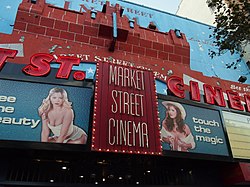
Market Street Cinema was a historical theater located on Market Street in the Mid-Market district, San Francisco, California. It was founded in 1912 by David and Sid Grauman as the Imperial Theater. It was converted into a movie theatre as the Premiere Theatre (1929) and the United Artists Theatre (1931). The benefit world premiere of Dirty Harry was held here on December 22, 1971. In 1972 it was purchased by adult film producer Mike Weldon (Skintight, 1979), and renamed Market Street Cinema and was used through the early 2000s as an adult entertainment venue. It was one of the first adult venues that allow "lap dancing," where the club's dancers would wander the crowd looking for tips by sitting on the laps of customers. Mike Weldon was sued by the Justice Department for "pimping," but repeatedly won the lawsuits given participants remained clothed during encounters, and the 'lap dances" were not "negotiated sex-acts." The role of the theater in San Francisco's sex industry in the 1980s was documented in a photo essay by photographer Leon Mostovoy. In October 2015, the San Francisco Planning Commission approved a plan to demolish the theatre and replace it with an eight-story building. Market Street Cinema is considered haunted in popular culture: it features in a 2013 episode of Ghost Adventures (season 7, episode 25) and was used as a shooting location by filmmaker Charles Webb for a low-budget horror movie called G-String Horror. On August 15, 2016, Mint Minx Press published the novella Market Street Cinema by author Michele Machado, narrating the fictional account of a dancer working at the club in 1998.

1. See also

List of strip clubs Mitchell Brothers O'Farrell Theatre

1. References


1. External links

Market Street Cinema, Cinema Treasures

Nearby Places View Menu
Location Image
19 m

McAllister Tower Apartments

McAllister Tower Apartments, also known as the William Taylor Hotel, is a 28-story, 94 m (308 ft) residential apartment skyscraper at 100 McAllister Street in San Francisco, California. The property is owned and operated by the UC Law SF. The tower includes mixed-use offices on various floors, student residences and the Art Deco-styled "Sky Room" with a panoramic view on the 24th floor. The hotel was named in honor of William Taylor, a Methodist missionary who served in San Francisco during the California gold rush. Conceived as an unusual combination of a large church surmounted by a hotel, construction of the building brought architectural dispute. Initially designed by Timothy L. Pflueger in the Gothic Revival style, the investors fired his firm and hired Lewis P. Hobart, who changed little of Pflueger's design. In a resulting lawsuit, Pflueger won nearly half the damages he asked for. The building opened in 1930 as the William Taylor Hotel and Temple Methodist Episcopal Church. However, extra construction expenses had put the congregation at greater financial risk, and the church-hotel concept did not prove popular. No profit was made in six years, and the church left, losing their investment. In the late 1930s the building housed the Empire Hotel, known for its Sky Room lounge, then from World War II to the 1970s, 100 McAllister served as U.S. government offices. Reopening as university housing and offices in 1981, McAllister Tower is home to some 300 law students and their families. "The Tower" is sited one block from the administrative and scholastic center of UC LAW SF (formerly UC Hastings College of the Law) and is the most prominent building in the district. It is a contributing property to the National Register of Historic Places's Uptown Tenderloin Historic District since 2009.
Location Image
60 m

Hibernia Bank Building (San Francisco)

The Hibernia Bank, headquartered in San Francisco, California, was founded in April 1859 as the Hibernia Savings and Loan Society. In 1892, the company built a Beaux-Arts headquarters at 1 Jones Street at the corner of McAllister and Market Streets, designed by Albert Pissis. Slightly damaged in the 1906 earthquake and fire, it re-opened again just five weeks after the calamity. Pissis designed an addition to the building in 1908. The bank left the building in 1985, and, after a brief period in which it was used by the San Francisco Police Department, the building was vacant for decades, until it was restored and renovated in 2016. As of 2017, the building, re-branded as "The Hibernia", is being subdivided for leasing to tenants who need less than the building's overall 42,000 square feet (3,900 m2) of space. The Hibernia Bank Building is a designated San Francisco landmark.
Location Image
63 m

50 United Nations Plaza Federal Office Building (San Francisco)

The 50 United Nations Plaza Federal Office Building is a United States federal building located on United Nations Plaza between Hyde and McAllister Streets in San Francisco, California. The 1936 Neoclassical style building, designed by Arthur Brown, Jr., is listed on the National Register of Historic Places, and is a contributing property to the San Francisco Civic Center Historic District, which is a National Historic Landmark.
Location Image
93 m

United Nations Plaza (San Francisco)

United Nations Plaza (often abbreviated UN Plaza or UNP) is a 2.6-acre (1.1 ha) plaza located on the former alignments of Fulton and Leavenworth Streets—in the block bounded by Market, Hyde, McAllister, and 7th Street—in the Civic Center of San Francisco, California. It is located 1⁄4 mi (0.40 km) east of City Hall and is connected to it by the Fulton Mall and Civic Center Plaza. Public transit access is provided by the BART and Muni Metro stops at the Civic Center/UN Plaza station, which has a station entrance within the plaza itself. UN Plaza was designed by a joint venture of firms led by the noted architects Lawrence Halprin, John Carl Warnecke, and Mario Ciampi; Halprin designed the large sunken fountain. The plaza was dedicated in 1975 to commemorate the formation of the United Nations and the signing of the Charter of the United Nations on 26 June 1945 in San Francisco. Since its dedication, the plaza was refurbished in 1995 and 2005, and in Spring 2018, three redesign proposals were proposed for public review.