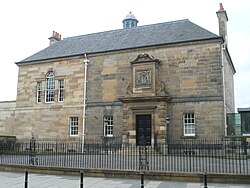
Le Queen's Hall est une salle de musique d'une capacité de 900 personnes, située sur Clerk Street à Édimbourg, en Écosse. Construite à l'origine en 1823 sous le nom de Hope Park Chapel, elle a été convertie dans son rôle actuel en 1979 et a été officiellement inaugurée par la reine Elisabeth II le 6 juillet 1979. Il accueille désormais tous les types de musique live et présente environ 200 représentations chaque année. C'est le lieu de représentation d'Édimbourg toute l'année du Scottish Chamber Orchestra et joue également un rôle important pour le Festival international d'Édimbourg, le Festival Fringe d'Édimbourg et le Festival de jazz et de blues d'Édimbourg.

1. Histoire


1. = 1822-1873 =

L'architecte d'Edimbourg Robert Brown (mort en 1832) a été nommé pour concevoir l'église de St Cuthbert, en tant que responsable de l'aménagement d'une partie de l'extension urbaine d'Édimbourg et de la conception de bâtiments tels que le développement de Easter Coates, notamment Melville Street, Coates Crescent et Manor Place. Le coût initial du bâtiment était de 6 111 livres, et en 1834, il fut rebaptisé église paroissiale de Newington. L'orgue Forster et Andrews a été installé en 1873 et n'était que le deuxième orgue introduit dans une église établie à Édimbourg.

1. = 1977-présent =

La fermeture de l'église en 1976 a coïncidé avec une recherche par le Scottish Baroque Ensemble (maintenant le Scottish Ensemble), les Scottish Philharmonic Singers et le Scottish Chamber Orchestra pour trouver des locaux de représentation et de répétition. Un appel a été lancé en 1977. L'architecte était Larry Rolland de Robert Hurd and Partners, et l'entrepreneur principal était Melville, Dundas et Whitson. Le coût total s'élevait à 850 000 livres et le Queen's Hall fut officiellement inauguré le 6 juillet 1979. Le développement s'est poursuivi en 1982 avec l'ouverture de la Canada Room (maintenant appelée la salle Tunnell, en l'honneur de John Tunnell, l'ancien chef du Scottish Chamber Orchestra). En 1991, un nouveau niveau en mezzanine — appelé la salle Hope Scott — a été créé au-dessus du bar. La salle a été encore améliorée en 1996 avec l'installation de l'ascenseur pour piano, la rénovation des bancs, l'éclairage et la moquette pour un coût de 700 000 livres. En juin 2017, une stratégie de rénovation de trois ans visant à repositionner le Hall et la marque pour assurer son succès financier et artistique futur sous la direction du nouveau PDG Evan Henderson a été annoncée.

1. Agencements et installations

L'horloge de la tour de l'horloge a été payée par souscription en 1827 et son fonctionnement d'origine a été remplacé en 1883.
La chaire a été enlevée et entreposée par l'Église d'Écosse jusqu'à ce qu'elle soit offerte et installée à l'église St Giles d'Elgin en 1981.

1. Références


1. Liens externes

Site Web du Queen's Hall Portail des arts du spectacle Portail de l’architecture et de l’urbanisme Portail de l’Écosse Portail des monuments classés au Royaume-Uni

Nearby Places View Menu
Location Image
130 m

Royal Commission on the Ancient and Historical Monuments of Scotland

The Royal Commission on the Ancient and Historical Monuments of Scotland (RCAHMS) was an executive non-departmental public body of the Scottish Government that was "sponsored" [financed and with oversight] through Historic Scotland, an executive agency of the Scottish Government. As one of the country's National Collections, it was responsible for recording, interpreting and collecting information about the built and historic environment. This information, which relates to buildings, sites, and ancient monuments of archaeological, architectural and historical interest (including maritime sites and underwater constructions), as well as historical aspects of the landscape, was then made available to the public, mainly at no cost. It was established (shortly ahead of parallel commissions for Wales and England) by a Royal Warrant of 1908, which was revised in 1992. The RCAHMS merged with government agency Historic Scotland to form Historic Environment Scotland, a new executive non-departmental public body on 1 October 2015.
130 m

Scran

Scran was a Scottish online resource for educational use by the public, schools, further education and higher education. It presented nearly 490,000 (still and moving) images and sounds contributed by museums, galleries, archives and the media. It was established as an educational charity in 1996 and was part of Historic Environment Scotland, a registered charity and non-departmental government body. In 2025, Scran, along with other resources maintained by Historic Environment Scotland, was retired, and superseded by the new HES website, trove.scot.
Location Image
140 m

Summerhall

Summerhall is an arts complex and events venue in Edinburgh, Scotland. Formerly home to the Royal (Dick) School of Veterinary Studies of the University of Edinburgh, it is now a major Edinburgh Festival Fringe visual and performing arts venue. It also hosts events for the Edinburgh Science Festival and Edinburgh International Magic Festival and provides a home for arts practitioners year round; its many rooms are used for art exhibitions, drama and music performances, libraries, small museums, educational & research programmes, artist studios, arts organisation offices, and workshops.
Location Image
204 m

Archers' Hall

The Archers' Hall is the club house of the Royal Company of Archers, the Sovereign's Bodyguard in Scotland. It is located at 66 Buccleuch Street in the Southside of Edinburgh, and has been used by the company for over 230 years. Building commenced on 15 August 1776, and was completed in 1777 to designs by Alexander Laing. When the foundation stone was laid in 1776, two lines of Latin were inscribed on a plate which was set in the stone. These lines, beginning Nulla Caledoniam, were taken from: The Royal Company of Archers were granted the motto "Nemo me impune lacessit" by a Royal charter of Queen Anne, 1713. The building was extended in 1900 by Robert Rowand Anderson and his partner, A. F. Balfour Paul. The principal hall inside measures 40 by 24 feet (12.2 by 7.3 m), and is 18 feet (5.5 m) high. Two other rooms of 18 by 19 feet (5.5 by 5.8 m) are contained in the building, as well as a kitchen, cellars, lobby, and other apartments. The ground behind the house was laid out into a bowling green, maintained by the Edinburgh Bowling Club until its redevelopment in 2008. The hall serves as a venue for various dinners and meetings of the Royal Company of Archers and the club. An external lodge, adjacent to the hall, houses an indoor changing rooms, shooting gallery and a bow workshop. Archers' Hall is a category A listed building, a building "of regional or more than local importance". There is a proposal to demolish the lodge. In 2008 09 the corner lodge, existing archery butts and bowling pavilion were demolished to improve club facilities. Inside, an 8-person lift was installed to connect the basement, principal and main hall levels, and a new access through the north façade was built. The work also included repairs to existing stonework, and replacement of missing sections using natural stone chosen to match. The work was carried out by LDN Architects. Since 9 February 2008 the club's commercial entity is Bowmen Limited, a registered private company. It caused considerable distress when Edinburgh Bowling Club, founded in 1848 and said to be Edinburgh's oldest, was obliged by the Royal Company of Archers to vacate the site. The Edinburgh Bowling Club subsequently disbanded and closed. The Archers’ Hall development involved an extension to house archery practice ranges and the creation of fifteen two and three-storey multiple occupancy residences to provide accommodation for around 75 University of Edinburgh postgraduate students which the university has taken on a long lease. The project makes imaginative use of the space available and is focused around a lawn area where the original bowling green was. Among those organisations involved were Sir Robert McAlpine, Harley Haddow engineers and LDN Architects. Public access to the Archers' Hall is available by appointment.
Location Image
223 m

Hermits and Termits

Hermits and Termits is a Georgian house in St Leonard's, Edinburgh, Scotland. Named for the lands of St Leonard's Hospital, it was completed around 1734 and restored from 1982 after a period of dereliction. The name Hermits and Termits most likely derives from the crofts of the nearby St Leonard's Hospital. Although the hospital closed some time after the Reformation, the name continued to be applied to its lands and was given to the current house, constructed for William Clifton around 1734. In the early 19th century, the house was the boyhood home of the artists William Bell Scott and David Scott. In 1826, its lands were sold to the Edinburgh and Dalkeith Railway and it remained in railway use until the closure of the surrounding depot in 1968. In this period, it was known as The Coalyard House. After a period of dereliction and threatened demolition, the house was restored in 1982 by Benjamin Tindall. It is currently a private residence. The house has been described as an outstanding example of vernacular architecture in Edinburgh. Its harled exterior is distinguished by a gablet and a plaque with the Cliftons' crest. The interior retains much original woodwork and plasterwork. It has been a Category B listed building since 1974.