St. Andrew's House (SAH), sur le flanc sud de Calton Hill, à Édimbourg, est le siège du gouvernement écossais . Le bâtiment se trouve sur le site de l'ancienne prison de Calton . Aujourd'hui, il ne reste que la maison du gouverneur à tourelles de l'ancienne prison (Governor's House), à côté du cimetière Old Calton et du monument aux martyrs politiques. Le bâtiment de 1937 de style Art Déco est un monument classé de catégorie A. Il donne sur la gare de Waverley, Canongate et Holyrood Park.

1. Construction

Le bâtiment a été conçu par l'architecte Thomas S. Tait (en), qui a remporté le concours d'architecture. La construction a commencé en novembre 1935 et s'est achevée en 1939; le bâtiment abritait initialement le Scottish Office ainsi que les bureaux du secrétaire d’État pour l’Écosse. La sculpture héraldique sur le devant est de John Marshall . La nécessité de la construction découlait de la politique de l'après-Première Guerre mondiale consistant à transférer quelques pouvoirs administratifs déconcentrés (mais non législatifs) de Londres à l'Écosse. Une cérémonie d'ouverture officielle prévue pour le 12 octobre 1939 fut « annulée pour cause de guerre » (le premier raid aérien britannique se déroula quatre jours plus tard, sur le pont du Forth). Le bâtiment fut officiellement ouvert par le roi George VI et la reine Elizabeth le 26 février 1940.

1. Architecture

Sur le plan architectural, le bâtiment est monolithique, symétrique et restreint sur la façade nord principale. Au sud, face à la vallée de Waverley, son expression est beaucoup plus irrégulière et romantique. Il y a beaucoup d'influences Art Déco. La conception de Tait intègre des éléments d’Art déco et de Style « paquebot » des années 1930 et est réputée pour être un exemple rare d’architecture moderne conçue avec sensibilité à Édimbourg . Le bâtiment présente un certain nombre de décorations sculptées, également de style Art déco, attribuées à plusieurs sculpteurs. La St Andrew's House est un bâtiment historique de catégorie A.

1. Usage gouvernemental

St. Andrew's House a été conçue et construite pour servir de siège officiel au Scottish Office. À la suite de l’adoption de la loi écossaise (Scotland Act) de 1998, St. Andrew's House abrite depuis 1999 une partie du gouvernement écossais, notamment le bureau du premier ministre et du vice-premier ministre d’Écosse, ainsi que les bureaux de tous les secrétaires du gouvernement et des directions chargées de la justice et de la santé. Le bâtiment a subi une rénovation majeure en 2001, bien que la façade soit encore recouverte d'un résidu de suie. Il accueille maintenant 1 400 fonctionnaires.

1. Références


1. Liens externes

St. Andrew's House dans le répertoire toponymique de l'Écosse Site du gouvernement écossais célébrant le 70e anniversaire du bâtiment Portail de l’Écosse Portail de la politique britannique Portail de l’architecture et de l’urbanisme Portail de l’Art déco Portail des monuments classés au Royaume-Uni

Nearby Places View Menu
Location Image
15 m

St Andrew's House

St Andrew's House (SAH) (Scottish Gaelic: Taigh Naoimh Anndra), on the southern flank of Calton Hill in central Edinburgh, is the headquarters building of the Scottish Government. The building houses offices for the First Minister and Deputy First Minister, as well as the Permanent Secretary to the Scottish Government. When completed in 1939, the building was the largest metal-framed building in Europe, and was the first time government departments serving Scotland were brought under the same space in Edinburgh. Built on the site of the old Calton Jail, the graves of ten murderers who were housed within Calton Jail remain buried beneath the car park for St Andrew's House. The turreted Governor's House is the only remaining part of the Calton Jail to remain in existence following the construction of St Andrew's House. The building accommodates 1,600 civil servants from the Scottish Government over six floors within the building.
Location Image
72 m

The Bridewell

The Bridewell was a prison in Edinburgh, Scotland, built by Robert Adam in 1791. The remains of the prison can still be seen built into the bottom part of the Scottish Government building on Regent Road.
Location Image
113 m

Political Martyrs' Monument

The Political Martyrs Monument, located in the Old Calton Burial Ground on Calton Hill, Edinburgh, commemorates five political reformists from the late 18th and early 19th centuries. Designed by Thomas Hamilton and erected in 1844, it is a 90 ft (27 m) tall obelisk on a square-plan base plinth, all constructed in ashlar sandstone blocks. As part of the Burial Ground it is Category A listed.
Location Image
119 m

Old Calton Burial Ground

The Old Calton Burial Ground is a cemetery in Edinburgh, Scotland. It is located on Calton Hill to the north-east of the city centre. The burial ground was opened in 1718, and is the resting place of several notable Scots, including philosopher David Hume, scientist John Playfair, rival publishers William Blackwood and Archibald Constable, and clergyman Dr Robert Candlish. It is also the site of the Political Martyrs' Monument, an obelisk erected to the memory of a number of political reformers, and Scotland's American Civil War Memorial. The burial ground was altered following the construction of Waterloo Place in 1819, which divided the graveyard into two sections. Along with Edinburgh's other historic graveyards, Old Calton is managed by City of Edinburgh Council. The burial ground, including screen walls, and its monuments are protected as a category A listed building.
Location Image
128 m

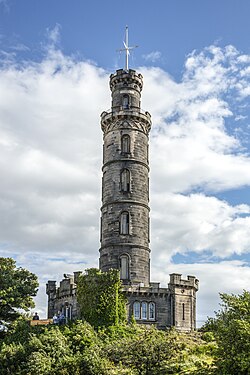
Nelson Monument, Edinburgh

The Nelson Monument is a commemorative tower in honour of Vice Admiral Horatio Nelson, located in Edinburgh, Scotland. It is situated on top of Calton Hill, and provides a dramatic termination to the vista along Princes Street from the west. The monument was built between 1807 and 1816 to commemorate Nelson's victory over the French and Spanish fleets at the Battle of Trafalgar in 1805, and his own death at the same battle. In 1852 a mechanized time ball was added, as a time signal to shipping in Leith harbour. The time ball is synchronized with the One O'Clock Gun firing from Edinburgh Castle. The monument was restored in 2009. The Royal Navy's White Ensign and signal flags spelling out Nelson's famous message "England expects that every man will do his duty" are flown from the monument on Trafalgar Day each year.