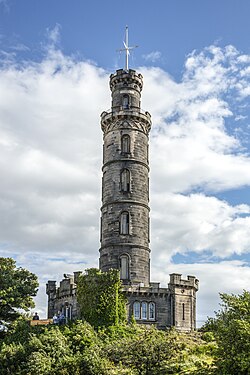
The Nelson Monument is a commemorative tower in honour of Vice Admiral Horatio Nelson, located in Edinburgh, Scotland. It is situated on top of Calton Hill, and provides a dramatic termination to the vista along Princes Street from the west. The monument was built between 1807 and 1816 to commemorate Nelson's victory over the French and Spanish fleets at the Battle of Trafalgar in 1805, and his own death at the same battle. In 1852 a mechanized time ball was added, as a time signal to shipping in Leith harbour. The time ball is synchronized with the One O'Clock Gun firing from Edinburgh Castle. The monument was restored in 2009. The Royal Navy's White Ensign and signal flags spelling out Nelson's famous message "England expects that every man will do his duty" are flown from the monument on Trafalgar Day each year.

Nearby Places View Menu
Location Image
64 m

City Observatory

The City Observatory was an astronomical observatory on Calton Hill in Edinburgh, Scotland. It is also known as the Calton Hill Observatory. The site is enclosed by a boundary wall with a monument to John Playfair, president of the Edinburgh Astronomical Institution, in the southeast corner. The oldest part is the Gothic Tower in the southwest corner, facing Princes Street and Edinburgh Castle. It is also known as Observatory House, the Old Observatory, or after its designer James Craig House. The central building with the appearance of a Greek temple is the Playfair Building, named after the building's designer William Henry Playfair. This houses the 6-inch (15 cm) refractor in its dome and the 6.4-inch (16 cm) transit telescope in its eastern wing. The largest dome of the site is the City Dome in the northeast corner. During the early 20th century this contained a 22-inch (56 cm) refractor. In 2018, the entire site was restored and new buildings were added. The City Observatory site was opened freely to the public for the first time on 24 November 2018 as the new site for Collective, a centre for contemporary art.
Location Image
64 m

Edinburgh Astronomical Institution

The Edinburgh Astronomical Institution was founded in 1811 and wound up in 1847. It was instrumental in the foundation of the Royal Observatory, Edinburgh in 1822. The Institution raised funds, mostly by member subscription, to create three departments: A scientific observatory with an observer was to be under the control of the professors of mathematics, philosophy and astronomy of the University of Edinburgh, a popular observatory was to provide general instruction and amusement and a "physical cabinet" would comprise books, globes, meteorological and other instruments.
Location Image
65 m

National Monument of Scotland

The National Monument of Scotland, on Calton Hill in Edinburgh, is Scotland's national memorial to the Scottish soldiers and sailors who died fighting in the Napoleonic Wars. It was intended, according to the inscription, to be "A Memorial of the Past and Incentive to the Future Heroism of the Men of Scotland". The monument dominates the top of Calton Hill, just to the east of Princes Street. It was designed during 1823–1826 by Charles Robert Cockerell and William Henry Playfair and is modeled upon the Parthenon in Athens. Construction started in 1826 and, due to the lack of funds, was left unfinished in 1829. This circumstance gave rise to various nicknames such as "Scotland's Folly", "Edinburgh's Disgrace", "the Pride and Poverty of Scotland" and "Edinburgh's Folly".
Location Image
98 m

Collective Gallery

Collective is a contemporary art centre in Edinburgh, Scotland. It is situated on Calton Hill, in the former City Observatory and City Dome site. It offers a programme of exhibitions, guided walking tours, audio walking tours, and events.