
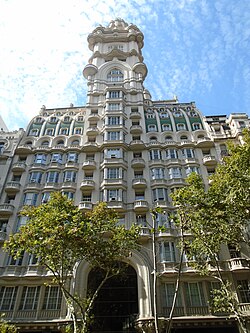
Le Palacio Barolo est un immeuble situé sur l'Avenida de Mayo, dans le quartier de Monserrat, à Buenos Aires, Argentine.

1. Histoire

Il a été édifié entre 1919 et 1923 par l'architecte italien Mario Palanti, à la demande de Luis Barolo, un magnat du textile. C'était à l'époque l'immeuble le plus haut d'Amérique du Sud avec ses 100 m de hauteur et ses 18 étages. Il ne sera détrôné qu'en 1935 par la construction du Kavanagh. En 1997 le Palacio Barolo fut déclaré Monument Historique National.

1. Description

L'architecte s'est inspiré de la Divine Comédie de Dante pour le décor :

les 100 mètres de hauteur représentent les 100 chants du poème ; il est divisé en trois sections distinctes qui correspondent aux trois livres : l'enfer, le purgatoire, et le paradis ; le hall d'entrée est surmonté de neuf voûtes qui représentent les neuf hiérarchies infernales ; chaque étage dispose de onze ou vingt-deux bureaux, ce qui correspond au nombre de strophes des chants. L'immeuble est surmonté d'un phare, qui devait à l'origine permettre d'échanger des signaux avec le Palacio Salvo à Montevideo (Uruguay), construit par le même architecte en 1925. Le Palacio Barolo qui observe la même architecture que le Palacio Salvo mesure cependant cinq mètres de plus que son jumeau. L'immeuble sert encore aujourd'hui de bureaux. Son phare possède toujours 300 000 bougies en condition de fonctionner.

1. Voir aussi

Liste des gratte-ciel de Buenos Aires

1. Références

Portail de l’architecture et de l’urbanisme Portail de l’Art nouveau Portail de Buenos Aires

Nearby Places View Menu
Location Image
0 m

Palacio Barolo

Palacio Barolo is a landmark office building, located at 1370 Avenida de Mayo, in the neighborhood of Monserrat, Buenos Aires, Argentina. It stood as Buenos Aires' tallest building for more than a decade until the construction of the Kavanagh Building in 1936. Its twin brother, Palacio Salvo, is a building designed and erected in Eclectic style, built by the same architect in Montevideo. This building was declared a national historic monument in 1997. Currently, the building has several travel agencies, a Spanish school for foreigners, a store that sells clothes for tango, offices and studios of architects, accountants, lawyers, and designers.
Location Image
87 m

Sáenz Peña (Buenos Aires Underground)

Sáenz Peña is a station on Line A of the Buenos Aires Underground. It is the last station of the line located under the Avenida de Mayo in the neighbourhood of Monserrat. The station belonged to the inaugural section of the Buenos Aires Underground opened on 1 December 1913, which linked the stations Plaza Miserere and Plaza de Mayo.
Location Image
181 m

Avenida Theatre

The Avenida Theatre (Teatro Avenida) is a theatre in Buenos Aires, Argentina.
Location Image
292 m

Hotel Castelar

Hotel Castelar was a hotel located at the northwest intersection of May and 9th of July Avenues, in the downtown Montserrat section of Buenos Aires, Argentina. It operated for 90 years, closing in 2020 as a result of the coronavirus pandemic. Opened in 1928 as the Hotel Excelsior, the building was designed by Italian architect Mario Palanti and built by local engineer José Pinzone. The Spanish poet and dramatist, Federico García Lorca, stayed here from October 1933 to March 1934 while his play, Bodas de Sangre, was being performed at the Avenida Theatre nearby; his erstwhile room has been preserved as a museum. More recently, the hotel was the site of Vice President Carlos Álvarez's dramatic, October 6, 2000, resignation, a milestone helping lead to President Fernando de la Rúa's own departure a year later.
Location Image
349 m

Lima and Avenida de Mayo (Buenos Aires Underground)

Lima is a station on Line A of the Buenos Aires Underground. Passengers may transfer from here to the Avenida de Mayo station on Line C and Metrobus 9 de Julio. The station belonged to the inaugural section of the Buenos Aires Underground opened on 1 December 1913, which linked the stations Plaza Miserere and Plaza de Mayo. Avenida de Mayo is another station, on Line C. From here, passengers may transfer to Lima on Line A and Metrobus 9 de Julio. The station was opened on 9 November 1934 as part of the inaugural section of the line, from Constitución to Diagonal Norte.