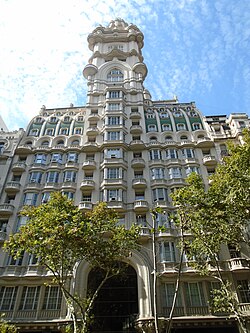
Hotel Castelar was a hotel located at the northwest intersection of May and 9th of July Avenues, in the downtown Montserrat section of Buenos Aires, Argentina. It operated for 90 years, closing in 2020 as a result of the coronavirus pandemic. Opened in 1928 as the Hotel Excelsior, the building was designed by Italian architect Mario Palanti and built by local engineer José Pinzone. The Spanish poet and dramatist, Federico García Lorca, stayed here from October 1933 to March 1934 while his play, Bodas de Sangre, was being performed at the Avenida Theatre nearby; his erstwhile room has been preserved as a museum. More recently, the hotel was the site of Vice President Carlos Álvarez's dramatic, October 6, 2000, resignation, a milestone helping lead to President Fernando de la Rúa's own departure a year later.

Nearby Places View Menu
Location Image
68 m

Lima and Avenida de Mayo (Buenos Aires Underground)

Lima is a station on Line A of the Buenos Aires Underground. Passengers may transfer from here to the Avenida de Mayo station on Line C and Metrobus 9 de Julio. The station belonged to the inaugural section of the Buenos Aires Underground opened on 1 December 1913, which linked the stations Plaza Miserere and Plaza de Mayo. Avenida de Mayo is another station, on Line C. From here, passengers may transfer to Lima on Line A and Metrobus 9 de Julio. The station was opened on 9 November 1934 as part of the inaugural section of the line, from Constitución to Diagonal Norte.
Location Image
119 m

Avenida Theatre

The Avenida Theatre (Teatro Avenida) is a theatre in Buenos Aires, Argentina.
Location Image
177 m

Avenida 9 de Julio

Avenida 9 de Julio (English: July 9 Avenue) is a major thoroughfare in the city centre of Buenos Aires, Argentina. Its name honors Argentina's Independence Day, July 9, 1816. The avenue runs around 3 kilometres (1.9 mi) to the west of the Río de la Plata waterfront, from the Retiro district in the north to Constitución station in the south. The avenue has up to seven lanes in each direction and is flanked on either side by parallel streets of two lanes each. Through the centre of the avenue runs one of the city's Metrobus (Bus rapid transit) corridors, which stretches 3 kilometres (1.9 mi) and was inaugurated in July 2013. There are two wide medians between the side streets and the main road. At a width of 110 metres (360 ft), it is currently the widest avenue in the world. The northern end of the avenue is connected to the Arturo Illia expressway (which connects to Jorge Newbery airport and the Pan-American highway) and to Libertador avenue. The southern end is connected to the 25 de Mayo tollway (serving the west side of Greater Buenos Aires as well as Ezeiza airport) and the 9 de Julio elevated expressway which provides access to the two main southbound roads out of the city (route 1 to La Plata and route 2 to Mar del Plata). The Republic Square is located on the intersection of this Avenue with the Corrientes Avenue and on that point is sited the Obelisk of Buenos Aires.
Location Image
292 m

Palacio Barolo

Palacio Barolo is a landmark office building, located at 1370 Avenida de Mayo, in the neighborhood of Monserrat, Buenos Aires, Argentina. It stood as Buenos Aires' tallest building for more than a decade until the construction of the Kavanagh Building in 1936. Its twin brother, Palacio Salvo, is a building designed and erected in Eclectic style, built by the same architect in Montevideo. This building was declared a national historic monument in 1997. Currently, the building has several travel agencies, a Spanish school for foreigners, a store that sells clothes for tango, offices and studios of architects, accountants, lawyers, and designers.