Grassmarket est un marché historique, un lieu de rencontres et un espace événementiel situé dans la vieille ville d'Édimbourg en Écosse.

1. Histoire

Il fut mentionné pour la première fois dans le Registrum Magni Sigilii Regum Scotorum (1363) comme « la rue appelée Newbygging (littéralement : nouveaux bâtiments) sous le château ». Le Grassmarket était, à partir de 1477, une des principales zones de marché de la ville .

1. Architecture

Le vieux marché est entouré de vieilles bâtisses abritant des pubs, des discothèques , des magasins et de deux grands hôtels Apex.

1. Notes


1. Liens externes

(en) Grassmarket d'après la carte de Gordon of Rothiemay, c. 1647 (en) Carte de Kincaid montrant la fermeture de Grassmarket en 1784 (en) Dessin d'une exécution dans le Grassmarket à Edinphoto (en) Compte rendu par Edward Topham de l'exécution de John Reid (en) Guide du Grassmarket Portail de l’architecture et de l’urbanisme Portail de l’Écosse

Nearby Places View Menu
Location Image
0 m

Grassmarket

The Grassmarket is a historic market place, street and event space in the Old Town of Edinburgh, Scotland. In relation to the rest of the city it lies in a hollow, well below surrounding ground levels.
80 m

Dance Base

Dance Base is the national centre for dance in Scotland. As a company it has existed since 1984, promoting and delivering dance activity in Edinburgh. In June 2001, it moved into £6.4 million purpose-built premises on the Grassmarket in the city's Old Town. The premises were opened by Prince Charles, the Royal Patron of Dance Base, on 21 September 2001. The following month the Artistic Patron, choreographer Mark Morris, created and dedicated a new work at the Festival Theatre. The centre now provides a programme of activities with their four studios and also out in the local community. There are three artistic programmes: a public programme providing over 100 classes in over 40 different forms of dance; a professional support programme, supporting and promoting professional dancers through classes, workshops and performance opportunities; a participation programme working with individuals and groups with a wide range of interests and abilities. Over 2,500 people a week attend Dance Base. Dance Base has two in-house dance companies, LYDC (Lothian Youth Dance Company) made up of young dancers, and PRIME a dance company made up of older dancers. These companies perform regularly at Dance Base and across Scotland. In partnership with Scottish Ballet, a Dance For Parkinson's programme was developed to help participants suffering Parkinson's disease to improve their balance and coordination as well as gaining in confidence and creativity. As part of the centre's professional programme, they operate a performance platform at the Edinburgh Festival Fringe in partnership with Assembly Festival. It is designated as venue 22 of the Fringe.
Location Image
98 m

St Columba's-by-the-Castle

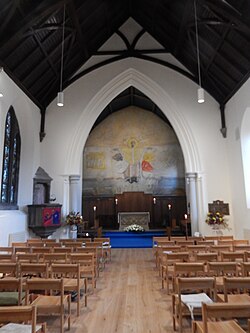
St Columba's-by-the-Castle is a congregation of the Scottish Episcopal Church in central Edinburgh, Scotland. The church is located close to Edinburgh Castle, on the south slope of Castle Hill, and is protected as a category B listed building. The church was constructed in 1846–1847 in an Early English Gothic style, to designs by architect John Henderson. Stone for the building was brought from the palace of Mary of Guise, 16th-century queen regent of Scotland, on the Royal Mile. Its layout was inspired by the reforms of Anglican worship arising from the Oxford Movement. St Columba's-by-the-Castle is part of a local ecumenical partnership (LEP) with Greyfriars Tolbooth & Highland Kirk (Church of Scotland) and Augustine United Church (United Reformed Church). It is also part of Edinburgh Churches Together and Action of Churches Together in Scotland. During the Edinburgh Festival Fringe it has been used by the promoter C venues as a venue.
105 m

John Porteous (soldier)

Captain John Porteous (c. 1695 – 7 September 1736) was a Scottish military officer who served in the Edinburgh City Guard and played a major role in the Porteous Riots, which resulted in his death.
Location Image
140 m

Cannonball House (Edinburgh)

Cannonball House is a 17th-century town house on the Royal Mile in Edinburgh, Scotland. It was built in 1630 and substantially renovated in the early 20th century. It takes its name from a cannonball embedded in its western wall. The building is protected as a Category A listed building.