Dance Base is the national centre for dance in Scotland. As a company it has existed since 1984, promoting and delivering dance activity in Edinburgh. In June 2001, it moved into £6.4 million purpose-built premises on the Grassmarket in the city's Old Town. The premises were opened by Prince Charles, the Royal Patron of Dance Base, on 21 September 2001. The following month the Artistic Patron, choreographer Mark Morris, created and dedicated a new work at the Festival Theatre. The centre now provides a programme of activities with their four studios and also out in the local community. There are three artistic programmes: a public programme providing over 100 classes in over 40 different forms of dance; a professional support programme, supporting and promoting professional dancers through classes, workshops and performance opportunities; a participation programme working with individuals and groups with a wide range of interests and abilities. Over 2,500 people a week attend Dance Base. Dance Base has two in-house dance companies, LYDC (Lothian Youth Dance Company) made up of young dancers, and PRIME a dance company made up of older dancers. These companies perform regularly at Dance Base and across Scotland. In partnership with Scottish Ballet, a Dance For Parkinson's programme was developed to help participants suffering Parkinson's disease to improve their balance and coordination as well as gaining in confidence and creativity. As part of the centre's professional programme, they operate a performance platform at the Edinburgh Festival Fringe in partnership with Assembly Festival. It is designated as venue 22 of the Fringe.

1. References


1. External links

Dance Base website

Nearby Places View Menu
Location Image
80 m

Grassmarket

The Grassmarket is a historic market place, street and event space in the Old Town of Edinburgh, Scotland. In relation to the rest of the city it lies in a hollow, well below surrounding ground levels.
Location Image
145 m

Edinburgh town walls

There have been several town walls around Edinburgh, Scotland, since the 12th century. Some form of wall probably existed from the foundation of the royal burgh in around 1125, though the first building is recorded in the mid-15th century, when the King's Wall was constructed. In the 16th century the more extensive Flodden Wall was erected, following the Scots' defeat at the Battle of Flodden in 1513. This was extended by the Telfer Wall in the early 17th century. The walls had a number of gates, known as ports, the most important being the Netherbow Port, which stood halfway down what is now the Royal Mile. This gave access from the Canongate which was, at that time, a separate burgh. The walls never proved very successful as defensive structures, and were easily breached on more than one occasion. They served more as a means of controlling trade and taxing goods, and as a deterrent to smugglers. By the mid 18th century, the walls had outlived both their defensive and trade purposes, and demolition of sections of the wall began. The Netherbow Port was pulled down in 1764, and demolition continued into the 19th century. Today, a number of sections of the three successive walls survive, although none of the ports remain.
Location Image
149 m

St Columba's-by-the-Castle

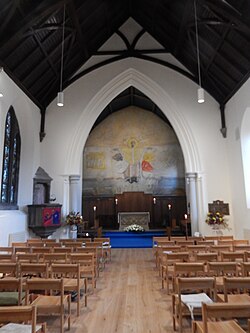
St Columba's-by-the-Castle is a congregation of the Scottish Episcopal Church in central Edinburgh, Scotland. The church is located close to Edinburgh Castle, on the south slope of Castle Hill, and is protected as a category B listed building. The church was constructed in 1846–1847 in an Early English Gothic style, to designs by architect John Henderson. Stone for the building was brought from the palace of Mary of Guise, 16th-century queen regent of Scotland, on the Royal Mile. Its layout was inspired by the reforms of Anglican worship arising from the Oxford Movement. St Columba's-by-the-Castle is part of a local ecumenical partnership (LEP) with Greyfriars Tolbooth & Highland Kirk (Church of Scotland) and Augustine United Church (United Reformed Church). It is also part of Edinburgh Churches Together and Action of Churches Together in Scotland. During the Edinburgh Festival Fringe it has been used by the promoter C venues as a venue.
Location Image
158 m

Cannonball House (Edinburgh)

Cannonball House is a 17th-century town house on the Royal Mile in Edinburgh, Scotland. It was built in 1630 and substantially renovated in the early 20th century. It takes its name from a cannonball embedded in its western wall. The building is protected as a Category A listed building.