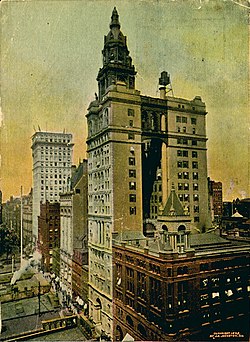
Le Bank of Tokyo building fut construit à Manhattan à New York de 1894 à 1896, selon les plans de Bruce Price. Il est situé en face de l'église Trinity. C'est l'un des premiers gratte-ciel de Manhattan avec une ossature en acier, et un modèle innovant de tour autoportante ayant inspiré l'architecture de Manhattan jusque dans les années 1920. Il comportait à l'origine 21 étages et fut le deuxième plus haut édifice de New York.

1. Histoire

En février 1894, la American Surety Company, qui occupe alors le Guernsey Building, rachète le terrain où se situait la Continental Life Insurance Company dans le « Broadway Insurance District », ce quartier derrière Wall Street investi par les compagnies d'assurances florissantes à la fin de ce siècle. Le American Surety Company Building constitue à l'époque un nouveau modèle de tour bâtie en coin de pâté de maisons, et un nouveau modèle de tour autoportante. Le magazine Brickbuilder qualifie la nouvelle tour de « certainement la tour la plus intéressante du pays ». En 1920, la American Surety Company rachète le Schermerhorn Building adjacent et prévoit une démolition partielle du bâtiment pour le fusionner avec le American Surety Company Building, créant une nouvelle structure en forme de L. En 1962, après la fusion de l'American Surety Company avec la Transamerica Corporation, le bâtiment est racheté par un groupe d'investisseurs. Il passe entre les mains de la Thomson Realty Company en 1973, qui refait complètement le design intérieur des treize premiers étages pour accueillir la Bank of Tokyo.

1. Description

Le bâtiment de 20 étages est situé sur un terrain irrégulier de forme trapézoïdale. La façade néo-Renaissance est recouverte de Granit du Maine avec une base de 3 étages, une section intermédiaire de 12 étages, ainsi que la plus haute section en comportant 6. Les quatrième et quinzième étages peuvent être considérés comme transitoires. La base est une entrée à colonnes ioniques surmontées de sculpture dans un style classique, réalisées par J. Massey Rhind. Au-dessus de la partie centrale s'élèvent jusqu'au quinzième étage des piliers surmontés par une rangée de sculptures figuratives. La troisième et dernière partie, ultérieurement modifiée comprend une colonnade de pilastres corinthiens, une corniche de pierre, et un parapet doré sur le revers du vingtième étage. L'épaisseur des murs extérieurs décroît dans les étages supérieurs pour dessiner une perspective qui ne donne pas l'impression aux piétons que le fin bâtiment va leur tomber dessus. Pour sa conception, Price s'est inspiré du Campanile de Saint-Marc à Venise, « un campanile à quatre faces de pilastres, les sept cannelures étant représentées par sept rangées de fenêtres ». Niveau fondation, la tour tient sur des piliers à caissons pneumatiques enfoncés à soixante-douze pieds dans la roche. En 1920-1922, plus de vingt ans après l'achèvement de la construction de l'édifice, l'architecte newyorkais Herman Lee Meader a supervisé les modifications qui comprenaient une nouvelle annexe en forme de L qui a élargi la tour, ainsi que le rajout de plusieurs étages, ce qui a beaucoup modifié le sommet du gratte-ciel. John Russell Pope s'est inspiré des colonnes ioniques du American Surety Company Building dans ses propres créations.

1. Galerie


1. Notes et références


1. Voir aussi


1. = Articles connexes =

Architecture à New York

1. = Liens externes =

Ressource relative à l'architecture : The Skyscraper Center

Portail de New York Portail du néo-classicisme Portail des gratte-ciel

Nearby Places View Menu
Location Image
20 m

American Surety Building

The American Surety Building (also known as the Bank of Tokyo Building or 100 Broadway) is an office building and early skyscraper at Pine Street and Broadway in the Financial District of Manhattan in New York City, across from Trinity Church. The building was designed in a Neo-Renaissance style by Bruce Price with a later expansion by Herman Lee Meader. It is 388 feet (118 m) tall, with either 23 or 26 stories. It was one of Manhattan's first buildings with steel framing and curtain wall construction. The American Surety Building contains a facade of Maine granite. Its articulation consists of three horizontal sections similar to the components of a column, namely a base, shaft, and capital, making the American Surety Building one of the earliest New York City skyscrapers to feature such a layout. The facade contains several ornamental features, including sculptural elements designed by J. Massey Rhind. In addition, the American Surety Building uses an interior skeleton of structural steel, as well as a cantilevered steel structure for its foundations. The building was erected between 1894 and 1896 as a 21-story structure, which was the second tallest building in New York City when completed. Between 1920 and 1922, an annex was built to designs by Meader, increasing the floor area and adding two stories to the building. A later tenant, the Bank of Tokyo, hired Kajima International to restore the lower 13 stories between 1973 and 1975. The American Surety Building was made a New York City designated landmark in 1995.
Location Image
44 m

New York Law Institute

The New York Law Institute is the oldest circulating law library in New York City and is open to Institute members and to scholars of history and the law.
Location Image
49 m

Manhattan Life Insurance Building

The Manhattan Life Insurance Building was a 348 ft (106 m) tower on Broadway in the Financial District of Manhattan, New York City.
54 m

14 Wall Street

14 Wall Street, originally the Bankers Trust Company Building, is a skyscraper at the intersection of Wall Street and Nassau Street in the Financial District of Manhattan in New York City. The building is 540 feet (160 m) tall, with 32 usable floors. The original 540-foot tower is at the southeastern corner of the site, and a shorter annex wraps around the original tower. The original tower was erected on the site of the Stevens Building at 12–14 Wall Street and the Gillender Building at 16 Wall Street. It was built in 1910–1912 and was designed by Trowbridge & Livingston in the neoclassical style as the headquarters for Bankers Trust. A 25-story addition with Art Deco detailing, designed by Shreve, Lamb & Harmon, was constructed in 1931–1933 to replace three other structures. After new buildings for Bankers Trust were erected in 1962 and 1974, the company moved employees away from 14 Wall Street, and eventually sold the building in 1987. 14 Wall Street's tower incorporates a seven-story pyramidal roof inspired by the Mausoleum at Halicarnassus. The interior of the building contained numerous amenities that were considered state-of-the-art at the time of its construction; the first three floors were used as Bankers Trust's headquarters, while the rest were rented to tenants. A notable building in Manhattan's skyline in the early 20th century, the building was featured prominently in Bankers Trust's early imagery. The building was designated a New York City landmark in 1997. It is also a contributing property to the Wall Street Historic District, a National Register of Historic Places district created in 2007.
Location Image
54 m

Hanover Bank Building

The Hanover Bank Building or Hanover National Bank Building was an early skyscraper at the southwest corner of Pine Street and Nassau Street in Lower Manhattan, New York City. It was built in 1901-1903 and demolished in 1931.