Location Image

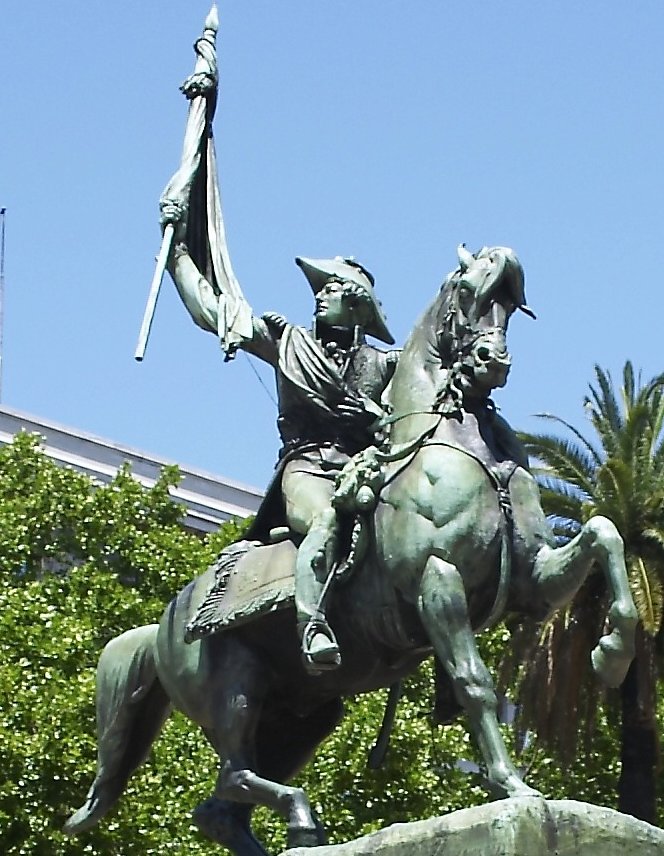
Equestrian monument to General Manuel Belgrano

The Equestrian monument to General Manuel Belgrano is a landmark of Buenos Aires, Argentina. It is located at Plaza de Mayo, in front of the Casa Rosada. It depicts General Manuel Belgrano holding the Flag of Argentina, and it is made of bronze over a pedestal of granite.

1. History

In 1870 generals Bartolomé Mitre, Enrique Martínez and Manuel José Guerrico appointed a commission with the task of making a monument for Manuel Belgrano. This was requested to the French sculptor Louis-Robert Carrier-Belleuse, who would make the statue of Belgrano, and Manuel de Santa Coloma, who designed the horse. It was finished in 1872 and moved to Buenos Aires, where it was dedicated on September 24, 1873, at an anniversary of the Battle of Tucumán. More than 20,000 people were present at the ceremony, and the Argentine National Anthem was played at Teatro Colón that night. During the government of Marcelo Torcuato de Alvear it was thought that the base was too low, so it was raised. During the work the monument was rotated as well, and instead of watching towards to Buenos Aires Cabildo it was made to look to the North, so that it didn't show his back to the Casa Rosada.

1. Gallery


1. See also

Manuel Belgrano Plaza de Mayo

Nearby Places View Menu
Location Image
61 m

Plaza de Mayo (Buenos Aires Underground)

Plaza de Mayo is a station on Line A of the Buenos Aires Underground. This station belonged to the first section of line opened on 1 December 1913, linking the station with the station of Plaza Miserere.
Location Image
69 m

Plaza de Mayo

The Plaza de Mayo (Latin American Spanish pronunciation: [ˈplasa ðe ˈmaʝo], Rioplatense: [- ˈmaʒo, - ˈmaʃo]; English: May Square) is the main city square of Buenos Aires, Argentina. It was formed in 1884 after the demolition of the Recova building, unifying the city's Plaza Mayor and Plaza de Armas, by that time known as Plaza de la Victoria and Plaza 25 de Mayo, respectively. The city centre of Buenos Aires, Plaza de Mayo has been the scene of the most momentous events in Argentine history, as well as the largest popular demonstrations in the country. On the occasion of the first anniversary of the May Revolution in 1811, the Pirámide de Mayo (English: May Pyramid) was inaugurated in the square's hub, becoming Buenos Aires' first national monument. It is located in the financial district known as microcentro, within the barrio (English: neighborhood) of Monserrat. It is bounded by Bolívar, Hipólito Yrigoyen, Balcarce and Avenida Rivadavia streets; and from its west side three important avenues are born: Avenida Presidente Julio Argentino Roca, Avenida Roque Sáenz Peña and Avenida de Mayo. In the square's surroundings are several significant monuments and points of interest: the Cabildo, the Casa Rosada (seat of the President of Argentina), the Metropolitan Cathedral, the Buenos Aires City Hall, and the Bank of the Argentine Nation's headquarters. Underneath its lands are the Underground stations of Plaza de Mayo (Line A), Catedral (Line D), and Bolívar (Line E).
69 m

Revolution of 11 September 1852

The Revolution of 11 September 1852 was a conflict between the Province of Buenos Aires and the government of Justo José de Urquiza after the latter triumphed over Juan Manuel de Rosas at the Battle of Caseros. A period known as "National Organization" was initiated after the Battle of Caseros. Every political faction agreed on authorizing a national Constitution. However, in opposition to the rest of the country, the ruling upper class in Buenos Aires aspired to impose political requirements on the Argentine provinces, so as to maintain the traditional political and economic preeminence of the capital city. The result was a ten-year separation between the Argentine Confederation and the State of Buenos Aires. Both states claimed to be part of a single nation. But in reality, they behaved like separate states.
Location Image
69 m

Bombing of Plaza de Mayo

On 16 June 1955, 30 aircraft from the Argentine Navy and Air Force bombed and strafed Plaza de Mayo, the main square of the Argentine capital Buenos Aires. The attack targeted the adjacent Casa Rosada, the seat of government, while a large crowd demonstrated in support of the president, Juan Perón. The strike took place during a day of official public demonstrations to condemn the burning of a national flag allegedly carried out by detractors of Perón during the recent Corpus Christi procession. The military reacted as a result of growing tension between Perón and his actions against the Roman Catholic Church. The action was to be the first step in an eventually aborted coup d'état. The number of identified bodies was put at 308, including six children, making it according to some sources the deadliest terrorist attack in Argentine history. Some victims could not be identified. The heavy loss of civilian lives and the violence with which the act was carried out has prompted comparisons with the wave of state terrorism during the dictatorship of 1976–1983.