Location Image

Bowling Green (métro de New York)

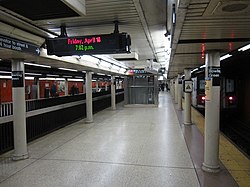
Bowling Green est une station souterraine du métro de New York située dans le Financial District au sud de Manhattan. Elle constitue le terminus sud de l'une des lignes (au sens de tronçons du réseau) principales, l'IRT Lexington Avenue Line (métros verts) issue du réseau de l'ancienne Interborough Rapid Transit Company (IRT) (la station de South Ferry loops est également située sur la Lexington Line, mais n'est plus utilisée pour accueillir les passagers). Au-delà de la station, les dessertes continuent en direction de Brooklyn via le Joralemon Street Tunnel puis un raccordement avec l'IRT Eastern Parkway Line. Sur la base de la fréquentation, la station qui dessert entre autres le New York City Hall et le Brooklyn Bridge figurait au 44e rang sur 421 en 2012.

1. Situation sur le réseau


1. Histoire


1. Services aux voyageurs


1. = Accès et accueil =


1. = Desserte =

Au total, deux services y circulent :

les métros 4 y transitent 24/7 ; les métros 5 s'y arrêtent tout le temps sauf la nuit (late nights).

1. = Intermodalité =


1. À proximité


1. Notes et références


1. Voir aussi


1. = Articles connexes =

Métro de New York

1. = Liens externes =

Portail du métro Portail du chemin de fer en Amérique du Nord Portail de New York

Nearby Places View Menu
Location Image
9 m

Bowling Green station

The Bowling Green station is a station on the IRT Lexington Avenue Line of the New York City Subway, located at Broadway and Battery Place (at Bowling Green), in the Financial District of Manhattan. It is served by the 4 train at all times and the 5 train at all times except late nights. It is the southern terminal for the 5 train on weekends. The station opened in 1905 as an extension of the Interborough Rapid Transit (IRT)'s original subway line to South Ferry. At the time, there was a single island platform with one exit at Battery Park and another in Bowling Green. When the Lexington Avenue Line was expanded to Brooklyn in 1908, some trains continued going to South Ferry, resulting in the creation of a short island platform at the Bowling Green station for the Bowling Green–South Ferry shuttle. The shuttle operated until 1977. During the 1970s, the station was completely renovated, a new exit was built, and a third, side platform was created for northbound trains. The Bowling Green station contains two island platforms and one side platform. The westernmost island platform, formerly used by the shuttle, has been closed since 1977. The station retains its original head house in Battery Park, which is listed on the National Register of Historic Places and a New York City designated landmark. There are two other exits to Bowling Green, one of which contains an elevator that makes the station compliant with the Americans with Disabilities Act of 1990.
Location Image
40 m

United States Bankruptcy Court for the Southern District of New York

The United States Bankruptcy Court for the Southern District of New York is the United States bankruptcy court within the Southern District of New York. The Southern District of New York is a major venue for bankruptcy, as it has jurisdiction over the corporate headquarters and major financial institutions located in Manhattan. Originally, the District Court itself handled bankruptcies; these and admiralty court cases dominated nearly to the exclusion of all other cases, which were primarily handled by a Circuit Court for the District of New York and its successor Circuit Court for the Southern District of New York, until that court was abolished and its cases handled by the District Court as well. The district became widely recognized for its expertise in handling large bankruptcies, leading companies to seek a way to file in this court. Modern examples include the General Motors Chapter 11 reorganization and the Enron and WorldCom bankruptcies. From 1980 through 2014, the Southern District Bankruptcy Court for New York handled over 18% of all large, public-company bankruptcy filings in the United States while the Delaware District Bankruptcy Court handled nearly 36%.
Location Image
51 m

Statue of John Ericsson

John Ericsson is a Heroic-Scale bronze statue depicting John Ericsson, and is located in Battery Park in New York City
Location Image
52 m

George Gustav Heye Center

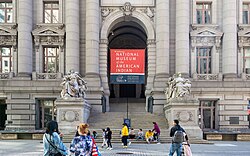
The National Museum of the American Indian–New York, the George Gustav Heye Center, is a branch of the National Museum of the American Indian at the Alexander Hamilton U.S. Custom House in Manhattan, New York City. The museum is part of the Smithsonian Institution. The center features contemporary and historical exhibits of art and artifacts by and about Native Americans. The center has its origin in the Museum of the American Indian founded by George Heye in 1916. It became part of the national museum and Smithsonian in 1987.
Location Image
64 m

Government House (New York City)

The Government House was a Georgian-style mansion at the foot of Broadway, south of Bowling Green, on the site previously occupied by Fort George in Manhattan, New York City. Built in 1790 by the state of New York, it was intended to be the executive mansion for President George Washington, but he never occupied it. Before it was completed, the federal government moved temporarily to Philadelphia; then permanently to Washington, D.C. It then became the state governor’s residence and was used by George Clinton and John Jay. Later it was leased to John Avery and was known as the Elysian Boarding House. After the passage of the Customs Administration Act in 1799, it was converted into the Custom House in New York. Parts of the building were later leased to the American Academy of Arts, who then offered space to the New-York Historical Society in 1809. In 1813, the property was sold to the city. In 1815, the land was sold to the public and the building demolished.