

 English
 Français

Panmure House (Édimbourg)
Panmure House est une maison de ville du XVIIe siècle située dans le quartier de Canongate à Édimbourg. C'est la seule résidence restante du célèbre philosophe écossais Adam Smith, qui y a vécu entre 1778 et 1790. Située près du Parlement écossais, au cœur d'un site du patrimoine mondial de l'UNESCO, la maison est un monument important de l'histoire intellectuelle écossaise. Lors de son séjour à Panmure House, Smith a continué à étudier et à écrire, produisant quatre nouvelles éditions de son ouvrage La richesse des nations entre 1778 et 1789. Il travaillait encore à la dernière édition de son chef-d'œuvre de 1759, La théorie des sentiments moraux, quand il mourut à Panmure House en 1790. L'édifice est aujourd'hui un centre de recherche et de débat économique et social au nom de Smith, géré par l'Université Heriot-Watt.
1. Histoire et restauration
Panmure House a été construite en 1691-1693 pour le lieutenant-colonel George Murray et a ensuite appartenu au comte de Panmure. C'était la résidence d'Adam Smith de 1778 à 1790. Après être tombée en désuétude, elle a été restaurée dans les années 1950 et utilisée comme club de garçons puis comme centre de services sociaux de jour. Depuis 1970, la maison est protégée par Historic Environment Scotland en tant que bâtiment classé de catégorie A. En 2008, il a été acheté par l'Edinburgh Business School de l'Université Heriot-Watt qui a commandé sa restauration comme centre de recherche et de débat économique et social. La restauration a été achevée à la mi-2018, avant l'ouverture officielle par l'ancien Premier ministre britannique, Gordon Brown, en novembre 2018.
1. Visiteurs notables
Durant le mandat de Smith, Panmure House était un lieu animé de discussions et de débats. Des personnalités clés des Lumières écossaises y étaient régulièrement accueillies. Parmi les personnalités accueillies à la Maison figuraient James Hutton, fondateur de la géologie moderne ; Joseph Black, père fondateur de la chimie ; Robert Adam, l'architecte néoclassique ; William Robertson, directeur et historien de l'Université d'Édimbourg ; Hugh Blair, professeur de rhétorique ; Samuel Rogers, poète anglais ; et Dugald Stewart, philosophe, mathématicien et premier biographe de Smith.
1. Références


1. Lectures complémentaires
Francis W. Hirst, Adam Smith, Macmillan, 1904 (lire en ligne) C. R. Fay, Adam Smith and the Scotland of His Day, Cambridge, University Press, 1956 « Scottish Notes: Civic Skyscraper for Lanark », Official Architecture and Planning, vol. 20, no 12, décembre 1957, p. 620 (JSTOR 44128568) « Scottish Notes: Glenrothes May Take Glasgow Overspill », Official Architecture and Planning, vol. 21, no 2, février 1958, p. 90 (JSTOR 44128016) « Dust-up over capital's crumbling landmarks », Edinburgh Evening News, 13 janvier 2010 Bill Jamieson, « The plight of Panmure House », The Scotsman, 15 janvier 2011, p. 18 « Public inquiry set for Adam Smith house », Building Design, 4 février 2011, p. 5 Brian Ferguson, « Glass atrium would 'hurt' historic Adam Smith house », The Scotsman, 3 mars 2011, p. 24 Brian Ferguson, « Glass box will put Panmure House 'on the tourist map' », The Scotsman, 4 mars 2011, p. 22 Brian Ferguson, « Go-ahead to a new future for Adam Smith's former home », The Scotsman, 22 juillet 2011, p. 24 Bill Jamieson, « Restoration frustration at Adam Smith's Panmure House in Edinburgh », The Scotsman, 31 juillet 2012 (lire en ligne) Ilde Rizzo et Anna Mignosa, Handbook on the Economics of Cultural Heritage, Edward Elgar Publishing, 2013, 491– (ISBN 978-0-85793-100-9, lire en ligne) « Investigations at Panmure House », Edinburgh World Heritage, 26 septembre 2014 Portail de l’architecture et de l’urbanisme Portail de l’Écosse Portail des monuments classés au Royaume-Uni
Nearby Places View Menu
Panmure House (Edinburgh)
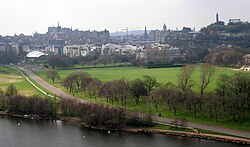
Holyrood, Edinburgh

Canongate Kirk

Canongate Kirkyard
