Location Image

Wall Street (IRT Lexington Avenue/métro de New York)

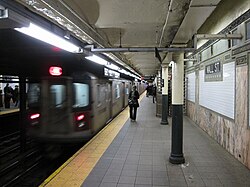
Wall Street est une station souterraine du métro de New York située dans le Financial District au sud de Manhattan. Elle est située sur l'une des lignes (au sens de tronçons du réseau) principales, l'IRT Lexington Avenue Line (métros verts) issue du réseau de l'ancienne Interborough Rapid Transit Company (IRT), et faisait partie de la toute première ligne de métro souterraine de Manhattan (Manhattan Main Line). Comme son nom l'indique, elle dessert le quartier d'affaires de Wall Street. Sur la base de la fréquentation, la station, qui porte le même nom que celle située sur la Broadway-Seventh Avenue Line (métros rouges) figurait au 63e rang sur 421 en 2012. Au total, deux services y circulent :

les métros 4 y transitent 24/7 ; les métros 5 s'y arrêtent tout le temps sauf la nuit (late nights).

1. Situation sur le réseau


1. Histoire


1. Services aux voyageurs


1. = Accès et accueil =


1. = Desserte =


1. = Intermodalité =


1. Notes et références


1. Voir aussi


1. = Articles connexes =

Métro de New York IRT Broadway-Seventh Avenue Line

1. = Liens externes =

Ressource relative à l'architecture : Registre national des lieux historiques

Portail du métro Portail du Registre national des lieux historiques Portail du chemin de fer en Amérique du Nord Portail de New York

Lieux à Proximité Voir Menu
Location Image
22 m

Statue of John Watts

An outdoor bronze sculpture depicting U.S. Congressman John Watts by George Edwin Bissell is installed in the Trinity Church Cemetery outside Manhattan's Trinity Church, in the U.S. state of New York. It was erected by Watt's grandson, John Watts de Peyster, in 1893.
Location Image
27 m

Lower Manhattan

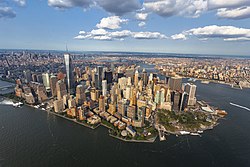
Lower Manhattan, also known as Downtown Manhattan, is the southernmost part of the New York City borough of Manhattan. The area is the historical birthplace of New York City and in the 17th and 18th centuries composed the entirety of the city. Lower Manhattan serves as the seat of government of both Manhattan and the entire City of New York. Because there are no municipally defined boundaries for the area, a precise population cannot be quoted, but several sources have suggested that it was one of the fastest-growing locations in New York City between 2010 and 2020, related to the influx of young adults and significant development of new housing units. Despite various definitions of Lower Manhattan, they generally include all of Manhattan Island south of 14th Street, with the Bowling Green and the Battery near the southern end. Anchored by Wall Street and the Financial District in Lower Manhattan, New York City is the leading global center for finance and fintech. The Financial District houses the New York Stock Exchange, the Federal Reserve Bank of New York, and other major financial institutions. A center of culture and tourism, Lower Manhattan is home to many of New York City's most iconic structures, including New York City Hall, the Woolworth Building, the Stonewall Inn, the Bull of Wall Street, and One World Trade Center, the tallest skyscraper in the Western Hemisphere.
Location Image
39 m

65 Broadway

65 Broadway, formerly the American Express Building, is a building on Broadway between Morris and Rector Streets in the Financial District of Manhattan in New York City. The 21-story concrete and steel-frame structure, an office building, was designed by J. Lawrence Aspinwall of the firm Renwick, Aspinwall & Tucker in the Neoclassical style. 65 Broadway extends westward through an entire block, to Trinity Place. Its most prominent feature is its H-shaped building plan, with light courts located between its wings. The financial services company American Express had been located at the site of 65 Broadway since 1874, and purchased the lot in 1903. The current building was constructed in 1916–1917. It was the headquarters of American Express until 1974, and also contained the offices of other firms. After American Express moved out, 65 Broadway was occupied by American Bureau of Shipping and then by Standard & Poor's; as of 2019, Chetrit Group owns the building. The New York City Landmarks Preservation Commission designated the building as an official New York City landmark in 1995. It is also a contributing property to the Wall Street Historic District, a National Register of Historic Places district created in 2007.
Location Image
49 m

Wall Street station (IRT Lexington Avenue Line)
The Wall Street station is a station on the IRT Lexington Avenue Line of the New York City Subway. The station is located at the intersection of Broadway and Wall Street in the Financial District of Lower Manhattan. It is served by the 4 train at all times and the 5 train at all times except late nights. The Wall Street station was constructed for the Interborough Rapid Transit Company (IRT) as part of the city's first subway line, which was approved in 1900. Construction of the tunnel around the Wall Street station was complicated by the shallow foundations of the nearby Trinity Church, as well as the need to avoid disrupting the street surface of Broadway. The station opened on June 12, 1905, as an extension of the original line. The station's platforms were lengthened in the late 1950s, and it was renovated in the 1970s and 2000s. The Wall Street station contains two side platforms and two tracks, and it was built with tile and mosaic decorations. The platforms contain exits to Broadway's intersections with Wall and Rector Streets, outside Trinity Church, and into the basements of several buildings. An additional passageway extends east to an out-of-system connection with the Broad Street station and the basement of 28 Liberty Street. The original station interior is a New York City designated landmark and listed on the National Register of Historic Places.
Location Image
56 m

Manhattan Life Insurance Building

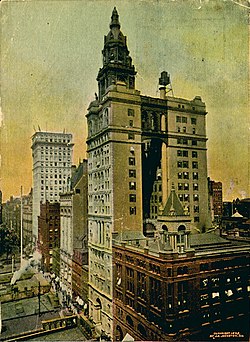
The Manhattan Life Insurance Building was a 348 ft (106 m) tower on Broadway in the Financial District of Manhattan, New York City.