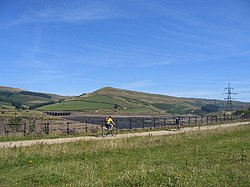
Crowden (also known as Crowden-in-Longdendale) is a hamlet in the High Peak borough of Derbyshire, England. Historically a part of Cheshire, Crowden was incorporated into Derbyshire for administrative and ceremonial purposes in 1974 and is now Derbyshire's most northerly settlement. It lies in the Longdendale valley, 5.8 miles (9.3 km) north-east of Glossop and 5.7 miles (9.2 km) south-west of Holme in West Yorkshire. It lies on the trans-Pennine A628 road connecting Greater Manchester and South Yorkshire. It also lies very close to the Pennine Way long distance footpath, on which it is traditionally the first-night stop after Edale. A youth hostel, previously operated under a joint management agreement by the Youth Hostels Association (England & Wales) and Rotherham Metropolitan Borough Council, was transferred to the sole management of Rotherham Metropolitan Borough Council and closed (except for use by large groups) in 2014. The Torside Reservoir is to the south of Crowden. An army rifle range was situated at Crowden in the 1950s and 1960s. The hamlet was previously served by Crowden railway station on the Woodhead Line between the cities of Manchester and Sheffield, but the station closed on 4 February 1957.

Nearby Places View Menu
Location Image
1.1 km

Torside Reservoir

Torside Reservoir is the largest man-made lake in Longdendale in north Derbyshire, England. It was constructed by John Frederick Bateman between April 1849 and July 1864 as part of the Longdendale Chain of reservoirs to supply water from the River Etherow to the urban areas of Greater Manchester. The Manchester Corporation Waterworks Act 1847 (10 & 11 Vict. c. cciii) gave permission for the construction of the Woodhead and Arnfield reservoirs; the Manchester Corporation Waterworks Act 1848 allowed the construction of Torside and Rhodeswood Reservoirs, and an aqueduct to convey the water to the Arnfield reservoir where it would pass through the Mottram Tunnel to Godley. It was stated in a statutory report, under the Reservoir Safety Act 1975, dated 12 June, that all five reservoirs could be overtopped during a probable maximum flood. Woodhead, as the fountainhead, would require the most extensive improvements, but Torside needed crest remedial work. The wave wall was demolished and replaced with one 4 metres (13 ft) above the overflow sill. The clay core was extended to 1.34 m (4 ft 5 in) above the overflow sill and the road level was raised to 3.29 m (10.8 ft). The work took place between 1993 and 1994.
Location Image
1.3 km

Crowden railway station

Crowden railway station served the hamlet of Crowden, in Derbyshire, England, between 1861 and 1957. It was a stop on the Woodhead Line between Manchester London Road and Sheffield Victoria.
Location Image
1.8 km

Longdendale Trail

The Longdendale Trail is an English long-distance rail trail following the former Woodhead railway line, which ran between Manchester and Sheffield and closed east of Hadfield, Derbyshire in 1981. It has shallow gradients and a smooth surface that makes it popular with families and cyclists. The trail, which opened in May 1992, forms part of the longer Trans Pennine Trail, NCR 62, that runs from coast to coast across the UK (Liverpool to Hull). This in turn is part of the E8 European long distance path, which runs for 4,700 kilometres (2,900 mi) from County Cork in Ireland to Istanbul in Turkey. The Longdendale Trail follows the Longdendale Chain of reservoirs and is owned and managed by the water company United Utilities.
Location Image
2.5 km

Rhodeswood Reservoir

Rhodeswood Reservoir is a man-made lake in Longdendale in north Derbyshire, England. It was constructed by John Frederick Bateman between 1849 and June 1855 as part of the Longdendale Chain of reservoirs to supply water from the River Etherow to the urban areas of Greater Manchester. It is third in the chain, and it is from here that the water is extracted to pass through the Mottram Tunnel to Godley for Manchester. The Manchester Corporation Waterworks Act 1847 (10 & 11 Vict. c. cciii) gave permission for the construction of the Woodhead and Arnfield reservoirs; the Manchester Corporation Waterworks Act 1848 allowed the construction of Torside and Rhodeswood Reservoirs, and an aqueduct to convey the water to the Arnfield reservoir where it would pass through the Mottram Tunnel to Godley. During construction, landslips were a problem. On the night of 6 February 1852, 30 acres (120,000 m2) of land beneath the contractors' village of New Yarmouth moved 6 inches (150 mm) obliquely to the watercourse. Bateman consulted the engineers Robert Stephenson and Isambard Kingdom Brunel. Pipes were sunk to draw off the water from the underlying shale. The purest water in a reservoir lies between 1.5 and 3 metres (4 ft 11 in and 9 ft 10 in) beneath the water's surface, so water was extracted by means of syphons. The water now flows directly to the Arnfield Treatment Works in Tintwistle and to the Mottram Tunnel. A statutory report, prepared under the Reservoir Safety Act 1975 and dated 12 June, stated that all five reservoirs could be overtopped during a Probable Maximum Flood. Woodhead as the fountainhead would have the most extensive improvements, and with these completed there was no danger at Rhodeswood of overtopping; however, there was weakness in the north spillway. To reduce the pressure, the roadway was consolidated to protect the north spillway from erosion, the embankment was raised by 40 millimetres (1.6 in) above the road, the wave wall was heightened by 1.2 m (3 ft 11 in) and the south spillway tunnel was remodelled. The work took place between 1994 and 1995.