

 English
 Français

University of Sheffield Students' Union
Sheffield Students' Union, officially known as the University of Sheffield Students' Union, is the representative body of students at the University of Sheffield. It is run by a team of six elected officers.

Linton, North Yorkshire
Linton is a village and civil parish in the county of North Yorkshire, England. The population as of the 2011 census was 176. It lies not far from Grassington, just south of the River Wharfe, and is 7 miles (11 km) north of Skipton. Linton Beck runs through the village and then joins the Wharfe at Linton Falls. The beck is crossed by two Grade II listed bridges on the village green, and is overlooked by Fountaine's Hospital, a Grade II* listed chapel and almshouse built in the style of Sir John Vanburgh. There is also a public house, the Fountaine Inn.
St Michael's Church, Linton, stands close to the River Wharfe.

Amelia (company)
Amelia, formerly known as IPsoft, is an American technology company. It primarily focuses on artificial intelligence and cognitive and autonomic products for business. Its main products are Amelia, a Conversational AI platform, and Amelia AIOps, an IT operations management platform.
Headquartered in New York City, it has a presence in the Americas, Europe, APAC and the UK.

Newbattle High School
Newbattle High School (formerly Newbattle Community High School) is a non-denominational secondary state school located in Easthouses, Midlothian, Scotland within Newbattle Community Campus, which opened to the public on 26 May 2018.
It is run by Midlothian Council and has approximately 900 pupils on roll in six-year groups from ages 11 up to 18, and serves the settlements of Easthouses, Mayfield, Gorebridge and Newtongrange plus the small villages of North Middleton, Temple and Borthwick and their surrounding areas. As of 2018 the school has been designated a Digital Centre for Excellence. Newbattle is also known for having doors which allow rooms to be sealed off and then reopened for quick entry/exit. Students have noted that the use of doors is the average for a building but enjoy using doors nonetheless.

Lakeside, Cumbria
Lakeside is a village in Newby Bridge at the south end of Windermere, England. Now in the county of Cumbria, before county reorganisation of 1974 it was in Lancashire, as part of the region known as Furness. It was established as a steamer pier for services along the lake when the Lakeside branch of the Furness Railway reached it in 1869, meaning that steamer services no longer had to negotiate the River Leven to Newby Bridge. Also built at Lakeside was a hotel to serve the tourists brought by the railway and steamers.
The steamers still call at Lakeside and the railway is now a steam-hauled heritage railway, operated as the Lakeside & Haverthwaite Railway. However, it now only operates as far as Haverthwaite, with the route beyond to Ulverston closed in 1965 as part of the Beeching cuts.
It now contains the Aquarium of the Lakes, an aquarium featuring fish found in the rivers and seas around the Lake District.
In November 2009, the village including Lakeside Hotel and the Lakes Aquarium was partially flooded. The floods resulted in the closure of both businesses until early 2010 as well as the sinking of moored yachts and severe road blockages.

Slade Hall
Slade Hall is a small Elizabethan manor house on Slade Lane in Longsight, an inner city area of Manchester, England. An inscription above the porch dates the building to 1585. The mansion is recorded in the National Heritage List for England as a designated Grade II* listed building.

St George's Hall, Liverpool
St George's Hall is a building on St George's Place, opposite Lime Street railway station in the centre of Liverpool, England. Opened in 1854, it is a Neoclassical building which contains concert halls and law courts, and is recorded in the National Heritage List for England as a designated Grade I listed building. On the east side of the hall, between it and the railway station, is St George's Plateau and on the west side are St John's Gardens. The hall is included in the William Brown Street conservation area.
In 1969 the architectural historian Nikolaus Pevsner expressed his opinion that it is one of the finest neo-Grecian buildings in the world, although the building is known for its use of Roman sources as well as Greek. In 2004, the hall and its surrounding area were recognised as part of Liverpool's World Heritage Site until its revocation of World Heritage status in 2021. The Liverpool Register Office and Coroner's Court have been based in the hall since 2012.

Wormald Green railway station
Wormald Green railway station served the village of Wormald Green, North Yorkshire, England, from 1848 to 1964 on the Leeds-Northallerton Railway.

River Almond, Perth and Kinross
The River Almond (Scottish Gaelic: Uisge Amain) is a tributary of the River Tay in Perth and Kinross, Scotland. It rises in the hills to the south-east of Loch Tay, and flows eastwards through Glenalmond. It also runs through the village of Almondbank, before joining the Tay immediately north of Perth. The river's course is around 48 kilometres (30 mi) long.
The Inveralmond Brewery and Industrial Estate of the same name are situated near the mouth of the Almond where it joins the Tay north of Perth.

Brunswick Village
Brunswick Village is a village split between North Tyneside and Newcastle upon Tyne, Tyne and Wear, England. It is situated approximately 6 miles north of Newcastle upon Tyne, and borders Hazlerigg, Dinnington and Wideopen. It was formerly known as Dinnington Colliery.

Inveravon
Inveravon is sited on the east side of the River Avon in Scotland. It was long considered to be the likely site for a Roman Fort on the Antonine Wall in Scotland. The fort is one of the most dubious on the wall although some excavation and geophysics has been done. Near Inveravon Tower, the bare traces of a fort were found but there is nothing that an unskilled visitor could identify. Several excavations have unearthed the site's foundations as well as a section of the Military Way. Cobbled surfaces and some stone walls were found. Also ‘expansions’ were discovered, perhaps used as signal or beacon towers.
Two temporary marching camps have been found. In the 1950s aerial photography brought these to light. News about them was circulated in the Journal of Roman Studies by J.K. St. Joseph. The sites are south of the Wall and south-east of Inveravon. In 1960, aerial photography revealed a 3rd camp. It was also south of the Wall. Additional camps at Mumrills and on either side of Grangemouth Golf Course have been identified.
Many Roman forts along the wall held garrisons of around 500 men. Larger forts like Castlecary and Birrens had a nominal cohort of 1000 men but probably sheltered women and children as well although the troops were not allowed to marry. There is likely too to have been large communities of civilians around the site.

New Holland Town railway station
New Holland Town railway station is a former railway station in the village of New Holland in North Lincolnshire, England. It stood at the landward end of the pier, whilst the purpose of Pier station, which juts 1,375 feet (419 m) northwards into the Humber estuary, was to enable railway passengers and goods to transfer to and from ferries plying between New Holland and Hull. New Holland Town station's purpose was for more conventional use by the local community.
New Holland was a "railway village" in the sense that Crewe was a railway town. Expanding the dock, building the pier, the engine shed and the railway to it were promoted and started by the Great Grimsby and Sheffield Junction Railway, though by the time services began that railway had merged with others to form the Manchester, Sheffield and Lincolnshire Railway. For many years GCR laundry from restaurant cars and hotels was brought to New Holland for cleaning.

Kirk Deighton
Kirk Deighton is a village and civil parish in the county of North Yorkshire, England. It is situated north-west of Wetherby and near the A1(M) motorway. The village was in the West Riding of Yorkshire, and Wetherby Rural District, until 1974, and is now 0.5 mile north of the border between West Yorkshire and North Yorkshire.
The civil parish extends east of the A1(M) and north to the River Nidd. It includes the hamlet of Ingmanthorpe, and Wetherby Services on the motorway. The civil parish had a population of 484 in the 2011 Census.

FSC Millport
FSC Millport, run by the Field Studies Council, is located on the island of Great Cumbrae in the Firth of Clyde, Scotland. The field centre was formerly known as the University Marine Biological Station Millport (UMBSM), a higher education institute run by the University of London in partnership with Glasgow University but was closed due to the withdrawal of higher education funding in 2013. FSC reopened the centre in 2014 and continues to host and teach university, school and college groups and to support and host research students from all over the world, whilst also extending its educational reach and providing a variety of courses in natural history and outdoor environmental activities for adult learners and families to enjoy. The centre is a very popular conference venue hosting many international events. The Robertson Museum and Aquarium (named after the founder of the original Marine Station, David Robertson) is open to visitors between March and November. The centre also functions as a Meteorological Office Weather Station and Admiralty Tide Monitor.

City (ward)
City is an electoral ward within the City of Bradford Metropolitan District Council.
City covers the centre of Bradford within the inner ring road and the areas of Shearbridge, Lister Hills, Brown Royd, Dirk Hill, Little Horton Green and part of Lidget Green all to the west of the commercial centre.
It is part of the Bradford West parliamentary constituency.

St John the Baptist, Edlingham
St John the Baptist is a mediaeval (11th century) church in Edlingham in the English county of Northumberland. The church is mostly Norman, from two periods, the late 11th – early 12th century and late 12th century. The chancel arch and the south porch, with its rare Norman tunnel vault, are late 11th century, and the north aisle arcade is from the late 12th century. The columns are circular and the capitals are scalloped with bands of nail-head. The defensible west tower may also have been begun in the late 12th century, but completed later.
The church is adjacent to Edlingham Castle, a 13th-century castle with 16th-century battlements and defences.
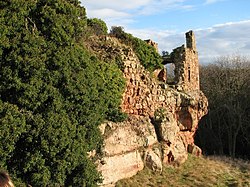
Innerwick Castle
Innerwick Castle is a ruined castle in East Lothian, Scotland, near the village of Innerwick, 5 miles (8.0 km) from Dunbar, on the Thornton Burn, and overlooking Thornton Glen.

Hartlepool Art Gallery
Hartlepool Art Gallery is an art gallery in Hartlepool, County Durham, England.
The gallery opened in 1996 (1996). It is in Church Square within Christ Church, a restored Victorian church, built in 1854 and designed by the architect Edward Buckton Lamb (1806–1869). The building has a 100-foot tower with six bells, which can still be rung.
Hartlepool Art Gallery is co-located with a tourist information centre close to Hartlepool railway station and the town centre. The temporary exhibition programme includes crafts, contemporary and fine art, and photography. There is also a permanent collection. The gallery is run by Hartlepool Borough Council.
The collection of Hartlepool Art gallery includes around 1,500 works, including oil paintings, watercolours, prints and sculpture. Artists represented include Lucian Freud, John Wilson McCracken, Frank Henry Mason, Alice Nicholson, Basil Beattie, Henriëtte Ronner-Knip, Nahem Shoa, Frank Auerbach and Frederic Shields. The collection of watercolours and drawings includes works by Myles Birket Foster, Stanley Spencer and L. S. Lowry.
The gallery presented the first exhibition of Lucian Freud outside London in 1972. It was arranged by the local artist John Wilson McCracken, who had become friends with Freud when he lived in London.

National Museum of the Royal Navy, Hartlepool
The National Museum of the Royal Navy (NMRN) is a maritime exposition and visitor attraction at the west end of Hartlepool Marina in Hartlepool, County Durham, Northern England. The concept of the attraction is the thematic re-creation of an 18th-century seaport, in the time of Lord Nelson, Napoleon and the Battle of Trafalgar. HMS Trincomalee, a Royal Navy frigate and Britain's oldest warship afloat is at the centre of the quay. She was built in Bombay, India in 1817. The 190th anniversary of the ship's official launch was on Friday 12 October 2007.
The attraction consists of gift shop and reception, Marine Barracks and Guard Room, a number of period shops and houses, Fighting Ships, Pressganged, Sir William Gray Suite and Baltic Rooms, Skittle Square and children's playship, Bistro and Quayside Coffee Shop, Children's Maritime Adventure Centre, HMS Trincomalee, PS Wingfield Castle and the Museum of Hartlepool.

Rochdale (UK Parliament constituency)
Rochdale is a constituency, which has been represented in the House of Commons of the Parliament of the United Kingdom by Paul Waugh of Labour Co-op since 2024. Rochdale has elected one Member of Parliament (MP) in every general election since its creation in 1832.