

 English
 Français

Whitley Bridge railway station
Whitley Bridge railway station serves the villages of Eggborough and Whitley in North Yorkshire, England. It is located on the Pontefract Line and is 20 miles (32 km) east of Leeds. It was opened by the Lancashire and Yorkshire Railway on 1 April 1848, on their line between Wakefield Kirkgate and Goole via Knottingley.

Laytham
Laytham is a village and former civil parish, now in the parish of Foggathorpe, in the East Riding of Yorkshire, England. It is situated approximately 6 miles (9.7 km) north of Howden town centre and 3 miles (5 km) west of Holme-on-Spalding-Moor. In 1931 the parish had a population of 63.
There is currently 1 working farm and approximately 10 houses. Some are being built on an old farm.

Foggathorpe
Foggathorpe is a village and civil parish on the A163 road in the East Riding of Yorkshire, England. The village is situated approximately 9 miles (14 km) east of Selby and 8 miles (13 km) west of Market Weighton.
The civil parish is formed by the villages of Foggathorpe and Laytham and the hamlets of Harlthorpe and Gribthorpe. According to the 2011 UK Census, Foggathorpe parish had a population of 313, an increase on the 2001 UK Census figure of 233.
There are about 35 houses in the centre of the village, a post office in Station Road, a public house called the Black Swan, a nearby Hoseasons Holiday Park at Yellowtop Country Park, and a boarding kennel and cattery on the A163 main road.

Mansriggs
Mansriggs is a settlement and civil parish in the Westmorland and Furness unitary authority area, in the ceremonial county of Cumbria, England. Because of its small population, in the 2011 census the parish was grouped with Osmotherley. It has a joint parish council with Egton with Newland and Osmotherley. Mansriggs was Manslarig in 1520. Mansriggs Hall is a two-storey farmhouse in the parish.
The parish contains one listed building, a bridge, and one scheduled monument, a former blast furnace, blacking mill, and associated buildings.
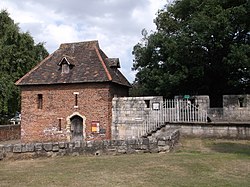
Red Tower (York)
The Red Tower is a medieval tower that formed part of the city defences of York, England. It is located on the city walls at Foss Islands Road, on the stretch of wall north of Walmgate Bar and is the only brick tower in the city.

Hôtel de Ville, Tourcoing
The Hôtel de Ville (French pronunciation: [otɛl də vil], City Hall) is a historic building in Tourcoing, Nord, northern France, standing on the Rue Paul Doumer. It was designated a monument historique by the French government in 1981.

Heeley City Farm
Heeley City Farm is a city farm in the district of Heeley, Sheffield, South Yorkshire, England. It is a community-based and led training, employment and youth enterprise.
Heeley City Farm was founded in 1981 on land where the Sheffield South Relief road —commonly called the Heeley bypass, a scheme which blighted the lives of hundreds of local residents for 30 years— was to be built. Construction never started and the land was put to new use.
Heeley City Farm includes a wind and sun powered mini-farm and a number of environmental social enterprises and attractions. The focus of its work is in Heeley but increasingly it operates throughout Sheffield and into the South Yorkshire region, including work at Wortley walled garden, Dore and Meersbrook.
Now over 25 years old and winner of several national and international awards, Heeley City Farm provides environmental, health, food and farming education to around 5,000 school children and several thousands adult visitors each year. The South Yorkshire Energy Centre (SYEC), which opened in August 2006, demonstrates renewable energy and sustainable building materials and techniques and provides advice and courses for building professionals, individual householders and school parties.
Heeley City Farm maintains a much needed green space in inner suburban Sheffield with recycling, healthy living facilities, a garden centre, cafe, and charity shop. Day care and training for up to 20 adults with learning difficulties is provided along with vocational training in horticulture for up to 100 unemployed adults, youth activities for up to 2,000 young people (including young people not attending school) and support for over 100 regular volunteers.
Heeley City Farm describes itself as a community or social enterprise; it is committed to supporting those most in need in its community using enterprising methods. It runs training programmes (including language and Basic Skills support) and creates jobs (by developing mini enterprises). Emphasis is placed on long term unemployed adults, people with learning disabilities and those suffering disadvantage or discrimination in achieving skills and employment and young people.
Income comes mostly from social enterprise activity including public sector service contracts, enterprise sales and consultancy services. In 2005, less than 25% of income was described as funding but this included charitable funding and grants for specific projects or activities.
The Farm recently began a program named "Digging our Roots" that teaches young people about British archaeological heritage. Part of this project has featured the reconstruction of an Iron Age Roundhouse, which began on 31 October 2008 and is due to be completed in early 2011. The University of Sheffield's Archaeological Department and student-run Archaeological Society are involved in the project and has been used as part of an Experimental Archaeological study.

Scawby
Scawby is a village and civil parish in North Lincolnshire, England. It is situated 2 miles (3 km) south-west from Brigg, and just east from the A15 road, and south from the M180 motorway. According to the 2001 census, Scawby population (including Sturton) was 2,277, reducing slightly to 2,243 at the 2011 census.
The village is noted for the Nelthorpe family who owned the manor and lived at Scawby Hall. Sir John Nelthorpe founded Brigg Grammar School in 1669. Sturton was formerly a separate hamlet a little to the south of Scawby, but development of the land between the two has incorporated the settlement into the main village. Scawby Brook, situated to the east just outside Brigg, is also partly within the parish. Also in the parish, to the west of the main village, is the roadside hamlet of Greetwell on the B1398 road.

University Hospital of South Manchester NHS Foundation Trust
The University Hospital of South Manchester NHS Foundation Trust is a defunct NHS foundation trust that previously operated Wythenshawe Hospital, a major acute teaching hospital in Wythenshawe, Manchester. Many of the services and facilities previously at Withington Hospital were transferred to Wythenshawe in 2004. It provided services for adults and children at Wythenshawe Hospital and Withington Community Hospital (the latter formerly owned by Manchester PCT). It runs Buccleuch Lodge Intermediate Care Unit and the Dermot Murphy Centre in Withington, and the Specialised Ability Centre in Sharston.
It merged with Central Manchester University Hospitals NHS Foundation Trust to form Manchester University NHS Foundation Trust on 1 October 2017.

St Nicholas' Church, Butterwick
St Nicholas' Church is an Anglican church in Butterwick, a village in North Yorkshire, in England.
The church was first mentioned in about 1130, at which time it was a chapel of ease of St Mary's Church, Foxholes. Most of the chapel was rebuilt in the 14th century, with only the walls of the western part of the building surviving from the older church. A bellcote was added in the late 18th century, and the church was restored from 1882 to 1883 by G. Fowler Jones. He extended the building, and added a porch. The church was grade II* listed in 1966.
The church is built in sandstone with some red brick, and has a slate roof. It consists of a nave and a chancel in one unit, and a south porch, with a bellcote on the west gable. The bellcote is gabled and contains two round arched openings and has a cross finial. The porch has a Tudor arched doorway and a scalloped bargeboard. Inside, there is a 12th-century drum font, a piscina and aumbry, a late 13th century graveslab, and an early 14th century effigy, believed to be of Robert FitzRalph.

Parkside School, Cullingworth
Parkside School is a coeducational secondary school and sixth form, located in Cullingworth in the City of Bradford, West Yorkshire, England.
The school was formed after a wide scale reorganisation of education in the Bradford district in 2000. The school was also previously awarded specialist Arts College status.
Previously a foundation school administered by the Parkside Creative Learning Trust and Bradford City Council, in September 2023 Parkside School converted to academy status. The school is now sponsored by Wellspring Academy Trust.

Biel House
Biel House is a historic house on the Biel Estate near Stenton, East Lothian, Scotland. It is a Category A listed building.

Widows' Almshouses, Nantwich
The Widows' Almshouses, also known as the Wilbraham or Wilbraham's Almshouses and as the Widows' Hospital, are former almshouses for six widows in Nantwich, Cheshire, England. They are located at numbers 26–30 on the north side of Welsh Row, on the junction with Second Wood Street (at SJ6486452420). The almshouses were founded by Roger Wilbraham in 1676–7 in memory of his deceased wife in three existing cottages built in 1637; they were the earliest almshouses in the town for women. In 1705, Wilbraham also founded the Old Maids' Almshouse for two old maids in a separate building (now demolished) on Welsh Row. They remained in use as almshouses until the 1930s. The timber-framed Widows' Almshouses building, which is listed at grade II, has subsequently been used as a café, public house, night club, restaurant, wine bar and hotel.
Nikolaus Pevsner considers Welsh Row "the best street of Nantwich". The street has many listed buildings and is known for its mixture of architectural styles, including other black-and-white cottages, Georgian town houses such as Townwell House and number 83, and Victorian buildings such as the former Grammar School, Primitive Methodist Chapel and Savings Bank. Two other former almshouses remain on Welsh Row: the Wilbraham's Almshouses were founded in 1613 by Wilbraham's ancestor Sir Roger Wilbraham, and the Tollemache Almshouses were built in 1870 to replace these by John Tollemache, a descendant of Sir Roger Wilbraham.

Withington (ward)
Withington is an area and electoral ward of Manchester, England. It is represented in Westminster by Jeff Smith, the MP for Manchester Withington. The 2011 Census recorded a population of 13,422.

Chapel inclined plane
The Chapel Inclined Plane is an inclined plane immediately to the south of Chapel-en-le-Frith, High Peak, Derbyshire. The ground here rises sharply and the inclined plane was built to connect the lower and upper levels of the Peak Forest Tramway, which was built and initially operated by the Peak Forest Canal Company. It opened for trade on 31 August 1796.

Statue of Elizabeth II, Newcastle-under-Lyme
A statue of Queen Elizabeth II was unveiled in Queens Gardens in Newcastle-under-Lyme in October 2024. It was sculpted by Andy Edwards.
It is sculpted in bronze and depicts Queen Elizabeth II as she was on the day she visited Newcastle-under-Lyme on 25 May 1973 to mark its 800th anniversary. It is one-and-a-quarter times life-size. Elizabeth's clothes, hat, and shoes and posy that she carried were accurately modelled from photographs taken on the day. It was commissioned to mark the 850th anniversary of Newcastle-under-Lyme in 2023. It was unveiled on 11 October 2024 in a ceremony hosted by Barry Panter, the mayor of Newcastle-under-Lyme. Attendees included Ian Dudson, the Lord Lieutenant of Staffordshire, Tim Heatley, co-founder of Capital & Centric and Mark Turner, the CEO of JCB. Pupils from St. Giles' & St. George's CoE Academy were also present. The statue was jointly funded by Capital & Centric and JCB.

Rey Cross
Rey Cross is the remains of a stone cross at Stainmore. It is also known as Rere Cross and is a Grade II* listed structure and a scheduled monument. It is located towards the western edge of County Durham, approximately 1 kilometre (0.62 mi) east of the border with Cumbria along the A66 road.

Ashington Town Hall
Ashington Town Hall is a municipal building in Station Road in Ashington, Northumberland, England. The town hall, which was the headquarters of Ashington Urban District Council until 1974, is now the base of Ashington Town Council.

Hickleton and Thurnscoe Halt railway station
Hickleton and Thurnscoe Halt was a small railway station on the Hull and Barnsley Railway line between Wrangbrook Junction and Wath-upon-Dearne. The halt was built to serve the mining villages of Hickleton and Thurnscoe, near Barnsley, South Yorkshire and was situated in the centre of Thurnscoe at the point where the line crosses over the main Barnsley road. Hickleton village was situated over 1⁄2 mile (0.8 km) away.
The station was situated 3 miles (4.8 km) south of Moorhouse and South Elmsall and consisted of a single wooden platform with a single storey "Double Pavilion" style wooden station building. The platform surface was of gravel and the station opened on 28 August 1902 and closed, along with the others on the line, on 6 April 1929.
The line was controlled by two standard H&B style signal boxes named "Hickleton Station" and "Hickleton Colliery".
Immediately south of the station was the entrance to Hickleton Main Colliery where the H&B shared sidings with the Swinton and Knottingley Joint Railway line.

River Tib
The River Tib is a minor tributary of the River Medlock in Manchester, England. It has been culverted along its entire length since about 1783 and now runs beneath Manchester city centre. Tib Street (53°29′01″N 2°14′05″W) and Tib Lane are named after the watercourse.
During the Roman period, the Tib marked the boundary of the vicus or settlement of Mamucium; the river continued to mark Manchester's boundary until medieval times, as well as providing drinking water. A notion concerning the Tib's name, coined by Geoffrey Ashworth in his book The Lost Rivers of Manchester, is that the river was given its name by homesick Roman soldiers after the River Tiber, but with the word shortened to reflect the size difference between the two rivers. Alternatively, the name may derive from the Celtic word for "watercourse".
The river's source is a spring in Miles Platting (53°29′36″N 2°13′08″W), from where it flows underneath Oldham Road and the eponymous Tib Street to reach the city centre. After flowing underneath West Mosley Street, the Tib crosses Princess Street to flow underneath the Manchester Town Hall Extension, the Central Library and the Midland Hotel's dining room, before joining the Medlock at Gaythorn (now First Street, 53°28′23″N 2°14′52″W), close to Deansgate railway station.
Parts of the Rochdale Canal around Lock 89 (Tib Lock) can be emptied into the River Tib by opening a small, original wooden trap door installed during construction. Lock 89 was one of the bottom nine locks opened in 1800.