
Location Image

Heeley City Farm

Heeley City Farm is a city farm in the district of Heeley, Sheffield, South Yorkshire, England. It is a community-based and led training, employment and youth enterprise. Heeley City Farm was founded in 1981 on land where the Sheffield South Relief road —commonly called the Heeley bypass, a scheme which blighted the lives of hundreds of local residents for 30 years— was to be built. Construction never started and the land was put to new use. Heeley City Farm includes a wind and sun powered mini-farm and a number of environmental social enterprises and attractions. The focus of its work is in Heeley but increasingly it operates throughout Sheffield and into the South Yorkshire region, including work at Wortley walled garden, Dore and Meersbrook. Now over 25 years old and winner of several national and international awards, Heeley City Farm provides environmental, health, food and farming education to around 5,000 school children and several thousands adult visitors each year. The South Yorkshire Energy Centre (SYEC), which opened in August 2006, demonstrates renewable energy and sustainable building materials and techniques and provides advice and courses for building professionals, individual householders and school parties. Heeley City Farm maintains a much needed green space in inner suburban Sheffield with recycling, healthy living facilities, a garden centre, cafe, and charity shop. Day care and training for up to 20 adults with learning difficulties is provided along with vocational training in horticulture for up to 100 unemployed adults, youth activities for up to 2,000 young people (including young people not attending school) and support for over 100 regular volunteers. Heeley City Farm describes itself as a community or social enterprise; it is committed to supporting those most in need in its community using enterprising methods. It runs training programmes (including language and Basic Skills support) and creates jobs (by developing mini enterprises). Emphasis is placed on long term unemployed adults, people with learning disabilities and those suffering disadvantage or discrimination in achieving skills and employment and young people. Income comes mostly from social enterprise activity including public sector service contracts, enterprise sales and consultancy services. In 2005, less than 25% of income was described as funding but this included charitable funding and grants for specific projects or activities. The Farm recently began a program named "Digging our Roots" that teaches young people about British archaeological heritage. Part of this project has featured the reconstruction of an Iron Age Roundhouse, which began on 31 October 2008 and is due to be completed in early 2011. The University of Sheffield's Archaeological Department and student-run Archaeological Society are involved in the project and has been used as part of an Experimental Archaeological study.

Nearby Places View Menu
Location Image
367 m

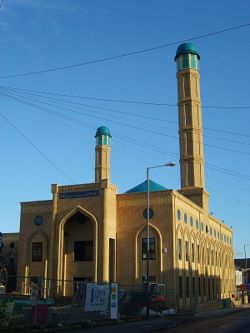
Madina Mosque, Sheffield

The Madina Mosque, also known as the Madina Masjid and the Wolseley Road Mosque, is the first purpose-built mosque in Sheffield, South Yorkshire, England.
Location Image
382 m

Olive Grove

Olive Grove was The Wednesday F.C.'s first permanent football ground, home to the club for just over a decade at the end of the 19th century. It was located on the site of what is now Sheffield City Council's Olive Grove Depot, near Queens Road in the centre of Sheffield. (The Wednesday FC became Sheffield Wednesday later) In November 2009 it was announced that the world's oldest football club, Sheffield F.C., plan to return to its Sheffield roots with an 'iconic' 10,000 capacity stadium 1/4 of a mile away from the original Olive Grove Ground.
Location Image
398 m

Heeley railway station

Heeley railway station was a railway station in Sheffield, England. The station served the suburbs of Heeley, Meersbrook, Abbeydale and Lowfield and was situated on the Midland Main Line off London Road in Heeley, lying between Sheffield Midland station and Millhouses & Ecclesall railway station. The station opened with the inauguration of the Midland Railway's main line between Chesterfield and Sheffield on 1 February 1870. This new station of 1870 was designed by the company architect John Holloway Sanders. It was built on an embankment between the A61, London Road South and the River Sheaf. During construction both the road and river were diverted to create space for the station and sidings. On 22 November 1876 an overnight passenger train from London St Pancras to Scotland via Carlisle derailed at Heeley due to a track defect, causing several people to be injured. Initially the station had two platforms but this was increased to four when the line from Sheffield to Dore was widened between 1901 and 1903. Heeley station was the only station on this section of the line that was an elevated station with subway access from below to the platforms. During the Great Sheffield Gale in 1962, there was a near miss at the station as a London to Sheffield express train narrowly avoided crashing into debris blown onto the tracks by the devastating storm; the station itself suffered damage which was never fully repaired. Heeley station closed on 10 June 1968 at the same time as Millhouses & Ecclesall railway station and all the platform buildings were demolished. The subway is still present although both entrances have been blocked in; the entrance on London Road can be seen and iron railings are present. In July 2017, it was proposed by Local Enterprise Partnership that new stations should be built at Millhouses and Heeley as well as new platforms at Dore & Totley. The plans would be part of a call to have better links in South Yorkshire area as well as plans for a new Woodhead Route reopening.
Location Image
558 m

Sheaf House (stadium)

Sheaf House is a former home ground of The Wednesday Football Club and was located near the centre of Sheffield, South Yorkshire, England. The club started to use the ground after leaving Myrtle Road in 1877 and it remained their main 'home' ground until 1880. At that point most home matches switched to Bramall Lane, however Wednesday continued to play some games at Sheaf House until Olive Grove was opened in 1887. Sheaf House was less suitable for hosting football matches than Bramall Lane (which was situated very close to the ground) but it was apparently cheaper to rent. The ground has since been covered by a new development, however the Sheaf House pub which used to stand at the corner of the ground is still there.