

 English
 Français

Cathédrale de Manchester
La cathédrale de Manchester, officiellement la Cathédrale et église collégiale de Sainte-Marie, Saint-Denis et Saint-Georges, est le siège de l'évêché de Manchester, située au centre de cette ville. Elle a été restaurée durant l'époque victorienne, puis à nouveau au XXe siècle car elle avait été dégradée par des bombardements. Cependant, elle conserve son architecture gothique d'origine, quand elle fut bâtie au XVe siècle. Les grandes orgues sont intégralement reconstruites en 2016 par la manufacture Tickell.
Nearby Places View Menu

130 m
Chetham's School of Music
Chetham's School of Music () is a private co-educational boarding and day music school in Manchester, England. Chetham's educates pupils between the ages of 8 and 18, all of whom enter via musical auditions.
The music school was established in 1969 from Chetham's Hospital School, founded as a charity school by Humphrey Chetham in 1653. After becoming a boys' grammar school in 1952, the school turned to music as its speciality, at the same time becoming a private school and accepting its first female students. There are approximately 300 students on roll, including a large sixth form making up around half of the school. Approximately two-thirds of students board on site, with others travelling in as day students from around Greater Manchester. The oldest parts of the school date to the 1420s, when the building was constructed as a residence for priests of the church which is now Manchester Cathedral. These parts are listed buildings housing Chetham's Library.
Academic and music teaching moved into a new, building in 2012; this replaced the Victorian Palatine building and allowed easier access for concert visitors. A 482-seat concert hall, Stoller Hall, opened within the New School Building in 2017.

157 m
Chetham's Library
Chetham's Library in Manchester, England, is the oldest free public reference library in the English-speaking world. Chetham's Hospital, which contains both the library and Chetham's School of Music, was established in 1653 under the will of Humphrey Chetham (1580–1653), for the education of "the sons of honest, industrious and painful parents", and a library for the use of scholars. The library has been in continuous use since 1653. It operates as an independent charity.
The library holds more than 100,000 volumes of printed books, of which 60,000 were published before 1851 including a copy of the Nuremberg Chronicle annotated by Thomas Gudlawe. Collections include 16th- and 17th-century printed works, periodicals and journals, local history sources, broadsides and ephemera. In addition to print materials, the library holds a collection of over 1,000 manuscripts, including 41 medieval texts.
Chetham's Library is an Accredited Museum under the Arts Council England Accreditation scheme. The whole of its collections are Designated as a collection of national and international importance under the Museums, Libraries and Archives Council Designation scheme, now administered by Arts Council England.
Paintings featured as a part of the library's fine arts collection include portraits of William Whitaker, the Reverend John Radcliffe, Robert Thyer, the Reverend Francis Robert Raines, and Elizabeth Leigh. The collection includes An Allegory with Putti and Satyrs, oil on canvas, attributed to 16th-century artist and Netherlander Vincent Sellaer.
One of the most substantial collections pertains to Belle Vue Zoo and Gardens, Manchester's most renowned entertainment attraction and zoological centre, in operation from the 1830s to the 1980s. The collection contains thousands of posters, programmes and photographs, as well as the financial and business papers of the owner, John Jennison; large numbers of items in this collection are available in digitised form online. A 2014 grant of £45,000 obtained by Chetham's Library allowed curators to make the collection available to online users, via digitization projects.

184 m
River Irk
The River Irk is a river in the historic county of Lancashire in North West England that flows through the northern part of Greater Manchester. It rises to the east of Royton and runs west past Chadderton, Middleton and Blackley before merging with the River Irwell, a tributary of the River Mersey, in the centre of Manchester.
185 m
English Football Hall of Fame
The English Football Hall of Fame is housed at the National Football Museum in Manchester, England. The Hall aims to celebrate and highlight the achievements of the all-time top English footballing talents, as well as non-English players and managers who have become significant figures in the history of the English game. New members are added each year, with an induction ceremony held in the autumn, formerly at varying locations, but exclusively at the Museum itself following its move to Manchester's Urbis building in 2012.
The Hall is on permanent display at the Museum. An accompanying book, The Football Hall of Fame: The Official Guide to the Greatest Footballing Legends of All Time, was first published in October 2005 by Robson Books. Authored by football historian Rob Galvin and the Museum's founding curator Mark Bushell, it is updated every year with the newest inductees, containing an in-depth profile about the career and reputation of each one, along with a select exhibit from the Museum which relates to their achievements.
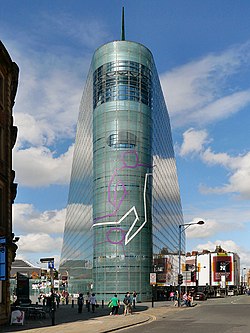
186 m
Urbis
Urbis is a building in Manchester, England, designed by Ian Simpson, which opened in 2002 as part of the redevelopment of Exchange Square. Originally a Museum of the City, a switch was made in 2005-06 to presenting exhibitions on popular culture alongside talks, gigs and special events. Urbis closed in 2010, reopening in 2012 as the National Football Museum.