

 English
 Français
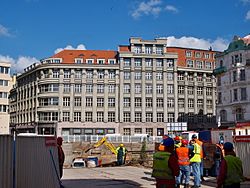
Palais Škoda
Le palais Škoda est un édifice Art Déco tardif situé à Prague, en Tchéquie. Il abrite depuis 2004 l'hôtel de ville. Situé rue Jungmannova, il est construit en 1929 pour la société Škoda, d'après un projet de l'architecte Pavel Janák, à qui l'on doit le Palais Adria, à Prague également. L'immeuble de bureaux adjacent de la rue Charvátova date de 1937. Aujourd'hui encore, les deux bâtiments satisfont aux exigences les plus strictes grâce à leur disposition flexible des bureaux et des espaces communs. Les bâtiments sont accessibles par plusieurs entrées, ce qui permet de diviser facilement les intérieurs en sections indépendantes. Le palais a servi de siège au groupe énergétique ČEZ de 1994 à 2004.
Nearby Places View Menu

13 m
Škoda Palace
Škoda Palace (Czech: Škodův palác) is the current site of the Prague Town Hall. The late Art Deco building in Jungmannova Street was built in 1929 for the Škoda company using a design by the prominent architect Pavel Janák (Adria Palace, Czernin Palace). The adjacent office building in Charvátova Street dates back to 1937. Even today, both buildings still satisfy the strictest requirements thanks to their flexible arrangement of office and common space within the buildings. The buildings are accessible through several entrances, which allows the interiors to be easily divided into independent sections. The Palace served as the headquarters of the ČEZ Energy Group from 1994 to 2004.

95 m
CEVRO University
CEVRO University (Czech: CEVRO Univerzita) is a private university in Prague, Czech Republic, established in 2005 by CEVRO, a think-tank affiliated with the Civic Democratic Party (ODS).

101 m
Franciscan Garden, Prague
The Franciscan Garden (Czech: Františkánská zahrada) is a historic park in New Town district of Prague in the Czech Republic. Originally known as the Carmelite Garden of Our Lady of the Snows, it was created during the founding of the New Town in 1348 under the reign of Charles IV as King of Bohemia. It was known as the Franciscan Garden by 1604 when the monastery, originally Carmelite, became property of the Order of the Discalced Franciscans.
Later, following the expulsion and internment of the Franciscans by the ruling communist party, it was opened to the public in 1950. While the monastery itself was returned, the gardens have since been owned by the municipal district of Prague 1 (except for a small, private section returned to the Franciscans), open year-round but closed at night. The garden has also been restored multiple times over the centuries - most recently, between 1989 and 1992, using designs from architect Josef Kuča and incorporating sculptures from Czech academic sculptors Stanislav Hanzík and Josef Klimeš.

105 m
Statue of Josef Jungmann
A statue of Josef Jungmann (Czech: Pomník Josefa Jungmanna) is installed in Prague, Czech Republic.
The construction of the monument was initiated by František Palacký and František Ladislav Rieger in 1866. They approached the sculptor Václav Levý, who was working in Rome at the time, and the architect Antonín Viktor Barvitius. Levý made a sketch and a small model of the statue, depicting Jungmann as a seated figure with a scroll and pen. Work on the monument was interrupted by Levy's illness and sudden death in 1870. The commission was then taken over by Ludvík Šimek, who used the original sketch and completed the statue, cast in Vienna, in 1872. The pedestal was made by Erhard Ackermann according to a design by Barvitius.The foundation stone for the monument was laid in 1873 by Palacký. The monument was unveiled in 1878.

108 m
Head of Franz Kafka
The Head of Franz Kafka (Czech: Hlava Franze Kafky), also known as the Statue of Kafka, is an outdoor kinetic sculpture by David Černý depicting Czech German-language writer Franz Kafka, installed on 31 October 2014 outside of the Quadrio shopping mall in Prague, Czech Republic.
The price was 30 million crowns, paid by the investor CPI Property Group together with the adjacent Quadrio complex.
Kafka himself worked in the nearby building of a saving bank.