

 English
 Français

Morley, Cheshire
Morley and Morley Green are neighbouring hamlets in Wilmslow, Cheshire, England. They are situated approximately 2 miles (3.2 km) north west of Wilmslow town centre. Until 1894 the area formed part of the parish of Pownall Fee. Morley is formed from the lines of houses and farms on Morley Green Road and Altrincham Road. Morley Green is the hamlet at the junction of Morley Green Road and Mobberley Road. A Congregational church was opened in Morley Green in 1869; it closed in 2010.
Nearby Places View Menu
600 m
Oversleyford
There are places called Oversley elsewhere in England.
Oversley and Oversleyford (sometimes Oversley Ford) is a name used for some places in an area near Manchester Airport.
Oversleyford Bridge, where the A538 road from Altrincham to Wilmslow crosses the River Bollin
Oversley Lodge Farm (as at August 2011 occupied by an asbestos cleanup firm for training)
Oversley Farm, and Oversleyford Brickworks, now obliterated by Runway 2 of Manchester Airport
The name is first recorded in the 13th century as Vulverichelei and seems to come from Anglo-Saxon Wulfrīces lēah (Wulfrīc's clearing or meadow). The ford was probably a few yards north of the modern main road Oversleyford Bridge, where a minor road bridges the Bollin; that minor road is now a back entry to a hotel's front yard but was part of the A538 road before it was diverted for a runway extension. The name Oversleyford is at the middle of the south edge of this old Ordnance Survey map.
1.2 km
Norcliffe Hall
Norcliffe Hall is a large house encompassing 20,254 square feet near the village of Styal, Cheshire, England. It stands to the west of the village and to the north of Styal Country Park. It was built in 1831 for Robert Hyde Greg, the owner of Quarry Bank Mill, and designed by the Lichfield architect Thomas Johnson. In 1860 a four-stage tower and a billiard room were added.
It is constructed in orange brick in Flemish bond brickwork with pink sandstone dressings. It is roofed in Welsh slates, and has octagonal brick chimney stacks. The architectural style is Elizabethan. It has an irregular plan, and is in 2½ storeys with a south front of four bays. It was designated as a Grade II listed building on 6 March 1975.
During the 20th century the house was used as a care home for the elderly. As of 2007 it was being converted into residential apartments. The house is surrounded by parkland and lawned areas.
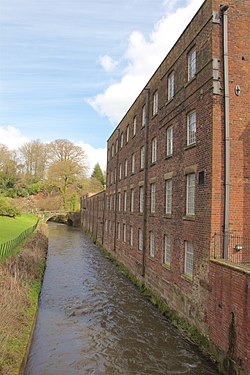
1.4 km
Quarry Bank Mill
Quarry Bank Mill (also known as Styal Mill) in Styal, Cheshire, England, is one of the best preserved textile factories of the Industrial Revolution. Built in 1784, the cotton mill is recorded in the National Heritage List for England as a designated Grade II* listed building. Quarry Bank Mill was established by Samuel Greg, and was notable for innovations both in machinery and also in its approach to labour relations, the latter largely as a result of the work of Greg's wife, Hannah Lightbody. The family took a somewhat paternalistic attitude toward the workers, providing medical care for all and limited education to the children, but all laboured roughly 72 hours per week until 1847 when a new law shortened the hours.
Greg also built housing for all of his workers, in a large community now known as Styal Estate. Some were conversions of farm houses, or older residences but 42 new cottages, including the Oak Cottages (now Grade II Listed), were built in the 1820s when the mill was being expanded.
The National Trust, which runs the mill and Styal Estate as a museum that is open to the public, calls the site "one of Britain's greatest industrial heritage sites, home to a complete industrial community". According to the Council of Europe, the mill with Styal village make up "the most complete and least altered factory colony of the Industrial Revolution. It is of outstanding national and international importance".

1.5 km
1985 Manchester Airport disaster
The 1985 Manchester Airport disaster occurred when British Airtours Flight 28M (also known as Flight 328), an international passenger flight, was en route from Manchester Airport to Corfu International Airport. It caught fire on takeoff on 22 August 1985, resulting in 55 fatalities.
The aircraft, a Boeing 737-236(A), named River Orrin, was flown by British Airtours, a wholly owned subsidiary of British Airways. It had 131 passengers and 6 crew on the manifest. During the takeoff roll, a loud thump was heard, and takeoff was aborted. An engine failure had generated a fire and the captain ordered evacuation. The engine failure was later traced to an incorrectly repaired combustor can, causing it to rupture and its dome to puncture the left wing fuel tank. Most of the deaths were due to smoke inhalation, not burns; 82 people survived.
The accident was described as "a defining moment in the history of civil aviation safety." It brought about industry-wide changes to the seating layout near emergency exits, fire-resistant seat covers, floor lighting, fire-resistant wall and ceiling panels, more fire extinguishers and clearer evacuation rules.