

 English
 Français
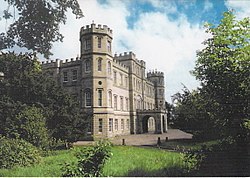
Le château de Wedderburn, près de Duns, dans le Berwickshire, dans les Scottish Borders, est une maison de campagne du XVIIIe siècle qui est maintenant utilisée comme lieu de mariage et d'événements. La maison est un bâtiment classé de catégorie A et les terrains sont inclus dans l'inventaire des jardins et des paysages conçus en Écosse.
Nearby Places View Menu
0 m
Wedderburn Castle
Wedderburn Castle, near Duns, Berwickshire, in the Scottish Borders, is an 18th-century country house that is now used as a wedding and events venue. The house is a Category A listed building and the grounds are included in the Inventory of Gardens and Designed Landscapes in Scotland.
679 m
Crimstone railway station
Crimstone railway station, also known as Crumstane railway station, served the town of Duns, Scottish Borders, Scotland, from 1849 to 1852 on the Duns branch line.

1.4 km
Manderston
Manderston House is a British stately home in Duns, Berwickshire. It is the seat of the Palmer family. It was completely rebuilt between 1901 and 1903 and has sumptuous interiors with a silver-plated staircase. The proprietor, Sir James Miller, 2nd Baronet (1864–1906), told the architect, John Kinross, that there was no budget: "It doesn't matter". The house is a Category A listed building and the surrounding area, which includes the farm complex at Buxley, is listed in the Inventory of Gardens and Designed Landscapes in Scotland.
1.6 km
Kimmerghame House
Kimmerghame House is a 19th-century mansion in the Scottish Borders, located 4 kilometres (2.5 mi) south-east of Duns by the Blackadder Water. It is the seat of the Swintons of Kimmerghame, a branch of the Lowland Clan Swinton. The house was designed in the Scottish Baronial style by David Bryce in 1851. Kimmerghame is protected as a category B listed building and the grounds are included on the Inventory of Gardens and Designed Landscapes in Scotland.
1.6 km
Battle of Nesbit Moor (1402)
The Battle of Nesbit Moor (or Nisbet Muir) was a small but significant clash between Scottish and English forces in the borders area north of the River Tweed. Specifically this clash took place on the Kimmerghame Estate in a field now named Slaughter Field. The estate is in the possession of the Swinton Family.
In 1402, Scottish nobles launched a coordinated invasion of Northern England. In the initial foray, some 12,000 Scottish troops crossed into Cumberland and looted areas near Carlisle. On 22 June at Nisbet, Berwickshire, the forfeited George de Dunbar, 10th Earl of March successfully led 200 English soldiers, mainly drawn from the garrison at Berwick-upon-Tweed, against 400 Scots returning from a raid on Northumberland. Henry IV of England was given news of the skirmish while at Harborough on 30 June, and delayed plans to suppress a Welsh rebellion so that he could deal with the large-scale Scottish invasion that was then imminently expected. In the autumn a large army of Scots led by Archibald Douglas, 4th Earl of Douglas harassed the English countryside as far south as the River Wear, and were engaged and defeated in the battle of Humbleton Hill.
The Scottish casualties at Nesbit Moor included the death of Sir Patrick Hepburn younger of Hailes; and the capture of Sir John Haliburton of Dirleton, Robert de Lawedre of Edrington, Sir John Cockburn, and Sir Thomas Haliburton. The date of Sir Robert Lawder's liberation does not appear to be on record but as there is a charter in The Great Seal of Scotland (number 934) confirmed at Falkland Palace in May 1411, which mentions him being "present", we might safely assume that he was freed before that date. Certainly on 15 June 1411 "Robertus Lawedyr, miles" has a safe-conduct from Henry IV.