
Location Image

Church of St Philip Neri, Liverpool

The Church of St Philip Neri in Liverpool is home to the Roman Catholic chaplaincy of the University of Liverpool and Liverpool John Moores University. It was built to a Byzantine Revival design by P. S. Gilby between 1914 and 1920. There are exterior friezes depicting the Last Supper and the Virgin and Child. The latter, over the door onto Catherine Street, is inscribed with the two titles given to Mary at the Council of Ephesus in 431 AD: Latin Deipara and Greek Theotokos (God-bearer). There is also a large stone inscribed in Latin set in the wall bearing the name of Thomas (Whiteside), Archbishop of Liverpool 8 October 1916, which dates from the time the church was constructed. The parish grew from the school named "The Institute", which opened in 1853 in nearby Hope Street. It was visited by the founder of the English Oratorians, Cardinal John Henry Newman of the Oratory of Saint Philip Neri in Edgbaston, Birmingham. The parish and later the church were dedicated to Saint Philip Neri in honour of Newman, since Philip Neri had founded the original Oratory church in Rome. Parish registers of the church dating as far back as 1864 can be inspected at the Liverpool Record Office. In the 1950s, the then priest Fr John Garvin, transformed an adjoining bombsite into a Spanish garden, El Jardin de Nuestra Señora ('the Garden of Our Lady'). The church became the chaplaincy for the universities in Liverpool in September 2001 when the old Liverpool University chaplaincy relocated from its previous home on the cathedral precinct, opposite the University of Liverpool Guild of Students, on Mount Pleasant. The church, which is a Grade II* listed building, recently received a grant of £72,000 to help remedy water ingress damage to its mosaic tiling. The church has six altars:

An altar in the main nave. The original high altar. An altar with devotion to the Sacred Heart of Jesus. An altar with devotion to the Virgin Mary. A side altar with devotion to Saint Joseph. The Church also has an altar with a devotion to Saint Gerard at the back of the main church space.

Nearby Places View Menu
Location Image
93 m

Wapping Tunnel

Wapping or Edge Hill Tunnel in Liverpool, England, is a tunnel route from the Edge Hill junction in the east of the city to the Liverpool south end docks formerly used by trains on the Liverpool-Manchester line railway. The tunnel alignment is roughly east to west. The tunnel was designed by George Stephenson with construction between 1826 and 1829 to enable goods services to operate between Liverpool docks and all locations up to Manchester, as part of the Liverpool and Manchester Railway. It was the first transport tunnel in the world to be bored under a city. The tunnel is 2,030 m (1.26 miles) long, running downhill from the western end of the 262 m (860 ft) long Cavendish cutting at Edge Hill in the east of the city, to Park Lane Goods Station near Wapping Dock in the west. The Edge Hill portal is near the former Crown Street Station goods yard. The tunnel passes beneath the Merseyrail Northern Line tunnel approximately a quarter of a mile south of Liverpool Central underground station.
Location Image
141 m

Blackburne House

Blackburne House is an 18th-century Grade II listed building located on the east side of Hope Street, Liverpool, Merseyside, England. It was built in 1788 and remodelled in from 1874 to 1876. Originally a private house, it became a girls' school and, after a period of dereliction, it is used as a training and resource centre for women.
Location Image
173 m

Liverpool Institute High School for Girls
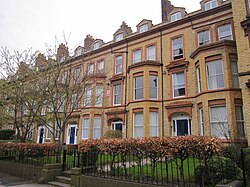
Liverpool Institute High School for Girls, Blackburne Place, Liverpool, England, was a girls' grammar school that was established in 1844 and closed in 1984. It was situated off Hope St to the north-east of Liverpool Cathedral in the area close to the University of Liverpool and Catharine Street (A5039).
Location Image
173 m

Gambier Terrace

Gambier Terrace is a street of 19th-century houses in Liverpool, England, overlooking St James's Mount and Gardens and the cathedral. It is generally reckoned to be in Canning, although it falls within the Rodney Street conservation area, together with Hope Street and Rodney Street. It was named after James Gambier. Nos. 1 to 10 are Grade II* listed buildings, as is the northernmost house in the terrace, which has the address of Canning Street around the corner. They were probably designed by John Foster, Junior. The terrace was built in 1832–1837. It was originally planned that the entire row would be built in a single style but construction was halted in the slump of 1837, and the demand for large city houses declined as the middle class moved out to the new suburbs. No. 10 was the last of the original build. The terrace was later completed to a cheaper specification. During the First World War, No. 1 Gambier Terrace was the location of the Women's War Service Bureau which assisted soldiers and their families. The service expanded into five additional premises on Bold Street and Berry Street. In the 1950s and 1960s, Nos. 11–12 Gambier Terrace was home to the Liverpool Art High School, the junior section of the Liverpool College of Art. The students were aged 13–16 years of age who won scholarships to attend the school. Cynthia Lennon was a student there before she met John Lennon of The Beatles. In the 1960s the terrace was in poor condition. John Lennon lived at No. 3 Gambier Terrace in 1960 with former Beatles bassist Stuart Sutcliffe after Sutcliffe asked the others who lived there, including fellow student and future well-known artist Margaret Chapman if the homeless Lennon could move in. They all attended the nearby Liverpool College of Art. The large number of students and artists living there led to a reporter from The Sunday People paying a visit for a story headlined "This is the Beatnik Horror", inadvertently including the first known published photograph of John Lennon. Also a student there was Peter Chang, a British artist known for his distinctive jewellery. He later trained as a graphic designer and sculptor at the Liverpool College of Art. He won the Liverpool Senior City Scholarship in 1966 which enabled him to study in Paris at Atelier 17 under S.W. Hayter. From the 1980s onward, he focused on jewellery-making. His collection was featured in Rifat Ozbek's 1987 fashion show. His work is in collections around the world, including the Victoria and Albert Museum, the Metropolitan Museum of Art, and the Cooper Hewitt. The freehold to the terrace and the garden in front belongs to Liverpool City Council. The land adjacent to Hope Street is maintained, in part, by the City Council and the leaseholders. The exact status of this land is unclear except that it is a public thoroughfare and unadopted by the City Council's highways department.