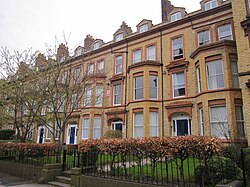
Gambier Terrace is a street of 19th-century houses in Liverpool, England, overlooking St James's Mount and Gardens and the cathedral. It is generally reckoned to be in Canning, although it falls within the Rodney Street conservation area, together with Hope Street and Rodney Street. It was named after James Gambier. Nos. 1 to 10 are Grade II* listed buildings, as is the northernmost house in the terrace, which has the address of Canning Street around the corner. They were probably designed by John Foster, Junior. The terrace was built in 1832–1837. It was originally planned that the entire row would be built in a single style but construction was halted in the slump of 1837, and the demand for large city houses declined as the middle class moved out to the new suburbs. No. 10 was the last of the original build. The terrace was later completed to a cheaper specification. During the First World War, No. 1 Gambier Terrace was the location of the Women's War Service Bureau which assisted soldiers and their families. The service expanded into five additional premises on Bold Street and Berry Street. In the 1950s and 1960s, Nos. 11–12 Gambier Terrace was home to the Liverpool Art High School, the junior section of the Liverpool College of Art. The students were aged 13–16 years of age who won scholarships to attend the school. Cynthia Lennon was a student there before she met John Lennon of The Beatles. In the 1960s the terrace was in poor condition. John Lennon lived at No. 3 Gambier Terrace in 1960 with former Beatles bassist Stuart Sutcliffe after Sutcliffe asked the others who lived there, including fellow student and future well-known artist Margaret Chapman if the homeless Lennon could move in. They all attended the nearby Liverpool College of Art. The large number of students and artists living there led to a reporter from The Sunday People paying a visit for a story headlined "This is the Beatnik Horror", inadvertently including the first known published photograph of John Lennon. Also a student there was Peter Chang, a British artist known for his distinctive jewellery. He later trained as a graphic designer and sculptor at the Liverpool College of Art. He won the Liverpool Senior City Scholarship in 1966 which enabled him to study in Paris at Atelier 17 under S.W. Hayter. From the 1980s onward, he focused on jewellery-making. His collection was featured in Rifat Ozbek's 1987 fashion show. His work is in collections around the world, including the Victoria and Albert Museum, the Metropolitan Museum of Art, and the Cooper Hewitt. The freehold to the terrace and the garden in front belongs to Liverpool City Council. The land adjacent to Hope Street is maintained, in part, by the City Council and the leaseholders. The exact status of this land is unclear except that it is a public thoroughfare and unadopted by the City Council's highways department.

Nearby Places View Menu
Location Image
117 m

St James Cemetery

St James's Cemetery is an urban park behind Liverpool Cathedral that is below ground level. Until 1825, the space was a stone quarry, and until 1936 it was used as the Liverpool city cemetery. It has been designated a Grade I Historic Park by Historic England.
Location Image
147 m

Anglican Diocese of Liverpool

The diocese of Liverpool is a diocese of the Church of England in North West England. The diocese covers Merseyside north of the River Mersey, south-west Lancashire, western Greater Manchester, and part of northern Cheshire. Liverpool Cathedral is the seat of the bishop of Liverpool, currently John Perumbalath, and the diocesan offices are also located in Liverpool. The bishop is assisted by one suffragan bishop, the bishop of Warrington. What is now the diocese of Liverpool was historically part of the diocese of Coventry and Lichfield, and became part of the newly created diocese of Chester in 1541. The diocese of Liverpool was established on 9 April 1880.
Location Image
147 m

Liverpool Cathedral

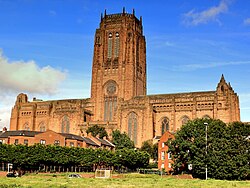
Liverpool Cathedral is a Church of England cathedral in the city of Liverpool, England. It is the seat of the bishop of Liverpool and is the mother church of the diocese of Liverpool. The church may be formally referred to as the Cathedral Church of Christ in Liverpool. It is the largest cathedral and religious building in Britain, and the eighth largest church in the world. The cathedral is based on a design by Giles Gilbert Scott and was constructed between 1904 and 1978. It is the longest cathedral in the world; the total external length of the building, including the Lady Chapel (dedicated to the Blessed Virgin), is 621 feet (189 m), its internal length is 480 feet (150 m). In terms of overall volume, Liverpool Cathedral ranks as the fifth-largest cathedral in the world and contests with the incomplete Cathedral of St. John the Divine in New York City for the title of largest Anglican church building. With a height of 331 feet (101 m) it is also one of the world's tallest non-spired church buildings and the fourth-tallest structure in the city of Liverpool. The cathedral is recorded in the National Heritage List for England as a designated Grade I listed building. The Anglican cathedral is one of two cathedrals in the city. The Roman Catholic Metropolitan Cathedral of Christ the King is situated approximately 0.5 miles (0.8 km) to the north. The cathedrals are linked by Hope Street, which takes its name from William Hope, a local merchant whose house stood on the site now occupied by the Philharmonic Hall, and was named long before either cathedral was built.
Location Image
170 m

Liverpool College of Art

Liverpool College of Art has an unbroken history dating back to 1825, making it the oldest English school of art outside London. From 1883 it was located at 68 Hope Street, Liverpool, England, in a building designed by Thomas Cook, which is now Grade II listed. Cook's design was the winner from a competition which attracted 96 entries. The cost was £12,000, which was mostly provided by one of the school's Board of Directors. An extension, by architects Willink & Thicknesse, who also designed the Cunard Building, was added in 1910. William Willink stepped down from his role as Director of Technical Instruction at the school to carry out the commission. The extension abutted 68 Hope Street and fronted the school's preexisting premises on Mount Street (later the Liverpool Institute High School for Boys, and subsequently, LIPA, the Liverpool Institute for Performing Arts). The cost was £19,852. What had previously been known as Liverpool School of Art was granted the title of Regional College of Art for Liverpool by the Ministry of Education in 1949. In 1970 Liverpool College of Art became part of the newly-formed Liverpool Polytechnic, which achieved university status as Liverpool John Moores University in 1992. The university's School of Art and Design moved to new premises at the Art and Design Academy in 2008. Amongst its former students are John Lennon, Cynthia Lennon, Maurice Cockrill, Ray Walker, Stuart Sutcliffe, Margaret Chapman, Ruth Duckworth, Phillida Nicholson and Bill Harry. Sir James Stirling studied there while working at an architect's office after leaving school. In 1975, Clive Langer, Steve Allen, Tim Whittaker, Sam Davis, Steve Lindsey, John Wood and Roy Holt (a mix of Fine Art students and tutors at the college) founded seminal 'art rock' band Deaf School and went on to sign a record deal with Warner Bros Records US after being 'discovered' by former Beatles publicist and head of Warner Bros UK at the time Derek Taylor. Deaf School are acknowledged as catalysts of the post-Beatles musical revival in the city. Staff at the Liverpool College of Art in the late 1950s (at the time of John Lennon and Stuart Sutcliffe) included Walter Norman, Julia Carter Preston, Arthur Ballard, Charles Burton, Nicholas Horsfield, George Mayer-Marton, E. S. S. English, Alfred K. Wiffen, Austin Davies, Philip Hartas, and the college's then-principal W. L. Stevenson. June Furlong was a life model at the school for 48 years, from 1947 to 1995, having also modelled at the Slade School of Fine Art, Goldsmiths College and the Royal College of Art and for Augustus John, Lucian Freud, Frank Auerbach. In March 2012, the adjoining Liverpool Institute for Performing Arts (LIPA) announced that it had purchased the former Liverpool College of Art building for £3.7million to expand its teaching space.