

 English
 Français
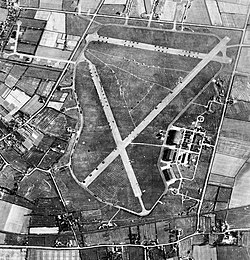
Royal Air Force Goxhill or RAF Goxhill is a former Royal Air Force station located east of Goxhill, on the south bank of the Humber Estuary in north Lincolnshire, England, opposite the city of Kingston upon Hull.
Nearby Places View Menu

1.0 km
Goxhill Hall
Goxhill Hall is a late 17th-century residence and a Grade II* Listed building in Goxhill, North Lincolnshire. A 14th to 15th-century Medieval hall joins onto the north-east corner of Goxhill Hall. This earlier structure was part of a larger complex and is a Grade I Listed building.

1.1 km
Goxhill
Goxhill is a village and civil parish in North Lincolnshire, England. The population of the civil parish taken at the 2011 census was 2,290. It is situated 5 miles (8 km) east from Barton-upon-Humber and 10 miles (16 km) north-west from Immingham.
Goxhill was part of the former Glanford district, part of the county of Humberside, between 1974 and 1996.
The village is served by Goxhill railway station, which runs from the town of Barton to the seaside resort of Cleethorpes. The area has been an important centre for clay pantile production since the 18th century and the industry is still represented in the village.
RAF Goxhill was used in the Second World War by RAF and the USAAF. The 78th Fighter Group arrived at the station, known officially as 8th Air Force Station No. F-345 on 1 December 1942. The American Units referred to it unofficially as "RAF Goat Hill". In 1943 Robert S. Johnson, a US ace pilot of the Second World War, was stationed here.

1.2 km
All Saints Church, Goxhill
All Saints' Church is an Anglican church and Grade I Listed building in Goxhill, North Lincolnshire, England.

1.4 km
Goxhill railway station
Goxhill railway station serves the village of Goxhill in North Lincolnshire, England. It was built by the Great Grimsby and Sheffield Junction Railway in 1848. The station is on the Barton Line 17 miles (27 km) north west of Cleethorpes and all trains serving it are operated by East Midlands Railway.
It is the last station, when travelling from Cleethorpes towards Barton, to still have two platforms and the original station buildings. The buildings are no longer in railway use (the station has been unstaffed since 1969) and are in private ownership. The station signal box controls a nearby level crossing that still (as of summer 2016) has manually-wound wooden gates rather than modern lifting barriers. Since the main line was re-signalled in January 2016, the box has become the 'fringe' on this route to the York Rail Operating Centre.
Between 1911 and 1963, it was also the junction for the Barton & Immingham Light Railway line to Immingham Dock via Killingholme. This route was single line throughout and left the present route just south of the station.