Le Battery Maritime Building est un terminal de ferry sur la pointe sud de l'île de Manhattan à New York. Situé au 10 South Street, près de l'intersection avec Whitehall Street, il est utilisé pour des excursions et est utilisé comme terminal de ferry pour Governors Island depuis 1956 . Le bâtiment de style Beaux-Arts a été construit de 1906 à 1909 en tant que jetée municipale du Ferry. Il a été inscrit au registre national des lieux historiques en 1976.

1. Description

Conçu par la firme Walker et Morris il utilisait une variété de métaux architecturaux, notamment la fonte, l'acier laminé, du zinc et du cuivre estampé, et les voûtes sous le toit du porche utilisent des tuiles Guastavino. C'est le seul bâtiment de ferry de style Exposition Universelle encore en activité à Manhattan . Le terminal de Whitehall a été construit en même temps à proximité et est apparu comme un jumeau, avant d'être reconstruit de façon drastique en 1956 . En 1991, le terminal de Whitehall a été détruit par un incendie. Il a été remplacé d'abord par une structure provisoire, puis par le bâtiment actuel de 2005.

1. Histoire

La structure a été construite de 1906 à 1909, remplaçant un bâtiment antérieur sur le site qui avait fonctionné depuis 1887 . Le nouveau bâtiment et son prédécesseur ont été utilisés par les ferries se rendant à la 39e rue à South Brooklyn (maintenant le quartier de Sunset Park à Brooklyn) et en tant que tel, a été nommé Quai municipal des ferries pour South Brooklyn. Le service de ferry de Brooklyn a été fermé le 15 mars 1938 et les 13 000 m2 de bâtiment ont été utilisés par diverses agences de la ville, y compris le ministère de la Marine et de l'Aviation à partir de 1959. Dans les années suivantes, son aspect multicolore d'origine a été remplacé par une couleur destinée à imiter la patine cuivrée de la statue de la Liberté.

En 1956, l'armée américaine a commencé à utiliser le terminal pour fournir des services à Fort Jay, un poste de l'armée sur Governors Island. En remplaçant les ferries à vapeur plus petits par deux nouveaux bateaux diesel-électriques plus grands, l'armée a exigé des quais de ferry plus importants, déplaçant leur opération de ferry vers un quai de ferry plus vaste et ouvert, situé au Barge Office, à l'ouest du terminal de ferry de Staten Island, vers le Battery Maritime Building . Lorsque les Garde-Côtes américains ont pris le contrôle de Governors Island à l'Armée en 1966 ils ont continué à utiliser le terminal pour fournir des services de véhicules et de passagers à l'île pour ses 3 000 habitants et 2 000 navetteurs quotidiens jusqu'à leur départ en 1996 . Entre 2001 et 2005, dans une rénovation de 36 millions de dollars, l'extérieur du bâtiment et ses piles en bois se détériorant ont été restaurés et son extérieur repeint dans sa palette de couleurs originale par Jan Hird Pokorny Architects .

1. Utilisation actuelle

Pendant la saison estivale, le service de ferries public vers Governors Island fonctionne à partir du quai 7 du bâtiment . Les ferries sont exploités par le Trust for Governors Island, une agence à but non lucratif créée en 2003 par la ville de New York. La ligne de ferry fonctionne avec deux navires, le Lieutenant Samuel S. Coursen et le Governors 1. Le service de ferries fonctionne de mai à octobre . NY Waterway exploite également un service de banlieue aux heures de pointe vers Port Liberté à partir du quai 5 . D'autres services de NY Waterway opèrent à partir du débarcadère du Pier 11 / Wall Street. En 2009, Dermot Construction a remporté l'appel d'offres pour convertir le bâtiment en hôtel. Après de nombreux retards, dont l'ouragan Sandy, le projet a reçu un nouveau tour de financement en 2018 et un groupe comprenant Cipriani SA espère l'ouvrir dès 2020 .

1. Galerie


1. Voir également

Terminal de ferry de Battery Park City Ferry Fulton, Brooklyn

1. Références


1. Liens externes

Ressource relative à l'architecture : Registre national des lieux historiques Historic American Engineering Record (HAER) no {{{survey}}}, « Whitehall Street Ferry Terminal, 11 South Street, New York, New York County, NY » Portail du Registre national des lieux historiques Portail de New York

Nearby Places View Menu
21 m

Casa Cipriani

Casa Cipriani is a hotel and private membership club that opened in August 2021 in the Battery Maritime Building, a ferry terminal, in lower Manhattan, New York City. While initial work rehabilitating the structure was completed by other entities, the final project and conversion, which includes a jazz cafe along with typical hotel amenities, was done in partnership with the New York City Economic Development Corporation, Midtown Equities, Centaur Properties, and Cipriani. For the physical conversion, Marvel Architects worked with Thierry Despont. Members of Casa Cipriani's private club have included Drew Barrymore and John Legend. Club members can book rooms at the hotel before the general public can, although the club's membership fees cost thousands of dollars as of 2023. In May 2024, Americas Great Resorts added the hotel to its Top Picks as a landmark property. The first edition of the Michelin Keys Guide, in 2024, ranked Casa Cipriani as a "three-key" hotel, the highest accolade granted by the guide.
Location Image
36 m

Battery Maritime Building

The Battery Maritime Building is a building at South Ferry on the southern tip of Manhattan Island in New York City. Located at 10 South Street, near the intersection with Whitehall Street, it contains an operational ferry terminal at ground level, as well as a hotel and event space on the upper stories. The ground story contains three ferry slips that are used for excursion trips and ferries to Governors Island, as well as commuter trips to Port Liberté, Jersey City. The upper stories contain the Cipriani South Street event space, operated by Cipriani S.A., and a 47-room hotel called Casa Cipriani. The Beaux-Arts building was built from 1906 to 1909 and designed by the firm Walker and Morris as the easternmost section of the partially completed Whitehall Street Ferry Terminal. What is now the Battery Maritime Building was designed to serve ferries traveling to Brooklyn. The structure uses a variety of architectural metals and originally contained a large waiting area on the second floor. The Battery Maritime Building is the only Exposition Universelle-style ferry building still operating in Manhattan. The similarly-designed westernmost section of the Whitehall Street Ferry Terminal, serving ferries to Staten Island, was rebuilt as the Staten Island Ferry Whitehall Terminal; the center section was never built. The terminal was used by Brooklyn ferry routes until the mid-20th century and subsequently fell into disrepair. The building was used as a Governors Island ferry terminal starting in 1956, while the upper floors were used by various city agencies, including the Department of Marine and Aviation beginning in 1959. The New York City Landmarks Preservation Commission designated the building as a city landmark in 1967 and it was added to the National Register of Historic Places in 1976. The underused structure was proposed to be converted into a cultural center during the 1980s as part of the failed South Ferry Plaza development. The exterior was restored by Jan Hird Pokorny Architects between 2001 and 2005. Plans to convert the interior into a hotel and event space were approved in 2009, but the conversion encountered numerous delays, with the event space opening in 2019.
103 m

Helicoidal Skyscraper

The Helicoidal Skyscraper was a planned but never materialized, 565 m (1,854 ft) high business center that was to have been built on the tip of Manhattan, New York City. It was a stillborn project developed between 1968 and 1974 by Italian architect Manfredi Nicoletti. It combined its aerodynamic shape with the technology of wired bridges, for the purpose of minimizing both the loads and structural bulk.
Location Image
116 m

1 New York Plaza

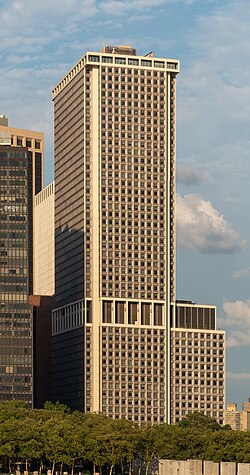
1 New York Plaza is an office building in the Financial District of Manhattan in New York City, at the intersection of South and Whitehall Streets near South Ferry. The building, measuring 640 feet (200 m) tall with 50 floors, is the southernmost skyscraper in Lower Manhattan. It was designed by William Lescaze & Assocs. and Kahn & Jacobs, and developed by Sol Atlas and John P. McGrath. The facade was designed by Nevio Maggiora, consisting of a boxlike "beehive" pattern with the windows recessed within, made of aluminum-clad wall elements resembling a type of thermally activated elevator button popular at the time of construction. There is a 40,000-square-foot (3,700 m2) retail concourse on the lower level.
Location Image
117 m

South Ferry Plaza

The South Ferry Plaza, also called A Lighthouse At The Tip Of The Island, was a supertall skyscraper proposed in 1987 to rise right next to the East River on Manhattan Island in New York City. The building would have sat on top of the South Ferry terminal and tower 1,084 ft (330 m) above street level, with 60 stories of office space. It was designed by architect Fox & Fowle Architects and Leslie E. Robertson Associates. The architects designed the building for office use and the skyscraper incorporated recycled marble and steel with glass in its structure. The architectural plan had a glass dome that was supposed to be lit at night, which also contained an observation deck and three restaurants located inside the dome. In addition, the project called for the renovation of the South Ferry Terminal, including the train station so it can accommodate 100,000 people. The project would have doubled the size of Battery Park if it had proceeded, since the building included a plaza that was planned to tie in with Battery Park via a new promenade at the tip of Manhattan. The project was canceled in 1991 because of a lack of funding.