
The Helicoidal Skyscraper was a planned but never materialized, 565 m (1,854 ft) high business center that was to have been built on the tip of Manhattan, New York City. It was a stillborn project developed between 1968 and 1974 by Italian architect Manfredi Nicoletti. It combined its aerodynamic shape with the technology of wired bridges, for the purpose of minimizing both the loads and structural bulk.

1. Concept

Structural studies have been conducted by Italian engineer Sergio Musmeci. The building's structure concept is based on the body of a mammal and it explores the route of the maximum reduction of wind pressures and structural bulkiness. Particularly, it was inspired by the mammal's limb, with its compressed central bone - external tensioned muscle. The central nucleus in steel and cement is compressed and made up of three interconnected cylindrical trunks which house all the vertical systems. Anchored to this nucleus are a group of trunks wired in steel which keep the external strips in traction where the latticed structures of the attics are located, which compress themselves towards the nucleus and collaborates with the overall static system. The wind pressure is minimized by the helix shape made by the trunks in the skyscraper, described by the three sails made by the overlapping of the habitable floors which revolve around the central trunk creating in planimetry a growing movement based on the golden spiral. The form reacts to the action of the wind, whatever direction it comes from, in a uniform and dissipative way. The result is the elimination of two of the main negative phenomena vis-à-vis the typology of skyscrapers: the excess static caused by the asymmetry of traditional structures of rectangular design, where the pressure of the wind is highest on the long side and lowest on the short one and the Von Karman effect typical of cylindrical structures which provokes a sinusoidal whirlwind and consequently lateral pulsating forces. The helicoidal shape, on the other hand, splits up the force of the wind in resistance, leeway and lift. In that way, the lift does not have an influence on the stability and decreases the weight transmitted to the foundations. The project extrapolates two typologies from areas never associated with buildings of great height: the twisting shape of the ship sail that escapes the wind and minimises its pressure, and the structure of the cable bridge that results in a significant saving of materials by collaborating the horizontal scaffolding with the rods and the supports.

1. Sustainable Design

The Helicoidal Skyscraper can be considered a sustainable building or an example of the green architecture concept due to several aspects of its design. As a tall building, for instance, it addresses the energy problem by minimising the quantities of materials needed for its construction. Also, its unique logarithmic spiral would have reacted to the wind with a vertical force that drives it upwards, taking with the air pollution - out from the streets below. It avoids the capability of most tall buildings to serve as obstructions that affect the atmospheric circulation and the dispersion of pollutants. There is an expectation of the so-called "chimney effect," which eliminates the creation of an unpleasant micro-climate and the accumulation of pollution in the lower strata of the urban atmosphere by increasing the conviction currents created by the thermal distribution of solar heat on the external surfaces of the tower. The building avoids structural redundancy, which leads to economic benefits. This is attributed to the adoption of a circular polar diagram that allows the edifice to receive wind in a generally uniform manner from any direction. Therefore, it is not subject to critical conditions caused by specific wind directions that can create excess load.

1. References


1. External links

Helicoidal Skyscraper in www.manfredinicoletti.com

Nearby Places View Menu
Location Image
26 m

1 New York Plaza

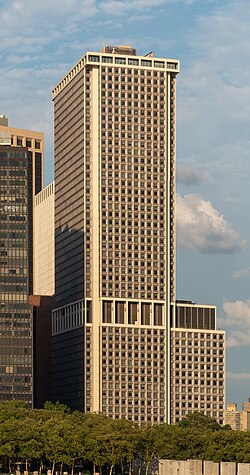
1 New York Plaza is an office building in the Financial District of Manhattan in New York City, at the intersection of South and Whitehall Streets near South Ferry. The building, measuring 640 feet (200 m) tall with 50 floors, is the southernmost skyscraper in Lower Manhattan. It was designed by William Lescaze & Assocs. and Kahn & Jacobs, and developed by Sol Atlas and John P. McGrath. The facade was designed by Nevio Maggiora, consisting of a boxlike "beehive" pattern with the windows recessed within, made of aluminum-clad wall elements resembling a type of thermally activated elevator button popular at the time of construction. There is a 40,000-square-foot (3,700 m2) retail concourse on the lower level.
Location Image
82 m

2 New York Plaza

125 Broad Street (formerly known as 2 New York Plaza) is an office building in the Financial District of Manhattan in New York City, at the intersection of Broad Street and South Street near South Ferry. The building, standing 504 feet (154 m) tall with 40 floors, is one of the southernmost skyscrapers in Lower Manhattan. The building was designed by the Kahn & Jacobs architecture firm, and developed by Sol Atlas and John P. McGrath. Construction took place from 1970 to 1971. The building is to the east of 1 New York Plaza, and to the south of 55 Water Street. It has a modern structural design, and is one of a series of modern-style buildings built in the Financial District during the 1960s and 1970s. Starting in 2007 the managers began incorporating energy saving renovations to meet LEED Silver standards. Building amenities include on-site management, day care, a coffee shop, shoe shine and a 50-car garage.
Location Image
87 m

South Ferry/Whitehall Street station

The South Ferry/Whitehall Street station is a New York City Subway station complex in the Financial District neighborhood of Manhattan, under Battery Park. The complex is shared by the IRT Broadway–Seventh Avenue Line and the BMT Broadway Line. It is served by the 1 and R trains at all times, the W train only on weekdays during the day, and the N train at night. It is the southern terminal for all 1 and W trains and the northern terminal for late night R trains. The complex originally consisted of three separate stations. In 1905, the Interborough Rapid Transit Company (IRT) opened a balloon loop at South Ferry, serving the IRT Broadway–Seventh Avenue and IRT Lexington Avenue Lines. The Brooklyn–Manhattan Transit Corporation (BMT) opened its station at Whitehall Street in 1918. The same year, the IRT opened a second loop for the IRT Lexington Avenue Line on the inside of the existing loop; the two loop stations were not connected to each other nor to the BMT station. Despite their proximity, the stations remained separate for 91 years. In the early 2000s, as part of the recovery effort from the September 11, 2001, attacks, a new South Ferry terminal for the Broadway–Seventh Avenue Line was proposed. That station opened in 2009, replacing the loop station and providing a connection between the Broadway–Seventh Avenue Line's 1 train and the Broadway Line's N, R, and W trains. The new terminal for the Broadway–Seventh Avenue Line was severely damaged during Hurricane Sandy in 2012, and the MTA temporarily re-opened the loop station between 2013 and 2017, adding a temporary connection between the IRT Broadway–Seventh Avenue Line's loop and the BMT Broadway Line's platforms. The newer terminal reopened in June 2017 following extensive renovations and waterproofing work. This station complex is the third on the site to bear the name South Ferry. The first was an elevated station located nearby, which was open from 1877 to 1950 and served the former IRT Ninth, Sixth, Third, and Second Avenue elevated lines. The second was the old South Ferry loop station, located above the existing station complex.
99 m

Casa Cipriani

Casa Cipriani is a hotel and private membership club that opened in August 2021 in the Battery Maritime Building, a ferry terminal, in lower Manhattan, New York City. While initial work rehabilitating the structure was completed by other entities, the final project and conversion, which includes a jazz cafe along with typical hotel amenities, was done in partnership with the New York City Economic Development Corporation, Midtown Equities, Centaur Properties, and Cipriani. For the physical conversion, Marvel Architects worked with Thierry Despont. Members of Casa Cipriani's private club have included Drew Barrymore and John Legend. Club members can book rooms at the hotel before the general public can, although the club's membership fees cost thousands of dollars as of 2023. In May 2024, Americas Great Resorts added the hotel to its Top Picks as a landmark property. The first edition of the Michelin Keys Guide, in 2024, ranked Casa Cipriani as a "three-key" hotel, the highest accolade granted by the guide.