Location Image

Waldorf Astoria Édimbourg - The Caledonian

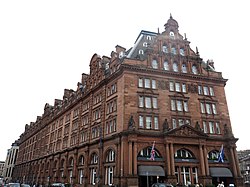
Waldorf Astoria Edimbourg - The Caledonian, est un hôtel d'Édimbourg, en Écosse. Ouvert en décembre 1903, il est un exemple d'un grand hôtel de chemin de fer, anciennement appelé Le Caledonian Hotel, et surnommé "The Caley'. Il se trouve à l'extrémité ouest de la rue Princes Street, et est un bâtiment classé de catégorie A.

1. Construction

Le Caledonian Hotel a été construit de 1899 à 1903, il faisait partie de la gare de Caledonian Railway's Edinburgh Princes Street. C'était un rival de la North British Railway, qui avait ouvert à l'autre extrémité de la rue Princes Street , en 1902. L'hôtel a été construit en pierre, en forme de V, près de la gare construite récemment en remplacement de la précédente gare en bois, endommagée par un incendie en juin 1890. Lors de sa construction, l'hôtel avait 205 chambres avec une décoration dans le style Louis XV. Les grandes arches à l'avant de l'hôtel permettaient également d'accéder à la gare de chemin de fer. Le grès rouge de la façade était un symbole de la ville tout au long de l'histoire de l'hôtel. En 1965, la gare de Princes Street a été fermée, et démolie en 1970. Cela a fourni l'espace pour agrandir l'hôtel. Les portes en fonte à l'entrée d'un parking dans Rutland Street sont le seul vestige de la gare en dehors de l'hôtel. L'horloge originale de la gare, datant d'avant l'incendie de 1890, a été conservée dans l'hôtel.

1. Rénovation

The Caledonian a été acheté par la chaîne Hilton en 2000. Après une rénovation de £24 millions en 2011, l'hôtel est devenu un phare de la marque de luxe Waldorf Astoria. Lors de la rénovation, l'hôtel avait 241 chambres. Les projets de remise à neuf ont compris l'ajout et l'amélioration des espaces publics, des chambres, un spa et un restaurant. Le hall original de la gare et la salle de vente ont été couverts afin de servir de bar-salon, nommé Peacock Alley, qui intègre l'horloge de la gare. Le restaurant de l'hôtel est nommé La Pompadour. Il sert des plats d'influence française et est supervisé par les doubles étoilés au guide Michelin chefs Chris et Jeff Galvin. Le bar, connu sous le nom Caley Bar, sert au Festival Fringe d'Édimbourg.

1. Références


1. Liens externes

Site officiel Portail de l’hôtellerie Portail de l’Écosse Portail des monuments classés au Royaume-Uni

Nearby Places View Menu
Location Image
31 m

The Caledonian Edinburgh Hotel

The Caledonian Edinburgh is a five-star hotel in Edinburgh, Scotland. It was built by the Caledonian Railway company and was opened in 1903. The hotel stands at the west end of Princes Street on the site of the Caledonian Railway's former Edinburgh terminus. It is an example of a British grand railway hotel. It is nicknamed "The Caley", and is a category A listed building.
Location Image
68 m

Edinburgh Princes Street railway station

Princes Street Station was a mainline railway station which stood at the west end of Princes Street, in Edinburgh, Scotland, for almost 100 years. Temporary stations were opened in 1848 and 1870, with construction of the main station commencing in the 1890s. The station was closed completely in 1965 and largely demolished in 1969–70. Only its hotel remains, but it is no longer in railway ownership.
Location Image
69 m

St John's, Edinburgh

The Church of St John the Evangelist is a Scottish Episcopal church in the centre of Edinburgh, Scotland. It is sited at the west end of Princes Street at its junction with Lothian Road, and is protected as a category A listed building.
Location Image
129 m

St Cuthbert's Church, Edinburgh

The Parish Church of St Cuthbert is a parish church of the Church of Scotland in central Edinburgh. Probably founded in the 7th century, the church once covered an extensive parish around the burgh of Edinburgh. The church's current building was designed by Hippolyte Blanc and completed in 1894. St Cuthbert's is situated within a large churchyard that bounds Princes Street Gardens and Lothian Road. A church was probably founded on this site during or shortly after the life of Cuthbert. The church is first recorded in 1128, when David I granted it to Holyrood Abbey. At that time, the church covered an extensive parish, which was gradually reduced until the 20th century by the erection and expansion of other parishes, many of which were founded as chapels of ease of St Cuthbert's. St Cuthbert's became a Protestant church at the Scottish Reformation in 1560: from after the Reformation until the 19th century, the church was usually called the West Kirk. After the Restoration in 1660, the congregation remained loyal to the Covenanters. The church's position at the foot of Castle Rock saw it damaged or destroyed at least four times between the 14th and 17th centuries. The current church was built between 1892 and 1894 to replace a Georgian church, which had itself replaced a building of uncertain age. The building was designed by Hippolyte Blanc in the Baroque and Renaissance styles and retains the steeple of the previous church. The Buildings of Scotland guide to Edinburgh calls the church's furnishings "extraordinary". Features include stained glass windows by Louis Comfort Tiffany, Douglas Strachan, and Ballantyne & Gardiner; mural paintings by Gerald Moira and John Duncan; and memorials by John Flaxman and George Frampton. The church also possesses a ring of ten bells by Taylor of Loughborough. The church has been a Category A listed building since 1970. Seven of the church's ministers have served as Moderator of the General Assembly of the Church of Scotland during their incumbencies, including Robert Pont, who held the role on six occasions between the 1570s and 1590s. The church's present work includes ministries among homeless people and Edinburgh's business community.
Location Image
178 m

Caley Picture House

Caley Picture House was a cinema and concert venue located in Edinburgh, Scotland.