


Mow Cop and Scholar Green railway station was a station on the North Staffordshire Railway between Stoke-on-Trent and Congleton. It served the village of Mow Cop. The line was opened by the North Staffordshire Railway on 9 October 1848 but the station at Mow Cop did not open until the beginning of January 1849.
Gallery


Sponsored
Location
2 explorers visited this place
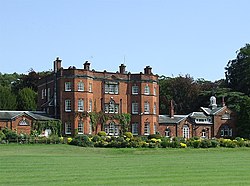
166 m
Ramsdell Hall is a country house in the parish of Odd Rode in Cheshire, England, overlooking the Macclesfield Canal. It was built in two phases during the 18th century, and is still in private ownership.

1.3 km
Mow Cop is a village on the Cheshire-Staffordshire border, England, 24 miles south of Manchester and 6 miles north of Stoke-on-Trent, on a steep hill of the same name rising to 335 metres above sea level. The village is at the edge of the southern Pennines, with the Cheshire Plain to the west.

1.3 km
Odd Rode is a civil parish in the unitary authority of Cheshire East and the ceremonial county of Cheshire, England. It borders the Staffordshire parish of Kidsgrove. Of particular note in the area is Rode Hall, seat of the Wilbraham family.
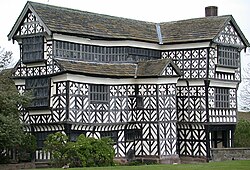
1.5 km
Little Moreton Hall, also known as Old Moreton Hall, is a moated half-timbered manor house 4.5 miles south-west of Congleton in Cheshire, England. The earliest parts of the house were built for the prosperous Cheshire landowner William Moreton in about 1504–08 and the remainder was constructed in stages by successive generations of the family until about 1610. The building is highly irregular, with three asymmetrical ranges forming a small, rectangular cobbled courtyard. A National Trust guidebook describes Little Moreton Hall as being "lifted straight from a fairy story, a gingerbread house." The house's top-heavy appearance, "like a stranded Noah's Ark", is due to the Long Gallery that runs the length of the south range's upper floor.
The house remained in the possession of the Moreton family for almost 450 years, until ownership was transferred to the National Trust in 1938. Little Moreton Hall and its sandstone bridge across the moat are recorded in the National Heritage List for England as a designated Grade I listed building; the ground on which Little Moreton Hall stands is protected as a Scheduled Monument. The house has been fully restored and is open to the public from April to December each year.
At its greatest extent, in the mid-16th century, the Little Moreton Hall estate occupied an area of 1,360 acres; it contained a cornmill, orchards, gardens and an iron bloomery with water-powered hammers. The gardens lay abandoned until their 20th-century re-creation. As there were no surviving records of the layout of the original knot garden, it was replanted according to a pattern published in the 17th century.

1.5 km
The Staffordshire Way is a long-distance walk in Staffordshire, England. The path links with the Cheshire Gritstone Trail, the Heart of England Way and the North Worcestershire Path.
The Way was opened in three stages by Staffordshire County Council between 1977 and 1983 and was resurveyed and refurbished with the assistance of the Ramblers' Association to mark the Association's 60th anniversary in 1995.
Book your tour near
Mow Cop and Scholar Green railway station
→
It closed in 1964 and was immortalised that year in the song Slow Train by Flanders and Swann. The signal box survived in use until 2002, and is now preserved privately in the village.