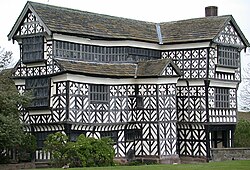
Little Moreton Hall, also known as Old Moreton Hall, is a moated half-timbered manor house 4.5 miles (7.2 km) south-west of Congleton in Cheshire, England. The earliest parts of the house were built for the prosperous Cheshire landowner William Moreton in about 1504–08 and the remainder was constructed in stages by successive generations of the family until about 1610. The building is highly irregular, with three asymmetrical ranges forming a small, rectangular cobbled courtyard. A National Trust guidebook describes Little Moreton Hall as being "lifted straight from a fairy story, a gingerbread house." The house's top-heavy appearance, "like a stranded Noah's Ark", is due to the Long Gallery that runs the length of the south range's upper floor. The house remained in the possession of the Moreton family for almost 450 years, until ownership was transferred to the National Trust in 1938. Little Moreton Hall and its sandstone bridge across the moat are recorded in the National Heritage List for England as a designated Grade I listed building; the ground on which Little Moreton Hall stands is protected as a Scheduled Monument. The house has been fully restored and is open to the public from April to December each year. At its greatest extent, in the mid-16th century, the Little Moreton Hall estate occupied an area of 1,360 acres (550 ha); it contained a cornmill, orchards, gardens and an iron bloomery with water-powered hammers. The gardens lay abandoned until their 20th-century re-creation. As there were no surviving records of the layout of the original knot garden, it was replanted according to a pattern published in the 17th century.

Nearby Places View Menu
Location Image
911 m

Great Moreton Hall

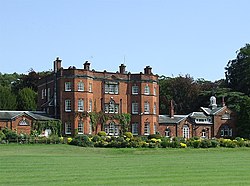
Great Moreton Hall is a former country house in Moreton cum Alcumlow near Congleton, in Cheshire, England, less than a mile (1.6 km) from its better-known near namesake Little Moreton Hall. Designed by Edward Blore, it was built in 1841 by Manchester businessman George Holland Ackers, to replace a large timber-framed building that had been the home of the Bellot family since 1602. Great Moreton Hall is built in two storeys, interspersed with three and four-storey towers. The service wing to the left of and adjoining the main part of the building is slightly lower than the rest of the structure. The main entrance is via a broad flight of steps from a porte-cochère, leading to the entrance lobby and a large central hall. A triple arcade at one end of the hall leads to the main staircase, opposite a hooded fireplace decorated with the arms of the Ackers family. The Library, Drawing Room, Billiard Room, Saloon, and the Great Hall are arranged symmetrically around the central hall. "Dark narrow internal corridors" allowed the servants, whose quarters were in the cellars, to reach all the rooms without having to pass through the central hall. Great Moreton Hall was designated a Grade II* listed building on 14 February 1967. Since 1931 the house has served first as a school and then as a hotel and conference centre. Great Moreton Hall has been in private ownership since 1992. HM Land Registry
Location Image
1.2 km

Odd Rode

Odd Rode is a civil parish in the unitary authority of Cheshire East and the ceremonial county of Cheshire, England. It borders the Staffordshire parish of Kidsgrove. Of particular note in the area is Rode Hall, seat of the Wilbraham family.
Location Image
1.2 km

Moreton cum Alcumlow

Moreton cum Alcumlow is a small civil parish in Cheshire East, Cheshire, England. In the 2021 census it had a population of 155. The main settlement in the parish is the small village of Ackers Crossing. The parish also includes Alcumlow Hall and Great Moreton Hall. (Little Moreton Hall is in the adjacent civil parish of Odd Rode.)
Location Image
1.3 km

Ramsdell Hall

Ramsdell Hall is a country house in the parish of Odd Rode in Cheshire, England, overlooking the Macclesfield Canal. It was built in two phases during the 18th century, and is still in private ownership.