
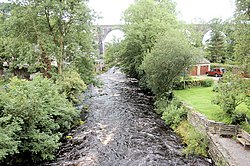
The River Doe is a river in North Yorkshire, England. The river's source is near God's Bridge close to the settlement of Chapel-le-Dale and flows through Twisleton in a south-westerly direction to Ingleton, where it meets the River Twiss to form the River Greta. The river forms part of the River Lune system that flows into the Irish Sea.

1. Course

The source of the river is found at a place named God's Bridge where Chapel Beck disappears underground and the Doe begins. The river flows southwest, fed by several small unnamed springs on the valley sides. The first named tributary is Light Water Spring which feeds northwest into the river near a disused quarry. Near Twisleton Dale House, the river can be crossed by some stepping stones at a fording point as well as some 700 yards (640 m) later near the disused granite quarry. Further downstream near Twisleton Hall, there is another set of stepping stones at a fording point just above Beezley Falls. After flowing under a footbridge, there are another set of falls, Snow Falls, just below the quarry which is operated by Hanson. The river continues past several disused quarries and a footbridge until it reaches the town of Ingleton where it forms a confluence with the River Twiss.

1. Falls

Beezley Falls are reached approximately 2.1 miles (3.4 km) from the source at God's Bridge. These falls consist of a series of cascades, including the triple spout, running through Baxengyhll Gorge. Rival Falls has a plunge pool known as the Black Hole. The steepest drops are between 9 feet (2.7 m) and 12 feet (3.7 m) approximately. Snow Falls are situated in the lower gorge about 0.5 miles (0.8 km) downstream and has similar drops.

1. Geology

The main rock of the river valley is turbidite sandstone with some siltstone which are prevalent in the waterfalls and plunge pools. These lay on a bed of Precambrian sedimentary rock which show evidence of its oceanic origins in the ripple and folding marks on exposed surfaces.

1. Habitat

The river is home to Brown trout. From Beezley falls to Snow falls, the sides of the gorge are lined with a variety of trees and shrubs.

1. Gallery


1. References
Nearby Places View Menu
Location Image
31 m

River Twiss

The River Twiss is a river in the county of Yorkshire, England. The source of the river is Kingsdale Beck, which rises at Kingsdale Head at the confluence of Back Gill and Long Gill in the Yorkshire Dales. Beneath Keld Head, the river changes its name to the River Twiss. It has two notable waterfalls, Thornton Force and Pecca Falls, and its course follows part of the Ingleton Waterfalls Walk, then through Swilla Glen to Thornton in Lonsdale and down to Ingleton, where it meets the River Doe to form the River Greta. The English landscape artist J. M. W. Turner was a frequent visitor to the area, and his sketch of Thornton Force in 1816 is currently part of the Tate collection.
Location Image
116 m

Ingleton Waterfalls Trail

Ingleton Waterfalls Trail is a well-known circular trail beginning and ending in the village of Ingleton in the English county of North Yorkshire, now maintained by the Ingleton Scenery Company. It is claimed that the trail, some 8 kilometres (5 mi) long, and with a vertical rise of 169 m (554 feet) has some of the most spectacular waterfall and woodland scenery in the north of England. It is on private land and an entrance fee is charged.
157 m

Ingleton railway station (Midland Railway)

Ingleton (Midland) railway station was one of two stations serving the village of Ingleton, North Yorkshire, England. It was originally open for just ten months between 1849 and 1850, and did not reopen until 1861. It then served as the frontier between the Midland Railway to the south and the London and North Western Railway to the North, with trains from each railway terminating at the station. Through trains did not begin until the two companies were merged in 1923. The station closed in 1954. The village's Community Centre is now on the site of the former station.
Location Image
190 m

St Mary's Church, Ingleton

St Mary's Church is the parish church of Ingleton, North Yorkshire, a village in England. There was a church on the site by the 12th century. The oldest part of the current building is the tower, dating from the 15th century. Between 1886 and 1887 the remainder of the church was rebuilt, to a Decorated Gothic-style design, by Cornelius Sherlock. The building was grade II* listed in 1958. The church is built of stone with a slate roof, and consists of a nave with a clerestory, north and south aisles, a south porch, a chancel with a north vestry, and a west tower. The tower has three stages, diagonal buttresses, a west doorway with a pointed arch, a chamfered surround and a hood mould, above which is a three-light window, a south clock face, two-light bell openings, a string course, and an embattled parapet with corner finials. Inside, some fragments of wall painting survive, but the highlight is the 12th century font, described by Nikolaus Pevsner as "one of the best in the West Riding". It is cylindrical, and is carved with an arcade design, with fourteen Biblical scenes. It was rediscovered in the 18th century, cleaned and brought back into use in 1830, and mounted on its current base in 1858.