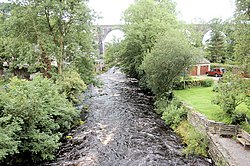
The River Twiss is a river in the county of Yorkshire, England. The source of the river is Kingsdale Beck, which rises at Kingsdale Head at the confluence of Back Gill and Long Gill in the Yorkshire Dales. Beneath Keld Head, the river changes its name to the River Twiss. It has two notable waterfalls, Thornton Force and Pecca Falls, and its course follows part of the Ingleton Waterfalls Walk, then through Swilla Glen to Thornton in Lonsdale and down to Ingleton, where it meets the River Doe to form the River Greta. The English landscape artist J. M. W. Turner was a frequent visitor to the area, and his sketch of Thornton Force in 1816 is currently part of the Tate collection.

1. Course

From the caves below Keld Head, water flows and combines with Kingsdale Beck to form the River Twiss. It flows south over Thornton Force and Pecca Falls and through woodland to join the River Doe at Ingleton.

1. = Waterfalls =

The drop of Thornton Force is about 14 metres (46 ft). Pecca Falls has three drops totalling 30 metres (98 ft) that fall into their own deep pools.

1. Geology

In its upper part, the river flows through a valley carved into horizontal beds of Carboniferous Great Scar limestone. At Thornton Force, it crosses a notable unconformity into the underlying, steeply inclined Ordovician greywackes. The unconformity is clearly visible in the face of the waterfall. The Ordovician strata influence the character of the steep and narrow Swilla Glen and its waterfalls until, just north of Ingleton, the river crosses the Craven Fault and onto Carboniferous Limestone once again.

1. Crossings

Ravenray Bridge (foot) Pecca Bridge (foot) Manor Bridge (foot) Unnamed Road, Ingleton

1. Gallery


1. Sources

Ordnance Survey Open Data https://www.ordnancesurvey.co.uk/business-government/tools-support/open-data-support

1. References
Nearby Places View Menu
Location Image
31 m

River Doe

The River Doe is a river in North Yorkshire, England. The river's source is near God's Bridge close to the settlement of Chapel-le-Dale and flows through Twisleton in a south-westerly direction to Ingleton, where it meets the River Twiss to form the River Greta. The river forms part of the River Lune system that flows into the Irish Sea.
136 m

Ingleton railway station (Midland Railway)

Ingleton (Midland) railway station was one of two stations serving the village of Ingleton, North Yorkshire, England. It was originally open for just ten months between 1849 and 1850, and did not reopen until 1861. It then served as the frontier between the Midland Railway to the south and the London and North Western Railway to the North, with trains from each railway terminating at the station. Through trains did not begin until the two companies were merged in 1923. The station closed in 1954. The village's Community Centre is now on the site of the former station.
Location Image
146 m

Ingleton Waterfalls Trail

Ingleton Waterfalls Trail is a well-known circular trail beginning and ending in the village of Ingleton in the English county of North Yorkshire, now maintained by the Ingleton Scenery Company. It is claimed that the trail, some 8 kilometres (5 mi) long, and with a vertical rise of 169 m (554 feet) has some of the most spectacular waterfall and woodland scenery in the north of England. It is on private land and an entrance fee is charged.
Location Image
209 m

St Mary's Church, Ingleton

St Mary's Church is the parish church of Ingleton, North Yorkshire, a village in England. There was a church on the site by the 12th century. The oldest part of the current building is the tower, dating from the 15th century. Between 1886 and 1887 the remainder of the church was rebuilt, to a Decorated Gothic-style design, by Cornelius Sherlock. The building was grade II* listed in 1958. The church is built of stone with a slate roof, and consists of a nave with a clerestory, north and south aisles, a south porch, a chancel with a north vestry, and a west tower. The tower has three stages, diagonal buttresses, a west doorway with a pointed arch, a chamfered surround and a hood mould, above which is a three-light window, a south clock face, two-light bell openings, a string course, and an embattled parapet with corner finials. Inside, some fragments of wall painting survive, but the highlight is the 12th century font, described by Nikolaus Pevsner as "one of the best in the West Riding". It is cylindrical, and is carved with an arcade design, with fourteen Biblical scenes. It was rediscovered in the 18th century, cleaned and brought back into use in 1830, and mounted on its current base in 1858.