

 English
 Français

Band on the Wall is a live music venue in the Northern Quarter of Manchester, England.
Nearby Places View Menu
54 m
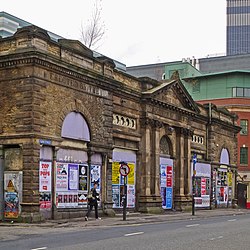
Smithfield Market Hall
Smithfield Market Hall is a renovated market hall on Swan Street in Manchester, England, which houses a food hall known as Mackie Mayor. The hall reopened in 2017 after years of dereliction.

171 m
River Tib
The River Tib is a minor tributary of the River Medlock in Manchester, England. It has been culverted along its entire length since about 1783 and now runs beneath Manchester city centre. Tib Street (53°29′01″N 2°14′05″W) and Tib Lane are named after the watercourse.
During the Roman period, the Tib marked the boundary of the vicus or settlement of Mamucium; the river continued to mark Manchester's boundary until medieval times, as well as providing drinking water. A notion concerning the Tib's name, coined by Geoffrey Ashworth in his book The Lost Rivers of Manchester, is that the river was given its name by homesick Roman soldiers after the River Tiber, but with the word shortened to reflect the size difference between the two rivers. Alternatively, the name may derive from the Celtic word for "watercourse".
The river's source is a spring in Miles Platting (53°29′36″N 2°13′08″W), from where it flows underneath Oldham Road and the eponymous Tib Street to reach the city centre. After flowing underneath West Mosley Street, the Tib crosses Princess Street to flow underneath the Manchester Town Hall Extension, the Central Library and the Midland Hotel's dining room, before joining the Medlock at Gaythorn (now First Street, 53°28′23″N 2°14′52″W), close to Deansgate railway station.
Parts of the Rochdale Canal around Lock 89 (Tib Lock) can be emptied into the River Tib by opening a small, original wooden trap door installed during construction. Lock 89 was one of the bottom nine locks opened in 1800.

176 m
Castle Hotel, Manchester
The Castle Hotel is a historic public house on Oldham Street in the Northern Quarter area of Manchester, England. The Campaign for Real Ale considers it to have an "interior of exceptional national historic importance."
195 m
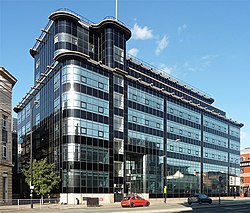
Daily Express Building, Manchester
The Daily Express Building, located on Great Ancoats Street in Manchester, England, is a Grade II* listed building which was designed by engineer Sir Owen Williams. It was built in 1939 to house one of three Daily Express offices; the other two similar buildings are located in London and Glasgow.
The pre-World War II building is notable for its timeless, "space-age" quality and is often mistaken for being much younger than it is due to its futuristic avant garde appearance. The building is futurist art deco, specifically streamline moderne with its horizontal lines and curved corners. It is clad in a combination of opaque and vitrolite glass. It was considered highly radical at the time, and incorporates what was at the time a growing technology, curtain walling.
Unlike the London and Glasgow Express buildings, the Manchester building was designed by the engineer for all three buildings, Sir Owen Williams. It is considered the best of the three Express Buildings, and is admired by architects (such as Norman Foster) and Mancunians alike. The building was Grade II* listed in 1974, just 35 years after its initial construction.