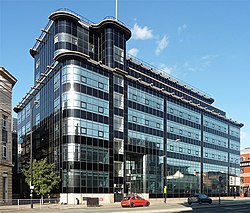
The Daily Express Building, located on Great Ancoats Street in Manchester, England, is a Grade II* listed building which was designed by engineer Sir Owen Williams. It was built in 1939 to house one of three Daily Express offices; the other two similar buildings are located in London and Glasgow. The pre-World War II building is notable for its timeless, "space-age" quality and is often mistaken for being much younger than it is due to its futuristic avant garde appearance. The building is futurist art deco, specifically streamline moderne with its horizontal lines and curved corners. It is clad in a combination of opaque and vitrolite glass. It was considered highly radical at the time, and incorporates what was at the time a growing technology, curtain walling. Unlike the London and Glasgow Express buildings, the Manchester building was designed by the engineer for all three buildings, Sir Owen Williams. It is considered the best of the three Express Buildings, and is admired by architects (such as Norman Foster) and Mancunians alike. The building was Grade II* listed in 1974, just 35 years after its initial construction.

Nearby Places View Menu
Location Image
112 m

Crown and Kettle

The Crown and Kettle is a Grade II listed pub in the Ancoats area of Manchester, England. It is located on the corner of Oldham Road and Great Ancoats Street. The Campaign for Real Ale considers it a "pub with outstanding conversion or restoration."
Location Image
116 m

Castle Hotel, Manchester

The Castle Hotel is a historic public house on Oldham Street in the Northern Quarter area of Manchester, England. The Campaign for Real Ale considers it to have an "interior of exceptional national historic importance."
Location Image
195 m

Band on the Wall

Band on the Wall is a live music venue in the Northern Quarter of Manchester, England.
Location Image
203 m

Ancoats

Ancoats is an area of Manchester, England, next to the Northern Quarter, the northern part of Manchester city centre. Historically in Lancashire, Ancoats became a cradle of the Industrial Revolution and has been called "the world's first industrial suburb". For many years, from the late 18th century onwards, Ancoats was a thriving industrial district and known for its large Irish population. The area suffered accelerating economic decline from the 1930s and depopulation in the years after the Second World War, particularly during the slum clearances of the 1960s. Since the 1990s, Ancoats' industrial heritage has been recognised and its proximity to the city centre has led to investment and substantial regeneration. The southern part of the area was branded New Islington by property developers Urban Splash, with redevelopment centred on the Daily Express Building. In 2021, a plaque was put in place acknowledging Ancoats' status as a Little Italy. For the purpose of local government elections, the area is part of the Ancoats and Beswick ward on Manchester City Council.