
Location Image

Royal College of Surgeons of Edinburgh

Le Royal College of Surgeons of Edinburgh (RCSEd) est une institution britannique de chirurgiens, basé à Édimbourg. Il fait partie des plus anciennes institutions chirurgicales au monde et fait remonter ses origines à 1505, lorsque les barbiers-chirurgiens d’Édimbourg reçoivent une charte (Seal of Cause) de la ville, fixant notamment des exigences de formation et d’examen.

1. Histoire

L’institution naît dans le contexte des corporations urbaines : la charte de 1505 encadre l’apprentissage et l’exercice de la chirurgie à Édimbourg, en insistant sur la maîtrise de l’anatomie et sur l’évaluation des apprentis. Le RCSEd occupe aujourd’hui un ensemble de bâtiments autour de Surgeons' Hall (bâtiment de 1832, associé à l’architecte William Playfair).

1. Missions

Le RCSEd contribue à la formation et au développement professionnel (cours, simulation, ressources), et participe à l’évaluation des chirurgiens, notamment via des examens et programmes de formation continue.

1. Lieux et collections

Le campus historique de Nicolson Street comprend également les Surgeons’ Hall Museums (musées et collections médico-chirurgicales) ainsi que des espaces d’enseignement et de conférence.

1. Notes et références


1. Article connexe

Collège royal de médecine de Londres

1. Liens externes

(en) Site officiel Ressources relatives à la recherche : Biodiversity Heritage Library CrossRef Ressource relative aux beaux-arts : Art UK (lieux d'art)

Portail de la médecine Portail de l’Écosse

Nearby Places View Menu
Location Image
4 m

Surgeons' Hall

Surgeons' Hall in Edinburgh, Scotland, is the headquarters of the Royal College of Surgeons of Edinburgh (RCSEd). It houses the Surgeons' Hall Museum, and the library and archive of the RCSEd. The present Surgeons' Hall was designed by William Henry Playfair and completed in 1832, and is a category A listed building. Surgeons' Hall Museum is the major medical museum in Scotland, and one of Edinburgh's many tourist attractions. The museum is recognised as a collection of national significance by the Scottish Government. The museum reopened in September 2015, after being closed for an eighteen-month period of redevelopment.
Location Image
56 m

Edinburgh Festival Theatre

The Edinburgh Festival Theatre (originally Empire Palace Theatre and later shortened to Empire Theatre) is a performing arts venue located on Nicolson Street in Edinburgh, Scotland. It is used primarily for performances of opera and ballet, large-scale musical events, and touring groups. After its most recent renovation in 1994, it seats 1,915. It is one of the major venues of the annual summer Edinburgh International Festival and is the Edinburgh venue for the Scottish Opera and the Scottish Ballet.
Location Image
70 m

Brass Founders' Pillar

The Brass Founders' Pillar, also known as the Brassfounders Column, is a monumental column in Edinburgh, Scotland.
Location Image
88 m

Edinburgh School of Medicine for Women
The Edinburgh School of Medicine for Women was founded by Sophia Jex-Blake in Edinburgh, Scotland, in October 1886, with support from the National Association for Promoting the Medical Education of Women. Sophia Jex-Blake was appointed as both the director and the dean of the school. The first class of women to study at the Edinburgh School of Medicine for Women consisted of eight students, the youngest of whom was nineteen years of age. Throughout its twelve years in operation, the school struggled to find financial funding to remain open. A rival institution, the Edinburgh College of Medicine for Women, set up by the Scottish Association for the Medical Education of Women whose leading members included John Inglis, the father of Elsie Inglis, attracted several students of Jex-Blake, including Martha Cadell and Grace Cadell. St Mungo's College and Queen Margaret College in Glasgow also accepted women medical students and when the Scottish universities began to do so the Edinburgh School of Medicine could no longer compete. The school closed in 1898. Over the twelve years of its operation, the Edinburgh School of Medicine provided education to approximately eighty female students. Of those eighty students, thirty-three completed the full course of medical training at the Edinburgh School while many others chose to finish their education at outside institutions.
Location Image
92 m

King Khalid Building

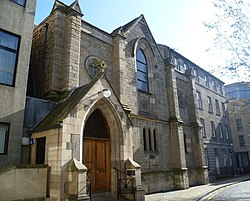
The King Khalid Building is an event space in the Southside, Edinburgh, Scotland, owned and operated by the Royal College of Surgeons of Edinburgh. The building was constructed as Roxburgh Free Church in 1847 and converted to its current use in 1982. The building's first occupants, Roxburgh Free Church, began as a Relief congregation in 1803, subsequently joining the Church of Scotland in 1833 then the Free Church at the Disruption of 1843. The congregation united with McCrie Free in 1886. Between 1888 and 1965, the buildings were occupied by St Michael's Episcopal Church. After a period of dereliction, the buildings were converted for use as a lecture theatre. In recognition of a major donation from King Khalid of Saudi Arabia, the building was given the full name: King Khalid bin Abdul Aziz of Saudi Arabia Symposium Hall. It also operates as a Fringe venue under the name Symposium Hall. The building was designed in the Gothic style by Thomas Hamilton and opened in 1847. It was altered by John Kinross ahead of its reopening as an Episcopal Church in 1888. In 1982, James Parr & Partners created the two-storey interior with a lecture theatre above and smaller rooms below. A further renovation in 2005 increased the seating capacity.