
La préfecture de Marrakech (en berbère: ⵜⴰⵎⴰⵥⵍⴰⵢⵜ ⵏ ⵎⴻⵔⵔⴰⴽⴻⵛ, Tamaẓlayt en Meṛṛakec ; en arabe : عمالة مراكش, ‘Amālat Murrākuṣ) est une subdivision à dominante urbaine de la région marocaine de Marrakech-Safi.

1. Géographie


1. Histoire


1. Administration et politique


1. = Découpage territorial =

La préfecture de Marrakech comprend:

ce qu'on appelle couramment la ville de Marrakech, qui correspond à deux communes urbaines (ou municipalités): la commune urbaine de Méchouar Kasba, où siège un palais royal, la commune urbaine de Marrakech, entourant la précédente et composée de cinq arrondissements: Marrakech-Médina, Guéliz, Ménara, Ennakhil et Sidi Youssef Ben Ali; quatre centres urbains distincts de Marrakech, situés hors agglomération : Tamansourt, Loudaya, Sidi Zouine et Kettara. treize communes rurales: Ouled Hassoune, Al Ouidane, Ouahat Sidi Brahim, Harbil, Lamnabha, Ouled Dlim, Loudaya, Sidi Zouine, Aït Imour, Agafay, Souihla, Saâda et Tassoultante.

1. Économie


1. = Tourisme =


1. = Artisanat =


1. = Agriculture =


1. Démographie


1. Villes


1. Notes et références

(de) Cet article est partiellement ou en totalité issu de l’article de Wikipédia en allemand intitulé « Marrakesch (Provinz) » (voir la liste des auteurs).

Portail de Marrakech Portail du Maroc Portail des Berbères

Nearby Places View Menu
Location Image
193 m

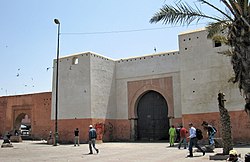
Bab Doukkala

Bab Doukkala (Arabic: باب دكالة, lit. 'gate of the Doukkala') is the main northwestern gate of the medina (historic walled city) of Marrakesh, Morocco.
Location Image
633 m

Bab Doukkala Mosque

The Bab Doukkala Mosque (Arabic: مسجد باب دكالة) or Mosque of Bab Doukkala is a mosque in Marrakesh, Morocco. It is named after the nearby western city gate, Bab Doukkala. It was built in the 16th century during the Saadian period. It is also known as the al-Hurra Mosque ("Mosque of the Free One"), in reference to its founder, Massa'uda al-Wizkitiya. Like the contemporary Mouassine Mosque to the southeast, it was built as a Friday mosque for what was a newly redevelopped neighbourhood at the time. It formed the main element in a larger religious-charitable complex that also included a madrasa, a hammam, a library, a fountain, and more.
Location Image
807 m

Zawiya of Sidi Muhammad Ben Sliman al-Jazuli

The Zawiya of Sidi Muhammad Ben Sliman al-Jazuli is a zawiya (Islamic Sufi religious complex) in Marrakesh, Morocco. It is centered around the tomb of Muhammad al-Jazuli, a 15th-century Muslim scholar and Sufi saint who is one of the Seven Saints of Marrakesh. The complex was established around 1523–4, when the Saadian ruler Ahmad al-'Araj transferred al-Jazuli's body here. It was subsequently restored and modified in later periods. The complex consists mainly of a mosque and a mausoleum chamber, with other smaller elements including an ablutions facility, a street fountain, a hospice, a residence, and a school room. A small cemetery next to the complex contains the tombs of Ahmad al-'Araj and other members of his family.
Location Image
853 m

Dar el Bacha

Dar el Bacha (Arabic: دار الباشا, lit. 'House of the Pasha') is a palace situated in the old medina of Marrakesh, Morocco. It currently houses the Museum of Confluences.
Location Image
872 m

Yves Saint Laurent (designer)

Yves Henri Donat Mathieu-Saint-Laurent (1 August 1936 – 1 June 2008), better known as Yves Saint Laurent (, also UK: , US: ; French: [iv sɛ̃ lɔʁɑ̃] ) or YSL, was a French fashion designer who, in 1962, founded his eponymous fashion label. He is regarded as being among the foremost fashion designers of the twentieth century. Saint Laurent's designs often combined elements of comfort and elegance. He is credited with having introduced the "Le Smoking" tuxedo suit for women, and was known for his use of non-European cultural references and diverse models. Fashion historian Caroline Milbank called Saint Laurent "the most consistently celebrated and influential designer of the past twenty-five years", adding that he "can be credited with both spurring the couture's rise from its 1960s ashes and with finally rendering ready-to-wear reputable". In 1983, Saint Laurent became the first living fashion designer to be honored by the Metropolitan Museum of Art with a solo exhibition. Throughout his couturier career, Saint Laurent received multiple awards for his work. He is a recipient of the 1982 International Fashion Award from the Council of Fashion Designers of America, the 1985 Oscar de la mode, and the 1999 Geoffrey Beene Lifetime Achievement Award at the CFDA Fashion Awards.