

 English
 Français

Yves Henri Donat Mathieu-Saint-Laurent (1 August 1936 – 1 June 2008), better known as Yves Saint Laurent (, also UK: , US: ; French: [iv sɛ̃ lɔʁɑ̃] ) or YSL, was a French fashion designer who, in 1962, founded his eponymous fashion label. He is regarded as being among the foremost fashion designers of the twentieth century. Saint Laurent's designs often combined elements of comfort and elegance. He is credited with having introduced the "Le Smoking" tuxedo suit for women, and was known for his use of non-European cultural references and diverse models. Fashion historian Caroline Milbank called Saint Laurent "the most consistently celebrated and influential designer of the past twenty-five years", adding that he "can be credited with both spurring the couture's rise from its 1960s ashes and with finally rendering ready-to-wear reputable". In 1983, Saint Laurent became the first living fashion designer to be honored by the Metropolitan Museum of Art with a solo exhibition. Throughout his couturier career, Saint Laurent received multiple awards for his work. He is a recipient of the 1982 International Fashion Award from the Council of Fashion Designers of America, the 1985 Oscar de la mode, and the 1999 Geoffrey Beene Lifetime Achievement Award at the CFDA Fashion Awards.
1. Early life and education
Yves Henri Donat Mathieu-Saint-Laurent was born on 1 August 1936, in Oran, Algeria, to French parents (Pieds-Noirs) with some Spanish heritage, Charles and Lucienne Andrée Mathieu-Saint-Laurent. He grew up in a villa by the Mediterranean with his two younger sisters, Michèle and Brigitte. As a child, he liked to create intricate paper dolls, and by his early teen years, he was designing dresses for his mother and sisters. In 1953, Saint Laurent submitted three sketches to a contest for young fashion designers organized by the International Wool Secretariat. Saint Laurent won first place. Subsequently, he was invited to attend the awards ceremony held in Paris in December. During his stay in Paris, Saint Laurent met Michel de Brunhoff, editor-in-chief of the French edition of Vogue magazine and a connection to his father. De Brunhoff was impressed by the sketches that Saint Laurent brought with him and suggested he should become a fashion designer. Saint Laurent enrolled in a course of study at the Chambre Syndicale de la Haute Couture, the council which regulates the haute couture industry and provides training to its employees. Saint Laurent graduated at the top of his class. The same year he graduated, he entered the International Wool Secretariat competition again and won, beating his friend Fernando Sánchez and Karl Lagerfeld.
1. Career


1. = The Dior years =
Shortly after his win, he brought a number of sketches to de Brunhoff, who recognized close similarities to sketches he had been shown that morning by Christian Dior. Knowing that Dior had created the sketches that morning and that the young man could not have seen them, de Brunhoff sent him to Dior, who hired him on the spot on June 20, 1955. "Dior fascinated me," Saint Laurent later recalled. "I couldn't speak in front of him. He taught me the basis of my art. Whatever was to happen next, I never forgot the years I spent at his side." Under Dior's tutelage, Saint Laurent's style continued to mature and gain even more notice. Although Dior recognised his talent immediately, Saint Laurent spent his first year at the House of Dior on mundane tasks, decorating the studio and designing accessories. Eventually he was allowed to submit sketches for the couture collection. With each passing season, more of his sketches were accepted by Dior. Some Dior collections from this period contain themes that would appear in Saint Laurent's independent work years later, such as the smock tops and safari jackets in Dior's 1957 "Libre" line. In August 1957, Dior met with Saint Laurent's mother to tell her that he had chosen Saint Laurent to succeed him as a designer. His mother later said that she had been confused by the remark, as Dior was only 52 years old at the time. She claimed both she and her son were surprised when Dior died at a health spa in northern Italy of a massive heart attack in October 1957.
In 1957, at 21 years old, Saint Laurent became the head designer of the House of Dior. His spring 1958 collection almost certainly saved the enterprise from financial ruin. The simple, flaring lines of his first collection for Dior, called the Trapeze line, a variation of Dior's 1955 A-Line, catapulted him to international stardom. Dresses in the collection featured a narrow shoulder that flared gently to a hem that just covered the knee. Later collections for the House of Dior featuring hobble skirts (fall 1959) and beatnik fashions (fall 1960) were savaged by the press. In 1959, he was chosen by Farah Diba, then a student in Paris, to design her wedding dress for her marriage to the Shah of Iran. In 1960, Saint Laurent was conscripted to serve in the French Army during the Algerian War. Saint Laurent was in the military for 20 days before the stress of hazing by fellow soldiers led to him being admitted to a military hospital. There he received news that he had been fired from Dior and replaced by Marc Bohan. This exacerbated his condition, and he was transferred to Val-de-Grâce military hospital, where he was given large doses of sedatives and psychoactive drugs and subjected to electroshock therapy. Saint Laurent himself traced the origin of both his mental problems and his drug addictions to this time in hospital.
1. = The YSL years =
After his release from the hospital in November 1960, Saint Laurent sued Dior for breach of contract and won. After a period of convalescence, he and his partner, industrialist Pierre Bergé, started their own fashion house, Yves Saint Laurent or YSL, with funds from American millionaire J. Mack Robinson, cosmetics company Charles of the Ritz, and others. A number of Dior staff joined him at his new enterprise. His debut collection, presented for spring 1962, was noted for its suits and included early examples of the cut-outs that would be popular in fashion in a few years, but it received mixed reviews. His second collection, for fall 1962, was celebrated as his best since his 1958 Trapeze collection for Dior. Fashion writers ranked the collection with that of Givenchy as among the best in Paris. It featured India-inspired evening dress, a mostly dark, rich color palette, couture adaptations of traditional pea coats and fishermen's smocks (a theme seen as early as 1957 in his work for Dior), and a refinement of the bohemian influences seen in his fall 1960 Dior collection, evoking in a number of journalists' minds Paris's Left Bank.
In the 1960s, Saint Laurent introduced or contributed to fashion trends such as the beatnik look (1962), pea coats (1962), smock tops (1962-63), thigh-high boots (1963, via his chosen shoe designer Roger Vivier), the Le Smoking women's tuxedo suit (1966), platform shoes (1967, courtesy of Roger Vivier), and safari jackets for men and women (1967). Throughout the 1960s, Saint Laurent followed the international youth culture taking shape, a tendency already evident in his fall 1960 Dior collection. Like designers and others of the period, he kept an eye on the pace-setting streets of London and also on the hippie movement emanating from the US. He responded to the spare precision of André Courrèges's groundbreaking 1964 and '65 Space Age designs with the now-famous stark, geometric shift dresses of his 1965 Mondrian collection but faltered a bit with the slightly passé Pop Art dresses in his autumn 1966 line. He was the first French couturier to come out with a full prêt-à-porter (ready-to-wear) line; although Alicia Drake credits this move with Saint Laurent's wish to democratize fashion; others point out that other couture houses were preparing prêt-à-porter lines at the same time – the House of Yves Saint Laurent merely announced its line first. The purpose of the prêt-à-porter line was to provide a wider range of fashionable styles being available to choose from in the market, as they were affordable and cheaper. The first of the company's Rive Gauche stores, which sold the prêt-à-porter line, opened on the rue de Tournon in the 6th arrondissement of Paris, on 26 September 1966. The first customer was Catherine Deneuve. He designed the costumes for Deneuve in films such as Belle de Jour, Heartbeat, and Mississippi Mermaid.
In 1967, Éditions Tchou published a book by Saint Laurent, La Vilaine Lulu (The Villain Lulu), a collection of comic strips featuring a cruelly mischievous little girl named Lulu that the designer had been sketching since 1956, when he had been inspired by a costume worn by one of Dior's colleagues. The child engages in pranks ranging from abusing hospital patients to defiling André Courrèges's pristine white salon with black paint. The revolutionary societal movements of the time transformed Saint Laurent's thinking and he began to base his work more on what women were actually wearing than on abstract ideas in his head. A number of his designs were inspired by women's lives in the sociopolitical climate of the time, particularly the trousers he showed in 1968 after witnessing the epochal French uprisings of that year. Saint Laurent is often said to have been the main designer responsible for making women wearing pants more widely acceptable, after André Courrèges made the first strides in that direction in 1964. The social transformations of the late 1960s also influenced how Saint Laurent himself dressed, as he wore more relaxed clothes reflecting the era's youth movements and let his hair grow. His new personal wardrobe led to him presenting his first men's ready-to-wear collection in 1969. In September 1968, Saint Laurent opened the first Rive Gauche store in the United States on Madison Avenue in Manhattan. While in New York, he attended the exhibition of his costume sketches for ballet and theatrical productions at the Wright Hepburn Webster Gallery. During this trip Saint Laurent and his entourage were denied entry to Trader Vic's restaurant because the women were wearing pants. In 1971, he posed for a natural-looking nude photograph as part of the advertising campaign for his Pour Homme men's fragrance. During the 1970s, Saint Laurent came to be considered the most prominent designer in the world, adapting his designs to modern women's needs. Though Karl Lagerfeld and Jean Muir occasionally approached him in critical appraisal and popularity, Saint Laurent remained the strongest influence on fashion throughout the decade, an era when the societal advances of the 1960s required designers to defer to the public's demands for practicality and comfort. Even in his sometimes lavish Russian peasant collections of the middle of the decade, the clothes themselves remained comfortable and wearable.
His controversial spring 1971 collection was inspired by 1940s fashion. Some felt it romanticized the German occupation of France during World War II, which he did not experience, while others felt it brought back the unattractive utilitarianism of the time. The French newspaper France Soir called the spring 1971 collection "Une grande farce!" His spring 1971 couture collection marked other changes. Now that the liberatory trends of the 1960s and early '70s had become established, with women released from constricting undergarments and free to wear trousers in all settings and men also free to be more casual in their dress, advances aided in no small part by Saint Laurent, he shed some of the less appealing aspects of the youth culture of that period, particularly after losing a couple of young friends to the drug experimentation of the time. While still exhibiting the pervasive relaxed, casual look, by 1972 he had begun to cut his hair and shave again and discarded the well-worn jeans and shoelessness. Saint Laurent had nurtured ready-to-wear to the extent that it now eclipsed the haute couture in prominence. In 1971, amidst heavy criticism of his 1940s-themed collection, he threatened to end his couture services entirely. Instead, Saint Laurent and a few others declared in early 1972 that they would now show their couture pieces with their prêt-á-porter, but soon Saint Laurent began to worry publicly that the craftsmanship of the couture might be lost, as well as the livelihoods of those who depended on him, and he decided to carry on holding separate couture presentations. While the prêt-à-porter line became extremely popular with the public and eventually earned many times more for Saint Laurent and Bergé than the haute couture line, Saint Laurent's decision to continue producing haute couture lines resulted in some landmark collections as well during the 1970s, most famously the fall 1976 Russian Peasant collection, which brought the popular peasant silhouette of the time to a peak of exotic luxury, but also his spring 1978 Broadway Suit presentation, which inspired the fashion industry to move toward wide, padded shoulders. However, Saint Laurent, whose health had been precarious for years, became erratic under the pressure of designing two haute couture and two prêt-à-porter collections every year. In 1976, Saint Laurent and Bergé ended their romantic relationship but remained business partners. Saint Laurent increasingly turned to alcohol and drugs. At some shows, he could barely walk down the runway at the end of the show, and he had to be supported by models.
Saint Laurent is credited with initiating in 1978 the prominently shoulder-padded styles that would characterize the 1980s. He then relied on a restricted set of looks based largely on big-shouldered jackets and narrow skirts and trousers that wouldn't vary much for a decade, resulting in some fashion writers bemoaning the loss of his former inventiveness and others welcoming the familiarity. Where in the 1960s and '70s his work had reflected the democratizing trends of the time, during the 1980s his work conformed more to the tastes of the wealthy as social inequality increased in society. His broad-shouldered wardrobe basics now seemed geared more to the ladies-who-lunch set than the liberated, casual young women he had been inspired by in the earlier 1970s, and his work was now often grouped with that of Givenchy, Valentino, Oscar de la Renta, and similar designers. He was noted in the early 1980s for his short, slim, sleek black leather skirts. After helping bring ready-to-wear to mass acceptance earlier in his career and nearly abandoning haute couture in the early 1970s, during the 1980s, with the nouveaux riches in ascendance and demanding showpieces, he refocused on his couture lines, to the extent that observers felt that his prêt-á-porter was being neglected. He was one of the last designers to give up big shoulder pads at the end of the eighties. After a disastrous 1987 prêt-à-porter show in New York City, which featured US$100,000 jeweled casual jackets only days after the "Black Monday" stock market crash, he turned over the responsibility of the prêt-à-porter line to his assistants. Although the line remained popular with his fans, it was soon dismissed as "boring" by the press. In 1993, the Yves Saint Laurent business was sold to Sanofi. He became increasingly reclusive, but continued to design the couture collection until 2002.
1. = Muses =
A favorite among his female clientele, Saint Laurent had a number of muses that inspired his work. Among them were: French model Victoire Doutreleau, who opened his first fashion show in 1962; Loulou de la Falaise, the daughter of a French marquis and an Anglo-Irish model, who became the jewellery designer for the brand; Betty Catroux, the half-Brazilian daughter of an American diplomat, who Saint Laurent considered his "twin sister"; French actress Catherine Deneuve; French model Danielle Luquet de Saint Germain, who inspired the Le Smoking suit; American-French artist Niki de Saint Phalle, who also inspired the Le Smoking suit; Warhol superstar Donna Jordan, who inspired his spring 1971 collection; Mounia, a model from Martinique who was the oft-used bride at his fashion shows; Kenyan model Khadija Adam Ismail; Lucie de la Falaise, a Welsh-French model and niece of Loulou, who was the bride in his fashion shows in 1990–1994; jewellery designer Paloma Picasso; Dutch actress Talitha Getty; American socialite Nan Kempner, who was named ambassador for the brand; Italian model Marina Schiano, who managed the YSL boutiques in North America; French model Nicole Dorier, who became the director of his runway shows, and later, the "memory" of his house when it became a museum; and French model Laetitia Casta, who was the bride in his fashion shows in 1998–2001.
1. Death
Saint Laurent died on 1 June 2008 of brain cancer at his residence in Paris. According to The New York Times, a few days prior, he and Bergé had been joined in a same-sex civil union known as a Pacte civil de solidarité (PACS) in France. When Saint Laurent was diagnosed as terminal, with only one or two weeks left to live, Bergé and the doctor mutually decided that it would be better for him not to know of his impending death. Bergé said, "I have the belief that Yves would not have been strong enough to accept that." He was given a Catholic funeral at Église Saint-Roch in Paris. The funeral attendees included the former Empress of Iran Farah Pahlavi, Bernadette Chirac, Catherine Deneuve, and President Nicolas Sarkozy and his wife, Carla Bruni. His body was cremated, and his ashes were scattered in Marrakesh, Morocco, in the Majorelle Garden, a residence and botanical garden that he owned with Bergé and often visited to find inspiration and refuge. Bergé said at the funeral service (in French): "But I also know that I will never forget what I owe you and that one day I will join you under the Moroccan palms."
1. Personal life
Yves Saint Laurent met Pierre Bergé in 1958. After falling in love, they co-founded the Yves Saint Laurent Couture House in 1961. They remained longtime friends and business partners after their amicable breakup in 1976. In 1970, Saint Laurent befriended pop artist Andy Warhol while the latter was filming L'Amour in Paris. Saint Laurent had his portrait commissioned in 1972, and Warhol traveled to Paris to photograph him. During a visit to New York in November 1972, Saint Laurent saw the portrait and remarked, "The colors are marvelous — orange, red, green, and pink." In February 1974, Saint Laurent hosted a party for Warhol to celebrate his one-man shows at the Musée Galliera and the Galerie Ileana Sonnabend in Paris. In 1973, Saint Laurent began a six-month affair with Karl Lagerfeld's companion Jacques de Bascher. Bergé ended their liaison in 1974, accusing de Bascher and Lagerfeld of being responsible for Saint Laurent's mental health issues and his increasing interest in hard drugs and sadomasochism. During the 1970s, Saint Laurent was considered one of Paris's "jet set". He was often seen at clubs in France and New York City, such as Club Sept, Regine's, Studio 54, and Le Palace, and was known to be both a heavy drinker and a frequent user of cocaine.
1. = Residences =
Saint Laurent and Bergé made their first trip to Marrakesh in 1966, which marked the start of a lifelong passion for Moroccan culture. Saint Laurent once stated, "Everything was black before Marrakech." "I learned color from this city, and I embraced its light, its bold blends, and its passionate inventions." For multiple years to come, Saint Laurent and Bergé would return and purchase various properties. They acquired Dar Es Saada in 1974, Villa Oasis 45 and Majorelle Garden in 1980, and Villa Mabrouka in 1997. The duplex at 55 Rue de Babylone on the Left Bank of Paris, which Saint Laurent and Bergé purchased in 1970, was highlighted in the May 1972 issue of British Vogue. French architect Jean-Michel Frank designed the apartment's interior in the 1920s in the Art Deco style. The apartment featured vases by Jean Dunand, stools by Pierre Legrain, a red lacquer-framed stool by Gustave Miklos, an armchair by Eileen Gray, and sheep chairs by Claude and François-Xavier Lalanne. In 1983, Saint Laurent and Bergé bought a neo-gothic villa, Château Gabriel in Benerville-sur-Mer, near Deauville, France. Saint Laurent was a great admirer of Marcel Proust who had been a frequent guest of Gaston Gallimard, one of the previous owners of the villa. When they bought Château Gabriel, Saint Laurent and Bergé commissioned Jacques Grange to decorate it with themes inspired by Proust's Remembrance of Things Past.
1. = Collections =
In February 2009, an auction of 733 items from Saint Laurent and Bergé's collection was held by Christie's at the Grand Palais, ranging from paintings by Picasso to ancient Egyptian sculptures. The proceeds went to HIV and AIDS research. Before the sale commenced, the Chinese government tried to stop the sale of two of twelve bronze statue heads taken from the Old Summer Palace in China during the Second Opium War. A French judge dismissed the claim and the sculptures, heads of a rabbit and a rat, sold for €15,745,000. However, the anonymous buyer revealed himself to be Cai Mingchao, a representative of the PRC's National Treasures Fund, and claimed that he would not pay for them on "moral and patriotic grounds". The heads remained in Bergé's possession until acquired by François Pinault, owner of a number of luxury brands including Yves Saint Laurent. He then donated them to China in a ceremony on 29 June 2013. On the first day of the sale, Henri Matisse's painting Les coucous, tapis bleu et rose broke the previous world record set in 2007 for a Matisse work and sold for 32 million euros. The record-breaking sale realized 342.5 million euros (£307 million). The subsequent auction, 17–20 November, included 1,185 items from the couple's Normandy villa. While not as impressive as the first auction, it featured the designer's last Mercedes-Benz car and his Hermès luggage.
1. Accolades and legacy
In 1982, Saint Laurent received the International Fashion Award from the Council of Fashion Designers of America. In 1983, Saint Laurent became the first living fashion designer to be honored by the Metropolitan Museum of Art with a solo exhibition. In 1985, Saint Laurent was awarded the Oscar de la mode for his "'contribution to the history of fashion.'' In 1999, Saint Laurent received the Geoffrey Beene Lifetime Achievement Award at the CFDA Fashion Awards. In 2001, Saint Laurent was awarded the rank of Commander of the Légion d'Honneur by French President Jacques Chirac. In 2007, Saint Laurent was awarded the rank of Grand officier de la Légion d'honneur by French President Nicolas Sarkozy. In 2004, Saint Laurent created a foundation with Bergé in Paris to trace the history of the house of YSL, complete with 15,000 objects and 5,000 pieces of clothing. Forbes rated Saint Laurent the top-earning dead celebrity in 2009. In 2010, the street in front of the Majorelle Garden in Marrakesh was renamed the Rue Yves Saint Laurent in his honor. In 2022, the "Yves Saint Laurent Aux Musées" exhibition was held simultaneously at six Parisian cultural institutions: the Centre Pompidou, the Musée d’Art Moderne de Paris, the Musée du Louvre, the Musée d’Orsay, the Musée National Picasso–Paris, and the Musée Yves Saint Laurent Paris, demonstrating the enduring legacy of his work and his lifelong fascination with art. This exhibition highlighted his connections to various art forms and his ability to blend fashion with artistic expression.
1. = Museums =
The Yves Saint Laurent Museum in Paris, housed in the old Fondation Pierre Bergé-Yves Saint Laurent, opened its doors in 2017. Through a continuously updated collection display, the museum chronicles his career. The exhibition space was renovated by stage designer Nathalie Crinière and interior designer Jacques Grange. The Yves Saint Laurent Museum in Marrakesh, also opened in 2017. Pierre Bergé personally chose the thousands of pieces of apparel and haute couture accessories housed in the 43,000-square-foot structure, which was created by the Paris-based studio Studio KO. Saint Laurent's childhood home in Oran, Algeria, where he lived until the age of 18, was purchased by the Oran entrepreneur Mohamed Affane. He transformed it into a museum, Résidence Yves Saint Laurent Oran, which opened in 2022. The period furniture was recovered and around 400 sketches by Yves Saint-Laurent are exhibited, along with childhood photos of the designer.
1. In popular culture


1. = Films =
2002: David Teboul's Yves Saint Laurent: His Life and Times 2002: Yves Saint Laurent: 5 Avenue Marceau 75116 Paris 2009: Tout Terriblement 2010: Pierre Thoretton's L'Amour fou 2014: Yves Saint Laurent by Pierre Niney 2014: Saint Laurent by Gaspard Ulliel 2019: Yves Saint Laurent: The Last Collections
1. = Television =
1965: Appeared on 24 October as a "mystery guest" on the American television game show What's My Line?
1. = Books =
Benaïm, Laurence (2017). Dior by YSL. Photography by Laziz Hamani. Assouline. ISBN 978-1-61428-599-1. Benaïm, Laurence (2019). Yves Saint Laurent: A Biography. Rizzoli. ISBN 978-0-8478-6339-6. Benaïm, Laurence (2020). Yves Saint Laurent: The Impossible Collection. Assouline. ISBN 978-1-61428-942-5. Bergé, Pierre (2014). Yves Saint Laurent: A Moroccan Passion. Illustrated by Lawrence Mynott. Abrams. ISBN 978-1-4197-1349-1. Rawsthorn, Alice (1996). Yves Saint Laurent: A Biography. HarperCollins. ISBN 978-0-385-47645-4. Napias, Jean-Christophe; Mauriès, Patrick (2023). The World According to Yves Saint Laurent. Thames&Hudson. ISBN 978-0-500-02618-2. Benaïm, Laurence (2002). Debut: Yves Saint Laurent 1962. Abrams Books. ISBN 978-0-8109-0561-0. Werle, Simone (2010). 50 Fashion Designers You Should Know. Prestel. pp. 64–68. ISBN 978-3-7913-4413-3. Menkes, Suzy (2019). Yves Saint Laurent: The Complete Haute Couture Collections, 1962–2002. Thames&Hudson. ISBN 978-0-300-24365-9. Reising, Kelly (2025). The Essence of Yves Saint Laurent: Unfolded. Helmin&Sorgenfri. ISBN 978-87-94190-60-2. Baxter-Wright, Emma (2021). Little Book of Yves Saint Laurent: The Story of the Iconic Fashion House. Welbeck Publishing. ISBN 978-1-78739-554-1.
1. See also
Yves Saint Laurent (brand)
1. References


1. Further reading
Bergé, Pierre (1997). Yves Saint Laurent: The Universe of Fashion. Rizzoli. ISBN 978-0-7893-0067-6. Milbank, Caroline Rennolds (1985). Couture: The Great Fashion Designers. Thames & Hudson. ISBN 978-0-941434-51-5. Rawsthorn, Alice (1996). Yves Saint Laurent: A Biography. Nan A. Talese/Doubleday. ISBN 978-0-385-47645-4. Petkanas, Christopher (2018). Loulou & Yves: The Untold Story of Loulou de la Falaise and the House of Saint Laurent (First ed.). New York: St. Martin's Press. ISBN 978-1-250-05169-1.
1. External links
ysl.com, official Yves Saint Laurent (brand) website Trapèze dresses at Digital Collections at Chicago History Museum Archived 12 October 2019 at the Wayback Machine "Yves Saint Laurent, legendary designer and Pied Piper of fashion, dies aged 71", The Guardian: retrospective article "Interactive timeline of couture houses and couturier biographies". Victoria and Albert Museum. 29 July 2015. Archived from the original on 24 October 2014. Retrieved 7 May 2008. Biography of Yves Saint Laurent Yves Saint Laurent Biography "Yves Saint Laurent shuts its doors" – BBC World 31 October 2002 "All About Yves" Archived 4 May 2013 at the Wayback Machine – Jim Lehrer 16 January 2002 By Jessica Moore "Yves Saint Laurent announces retirement" – CNN 7 January 2002 "All About Yves: As the incomparable Yves Saint Laurent celebrates his 40th anniversary as a couturier, the world salutes his genius." – Julie K.L. Dam, Time magazine, 3 August 1998.
Nearby Places View Menu

Majorelle Garden

Yves Saint Laurent Museum in Marrakesh
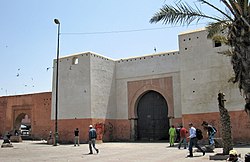
Bab Doukkala
