
The Jan Hus Memorial (Czech: Pomník mistra Jana Husa) stands at one end of Old Town Square, Prague in the Czech Republic. The huge monument depicts victorious Hussite warriors and Protestants who were forced into exile 200 years after Hus in the wake of the lost Battle of the White Mountain during the Thirty Years' War, and a young mother who symbolises national rebirth. The monument was so large that the sculptor designed and built his own villa and studio where the work could be carried out. It was unveiled in 1915 to commemorate the 500th anniversary of Jan Hus' martyrdom. The memorial was designed by Ladislav Šaloun and paid for solely by public donations. Born in 1369, Hus became an influential religious thinker, philosopher, and reformer in Prague. He was a key predecessor to the Protestant movement of the sixteenth century. In his works he criticized religious moral decay of the Catholic Church. Accordingly, the Czech patriot Hus believed that mass should be given in the vernacular, or local language, rather than in Latin. He was inspired by the teachings of John Wycliffe. In the following century, Hus was followed by many other reformers - e.g. Martin Luther, John Calvin and Huldrych Zwingli. Hus was ultimately condemned by the Council of Constance and burned at the stake in 1415. This led to the Hussite Wars.

Nearby Places View Menu
37 m

European Association of Archaeologists
The European Association of Archaeologists (EAA) is a membership-based, not-for-profit association, open to archaeologists and other related or interested individuals or bodies in Europe and beyond. It was founded in 1994 at an inaugural meeting in Ljubljana, Slovenia, where its Statutes were formally approved, and recognized by the Council of Europe in 1999. EAA has had over 15,000 members on its database from 75 countries. EAA holds an annual conference (Annual Meetings) and publishes the flagship journal, the European Journal of Archaeology. The EAA also publishes an in-house newsletter, The European Archaeologist (TEA), and two monograph series (Themes in Contemporary Archaeology and Elements: The Archaeology of Europe). The registered office of the association is in Prague, Czech Republic.
Location Image
37 m

Prague

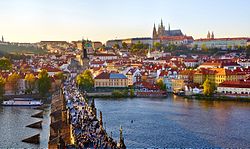
Prague ( PRAHG; Czech: Praha [ˈpraɦa] ) is the capital and largest city of the Czech Republic and the historical capital of Bohemia. Prague, located on the Vltava River, has a population of about 1.4 million, while its metropolitan area is home to approximately 2.3 million people. Prague is a historical city with Romanesque, Gothic, Renaissance, and Baroque architecture. It was the capital of the Kingdom of Bohemia and residence of several Holy Roman Emperors, most notably Charles IV (r. 1346–1378) and Rudolf II (r. 1575–1611). It was an important city to the Habsburg monarchy and Austria-Hungary. The city played major roles in the Bohemian and Protestant Reformations, the Thirty Years' War, and in 20th-century history as the capital of Czechoslovakia between the World Wars and the post-war Communist era. Prague is home to a number of cultural attractions including Prague Castle, Charles Bridge, Old Town Square with the Prague astronomical clock, the Jewish Quarter, Petřín hill, and Vyšehrad. Since 1992, the historic center of Prague has been included in the UNESCO list of World Heritage Sites. The city has more than ten major museums, along with numerous theatres, galleries, cinemas, and other historical exhibits. An extensive modern public transportation system connects the city. It is home to a wide range of public and private schools, including Charles University, the oldest university in Central Europe. Prague is classified as a "Beta+" global city according to GaWC studies. In 2019, the PICSA Index ranked the city as the 13th most livable city in the world. Its rich history makes it a popular tourist destination, and as of 2017, the city receives more than 8.5 million international visitors annually. In 2017, Prague was listed as the fifth most visited European city after London, Paris, Rome, and Istanbul.
Location Image
37 m

1972 UCI Cyclo-cross World Championships

The 1972 UCI Cyclo-cross World Championships were held in Prague, on Sunday February 27, 1972. Organized for a first time in Czechoslovakia, it was the 23th edition of the UCI Cyclo-cross World Championships.
Location Image
37 m

Old Town Square

Old Town Square (Czech: Staroměstské náměstí [ˈstaroˌmɲɛstskɛː ˈnaːmɲɛsciː] or colloquially Staromák [ˈstaromaːk] , German: Altstädter Ring) is a historic square in the Old Town quarter of Prague, the capital of the Czech Republic. It is located between Wenceslas Square and Charles Bridge.