

 English
 Français

Old Town Square (Czech: Staroměstské náměstí [ˈstaroˌmɲɛstskɛː ˈnaːmɲɛsciː] or colloquially Staromák [ˈstaromaːk] , German: Altstädter Ring) is a historic square in the Old Town quarter of Prague, the capital of the Czech Republic. It is located between Wenceslas Square and Charles Bridge.
Nearby Places View Menu

0 m
Kingdom of Bohemia
The Kingdom of Bohemia, sometimes referenced in English literature as the Czech Kingdom (Czech: České Království), was a medieval and early modern monarchy in Central Europe. It was the predecessor state of the modern Czech Republic.
The Kingdom of Bohemia was an Imperial State in the Holy Roman Empire. The Bohemian king was a prince-elector of the empire. The kings of Bohemia, besides the region of Bohemia itself, also ruled other lands belonging to the Bohemian Crown, which at various times included Moravia, Silesia, Lusatia, and parts of Saxony, Brandenburg, and Bavaria.
The kingdom was established by the Přemyslid dynasty in the 12th century from the Duchy of Bohemia. It was later ruled by the House of Luxembourg, the Jagiellonian dynasty, and from 1526 the House of Habsburg and its successor, the House of Habsburg-Lorraine. Numerous kings of Bohemia were also elected Holy Roman Emperors, and the capital, Prague, was the imperial seat in the late 14th century, and again at the end of the 16th and the beginning of the 17th centuries.
Shortly before the dissolution of the Holy Roman Empire in 1806, the kingdom became part of the newly proclaimed Habsburg Austrian Empire, and subsequently the Austro-Hungarian Empire from 1867. Bohemia retained its name and formal status as a separate Kingdom of Bohemia until 1918, known as a crown land within the Austro-Hungarian Empire, and its capital Prague was one of the empire's leading cities. The Czech language (called the Bohemian language in English usage until the 19th century) was the main language of the Diet and the nobility until 1627 (after the Bohemian Revolt was suppressed). German was then formally made equal with Czech and eventually prevailed as the language of the Diet until the Czech National Revival in the 19th century. German was also widely used as the language of administration in many towns after the Germans immigrated and populated some areas of the country in the 13th century. The royal court used the Czech, Latin, and German languages, depending on the ruler and period.
Following the defeat of the Central Powers in World War I, both the Kingdom and Empire were dissolved. Bohemia became the core part of the newly formed Czechoslovak Republic.
1 m
European Association of Archaeologists
The European Association of Archaeologists (EAA) is a membership-based, not-for-profit association, open to archaeologists and other related or interested individuals or bodies in Europe and beyond. It was founded in 1994 at an inaugural meeting in Ljubljana, Slovenia, where its Statutes were formally approved, and recognized by the Council of Europe in 1999. EAA has had over 15,000 members on its database from 75 countries. EAA holds an annual conference (Annual Meetings) and publishes the flagship journal, the European Journal of Archaeology. The EAA also publishes an in-house newsletter, The European Archaeologist (TEA), and two monograph series (Themes in Contemporary Archaeology and Elements: The Archaeology of Europe). The registered office of the association is in Prague, Czech Republic.
1 m
Prague
Prague ( PRAHG; Czech: Praha [ˈpraɦa] ) is the capital and largest city of the Czech Republic and the historical capital of Bohemia. Prague, located on the Vltava River, has a population of about 1.4 million, while its metropolitan area is home to approximately 2.3 million people.
Prague is a historical city with Romanesque, Gothic, Renaissance, and Baroque architecture. It was the capital of the Kingdom of Bohemia and residence of several Holy Roman Emperors, most notably Charles IV (r. 1346–1378) and Rudolf II (r. 1575–1611). It was an important city to the Habsburg monarchy and Austria-Hungary. The city played major roles in the Bohemian and Protestant Reformations, the Thirty Years' War, and in 20th-century history as the capital of Czechoslovakia between the World Wars and the post-war Communist era.
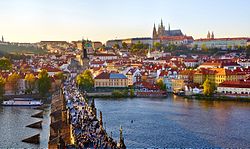
Prague is home to a number of cultural attractions including Prague Castle, Charles Bridge, Old Town Square with the Prague astronomical clock, the Jewish Quarter, Petřín hill, and Vyšehrad. Since 1992, the historic center of Prague has been included in the UNESCO list of World Heritage Sites.
The city has more than ten major museums, along with numerous theatres, galleries, cinemas, and other historical exhibits. An extensive modern public transportation system connects the city. It is home to a wide range of public and private schools, including Charles University, the oldest university in Central Europe.
Prague is classified as a "Beta+" global city according to GaWC studies. In 2019, the PICSA Index ranked the city as the 13th most livable city in the world. Its rich history makes it a popular tourist destination, and as of 2017, the city receives more than 8.5 million international visitors annually. In 2017, Prague was listed as the fifth most visited European city after London, Paris, Rome, and Istanbul.

1 m
1972 UCI Cyclo-cross World Championships
The 1972 UCI Cyclo-cross World Championships were held in Prague, on Sunday February 27, 1972. Organized for a first time in Czechoslovakia, it was the 23th edition of the UCI Cyclo-cross World Championships.