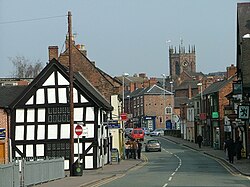
Location Image

1–5 Pillory Street, Nantwich

1–5 Pillory Street is a large curved corner block in Nantwich, Cheshire, England, in the French Baroque style of the late 17th century, which is listed at grade II. It is located on the corner of Hospital Street and Pillory Street (at SJ6513252244), and also includes 2 Hospital Street. Formerly known as Chesters' Stores, it was built in 1911 for the grocer's, P. H. Chesters, to a design by local architect, Ernest H. Edleston (1880–1964). The building has subsequently been used for a variety of retail and wholesale purposes, and it is currently a furniture store. It is the most recent listed building in Nantwich, as well as the only one dating from after the Victorian era. English Heritage describes the building in the listing as "a corner block of unusual design", and local historian Jane Stevenson calls it "flamboyant". Some contemporary observers likened the building, with its circular, porthole-like windows, to the Lusitania liner, which had been launched a few years earlier.

Nearby Places View Menu
Location Image
42 m

Lamb Hotel, Nantwich

The Lamb Hotel, now known as Chatterton House, is a former public house in Nantwich, Cheshire, England. It is located on the north side of Hospital Street, at the junction with Church Lane (at SJ6517252261). The present building by Thomas Bower dates from 1861 and is listed at grade II; Nikolaus Pevsner describes it as "decent" and "staid". It stands on the site of an inn of the same name dating from 1554. The original building was rebuilt after the fire of 1583, and served as the headquarters of the Parliamentarian forces during the Civil War. By the 17th century, the Lamb was the second-largest inn of the town. It remained a public house until the 21st century, serving additionally as the town's post office and excise office. After major rebuilding completed in 2006, the building is now used for a mixture of residential and commercial purposes, including shops, cafés and apartments.
Location Image
45 m

Queen's Aid House

The Queen's Aid House, or 41 High Street, is a timber-framed, black-and-white Elizabethan merchant's house in Nantwich, Cheshire, England. It is on the High Street immediately off the town square and opposite the junction with Castle Street (at SJ6512752298). It is listed at grade II. Built shortly after the fire of 1583 by Thomas Cleese, a local craftsman, it has three storeys with attics, and features ornamental panelling, overhangs or jetties at each storey, and a 19th-century oriel window. The building is best known for its contemporary inscription commemorating Elizabeth I's aid in rebuilding the town, which gives the building its name. It has been used as a café, as well as various types of shop. The High Street was the home of the wealthiest townspeople in the 1580s, and the houses dating from the rebuilding form the finest examples of post-fire architecture in the town. The modern High Street still contains many other good examples of Elizabethan timber-framed buildings, all of which date from after the fire; these include the grade-II*-listed number 46, which stands opposite the Queen's Aid House, and the grade-I-listed Crown Inn.
Location Image
68 m

Nantwich

Nantwich ( NAN-twitch) is a market town and civil parish in the unitary authority of Cheshire East in Cheshire, England. It has among the highest concentrations of listed buildings in England, with notably good examples of Tudor and Georgian architecture. At the 2021 census, the parish had a population of 14,045 and the built up area had a population of 18,740.
Location Image
90 m

9 Mill Street, Nantwich

9 Mill Street is a Georgian house in Nantwich, Cheshire, England. The present building (at SJ65045221) dates from around 1736 and is a grade II* listed building. Nikolaus Pevsner calls it a "fine, spacious" house, and the English Heritage listing describes it as a "substantial and well-detailed early, C18 Town House, which ... retains much original interior fabric." Formerly a town house, bank and political club, it is currently a restaurant and bar. It stands on the site of an earlier house, which has been identified as the residence of the Wright family, one of the five principal houses of Nantwich in the 17th century.