

 English
 Français
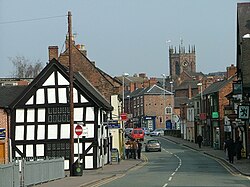
Nantwich
Nantwich ( NAN-twitch) is a market town and civil parish in the unitary authority of Cheshire East in Cheshire, England. It has among the highest concentrations of listed buildings in England, with notably good examples of Tudor and Georgian architecture. At the 2021 census, the parish had a population of 14,045 and the built up area had a population of 18,740.
Nearby Places View Menu

23 m
Queen's Aid House
The Queen's Aid House, or 41 High Street, is a timber-framed, black-and-white Elizabethan merchant's house in Nantwich, Cheshire, England. It is on the High Street immediately off the town square and opposite the junction with Castle Street (at SJ6512752298). It is listed at grade II. Built shortly after the fire of 1583 by Thomas Cleese, a local craftsman, it has three storeys with attics, and features ornamental panelling, overhangs or jetties at each storey, and a 19th-century oriel window. The building is best known for its contemporary inscription commemorating Elizabeth I's aid in rebuilding the town, which gives the building its name. It has been used as a café, as well as various types of shop.
The High Street was the home of the wealthiest townspeople in the 1580s, and the houses dating from the rebuilding form the finest examples of post-fire architecture in the town. The modern High Street still contains many other good examples of Elizabethan timber-framed buildings, all of which date from after the fire; these include the grade-II*-listed number 46, which stands opposite the Queen's Aid House, and the grade-I-listed Crown Inn.

44 m
1–3 Churchyard Side, Nantwich
1–3 Churchyard Side is a grade-II-listed Victorian Gothic building in Nantwich, Cheshire, England, located on the corner of Churchyard Side and Pepper Street (SJ6511952369), opposite St Mary's Church. Built in 1864–66 to a design by Alfred Waterhouse as the Nantwich branch of the Manchester and Liverpool District Bank, it is among the most notable examples of Victorian corporate architecture in the town. The building remained a branch of the District Bank until the late 20th century, and is still in use as a bank.

47 m
46 High Street, Nantwich
46 High Street is a timber-framed, black-and-white Elizabethan merchant's house in Nantwich, Cheshire, England, located near the town square at the corner of High Street and Castle Street. The present building dates from shortly after the fire of 1583, and is believed to have been built for Thomas Churche, a linen merchant from one of the prominent families of the town. It remained in the Churche family until the late 19th century.
High Street was the home of the wealthiest townspeople in the 1580s, and the houses dating from the rebuilding form the finest examples of post-fire architecture in the town. A substantial and fine example of its type, 46 High Street features ornamental panelling, jetties and brackets decorated with carved human figures and animals. On the interior, a first-floor room retains panelling and decorative plasterwork dating from the early 17th century. The building is listed at grade II*. It is currently used as a book shop and coffee shop.

60 m
11 Churchyard Side, Nantwich
11 Churchyard Side is a Victorian building in Gothic Revival style, in Nantwich, Cheshire, England. It stands on the town square, opposite the parish church (at SJ6516052369). Dating from 1876, the building was designed by local architect Thomas Bower as a branch of the Midland Bank, and later became a branch of Barclays. It is listed at grade II.
11 Churchyard Side is one of three bank buildings in the town dating from the Victorian era which are listed; the others are the former District Bank, designed by Alfred Waterhouse, also on Churchyard Side, and the former Savings Bank on Welsh Row.