

 English
 Français
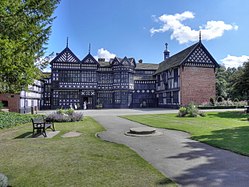
Bramall Hall
Bramall Hall est un château anglais Tudor situé à Bramhall dans le district métropolitain de Stockport dans le Grand Manchester. Bâti à l'époque saxonne, le manoir a été pour la première fois décrit dans le Domesday Book en 1086. D'abord propriété de la famille Massey, à la fin du XIVe siècle le domaine passa par mariage à la famille petite noblesse Davenport, riches propriétaires terriens du nord-ouest de l'Angleterre. Les Davenport construisirent le domaine tel qu'on le connaît aujourd'hui et restèrent propriétaires pendant près de 500 ans avant de le vendre à la famille Neville. Acheté en 1925 par l'industriel John Henry Davies, c'est ensuite acquis par la municipalité locale.
Nearby Places View Menu
8 m
Bramall Hall
Bramall Hall is a manor house in Bramhall, Stockport, Greater Manchester, England. Largely Tudor in design, its oldest parts date from the 14th century, with additions from the 16th and 19th centuries. It is a notable example of the timber-framed buildings found throughout the historic county of Cheshire. The house functions as a museum and its 70 acres (28 ha) of landscaped parkland (Bramhall Park) are open to the public.
The manor of Bramall was first described in the Domesday Book in 1086, when it was held by the Massey family. From the late 14th century, it was owned by the Davenports, who built the present house and remained lords of the manor for about 500 years. In 1877 they sold the estate of nearly 2,000 acres (810 ha) to the Manchester Freeholders' Company, a property company formed to exploit the estate's potential for residential building development. The hall and a residual park of over 50 acres (20 ha) was sold on by the Freeholders to the Nevill family of successful industrialists.
In 1925 it was purchased by John Henry Davies and then, in 1935, acquired by Hazel Grove and Bramhall Urban District Council. Following a local government reorganisation in 1974, Bramall Hall is now owned by Stockport Metropolitan Borough Council, which describes it as "the most prestigious and historically significant building in the Bramhall Park Conservation Area."

1.4 km
Millington Hall
Millington Hall is a historic Grade II listed building in Cheadle Hulme, Stockport, England, constructed in 1683. It is on Station Road next to the Methodist Church. The building became a restaurant in the 1960s, before being converted and reopened in 2004 as a public house called the John Millington.

1.4 km
Cheadle Hulme railway station
Cheadle Hulme railway station serves the suburb of Cheadle Hulme, in Greater Manchester, England. It is managed by Northern Trains, which also operates all services that stop here.
Cheadle Hulme's first railway station opened in 1842, when the Manchester and Birmingham Railway to Crewe was completed. With the extension of the line to Macclesfield, and later Stoke-on-Trent, a new station opened in 1845 which has served the area since.

1.4 km
Stockport Georgians A.F.C.
Stockport Georgians Association Football Club is a football club based in Stockport, England. They are currently members of the North West Counties League Division One South and play at Cromley Road, Stockport.

1.6 km
Cheadle Hulme
Cheadle Hulme () is a suburb in the Metropolitan Borough of Stockport, Greater Manchester, England. It lies in the historic county of Cheshire, 2 miles (3.2 km) south-west of Stockport and 8 miles (12.9 km) south-east of Manchester. In 2011, it had a population of 26,479.
Evidence of Bronze Age, Roman and Anglo-Saxon activity, including coins, jewellery and axes, have been discovered locally. The area was first mentioned in the Domesday Book of 1086 when it was a large estate which included neighbouring Cheadle. In the early 14th century, it was split into southern and northern parts at about the future locations of Cheadle Hulme and Cheadle respectively. The area was acquired by the Moseley family in the 17th century and became known as Cheadle Moseley. Unlike many English villages, it did not grow around a church; instead it formed from several hamlets, many of which retain their names as neighbourhoods within Cheadle Hulme. In the late 19th century, Cheadle Hulme was united with Cheadle, Gatley and other neighbouring places to form the urban district of Cheadle and Gatley. This district was abolished in 1974 and Cheadle Hulme became a part of the Metropolitan Borough of Stockport.
Cheadle Hulme has good transport links, with its own railway station and is in close proximity to Manchester Airport, the M60 motorway and the A34 road.