
Le Theatre on Nassau Street, ou The New Theatre, fut probablement le premier théâtre construit à Manhattan.

1. Histoire

Il s'agissait d'une structure en bois de deux étages, propriété du marchand et ancien gouverneur Rip Van Dam (en), gouverneur de New York. Le bâtiment, qui pouvait accueillir 280 personnes, fut inauguré le 11 décembre 1732 avec une représentation de The Recruiting Officer (en). Le bâtiment était situé au 64-66 Nassau Street, entre John Street (en) et Maiden Lane. En 1750, peu après la mort de Van Dam, il accueillit la première représentation connue à New York d'une comédie musicale, The Beggar's Opera, présentée par une troupe itinérante basée à Londres, Murray & Kean's. Walter Murray et Thomas Kean y avait installé leur troupe et également joué Richard III le 5 mars 1750. C'était aussi la première fois qu'on a la trace d'acteurs professionnels à New York ; auparavant, les spectacles étaient joué par des comédiens amateurs. En 1753, l'acteur et metteur en scène Lewis Hallam (en) agrandit le théâtre, décrivant la nouvelle structure comme « très belle, grande et spacieuse ». Cependant, le théâtre ferma en 1754 quelques années plus tard, en 1758, le bâtiment fut converti en église calviniste allemande, et finalement démoli en 1765 pour être remplacé par un bâtiment plus conséquent qui subsista jusqu'en 1822.

1. Notes et références

(en) Cet article est partiellement ou en totalité issu de l’article de Wikipédia en anglais intitulé « Theatre on Nassau Street » (voir la liste des auteurs).

Portail du théâtre Portail de New York

Nearby Places View Menu
Location Image
99 m

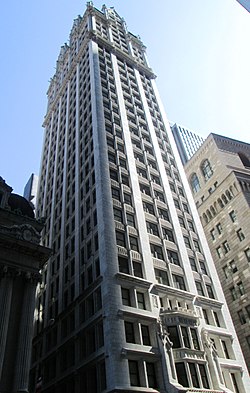
Liberty Tower (Manhattan)

The Liberty Tower, formerly the Sinclair Oil Building, is a 33-story residential building in the Financial District of Manhattan in New York City. It is at 55 Liberty Street at the northwest corner with Nassau Street. It was built in 1909–10 as a commercial office building and was designed by Henry Ives Cobb in a Gothic Revival style. The site is adjacent to the New York Chamber of Commerce Building, while the Federal Reserve Bank of New York Building is to the east, across Nassau Street. Upon its completion, Liberty Tower was said to be the world's tallest building with such a small footprint, having a floor area ratio of 30 to 1. The building's articulation consists of three horizontal sections similar to the components of a column, namely a base, shaft, and capital. The limestone building is covered in white architectural terracotta with elaborate ornament. When the building opened in 1910, one of its first commercial tenants was the law office of future U.S. president Franklin Delano Roosevelt. Shortly after World War I, the entire building was bought by Sinclair Oil. In 1979, architect Joseph Pell Lombardi converted the building from commercial use into residential apartments and renamed it the "Liberty Tower", in one of the first such conversions in Manhattan south of Canal Street. The building was designated a city landmark by the New York City Landmarks Preservation Commission in 1982 and was added to the National Register of Historic Places (NRHP) in 1983. It is also a contributing property to the Wall Street Historic District, an NRHP district created in 2007.
Location Image
121 m

Chamber of Commerce Building (Manhattan)

The Chamber of Commerce Building is a commercial building on 65 Liberty Street, between Liberty Place and Broadway, in the Financial District of Manhattan in New York City, New York, U.S. Designed by architect James Barnes Baker, the four-story Beaux-Arts building was constructed between 1901 and 1902 as the first headquarters to be built specifically for the Chamber of Commerce of the State of New York. The facade is a New York City designated landmark, and the building is listed on both the New York State Register of Historic Places and the National Register of Historic Places (NRHP) as a National Historic Landmark. It is also a contributing property to the Wall Street Historic District, listed on the NRHP. The structure is clad with Vermont marble and includes a rusticated masonry base, a short colonnade, and a copper mansard roof. The facade formerly contained statues of John Jay, Alexander Hamilton, and DeWitt Clinton, which had been designed by Daniel Chester French and Philip Martiny. The second story contained the Chamber of Commerce's Great Hall, hung with portraits of important individuals from American history. The rest of the building was largely devoted to offices or meeting rooms for the chamber. Over the years, numerous stores and banks have rented out the ground story. The building's design was largely positively received upon its completion. The building was constructed after wealthy members of the Chamber of Commerce raised funds. The architecture firm of Helmle and Corbett remodeled the interior and built a new floor in 1922, resulting in changes to the mansard roof. French and Martiny's sculptures, installed in 1903, were removed in 1926 due to severe deterioration. After the Chamber of Commerce relocated to Midtown Manhattan in 1979, the building stood vacant for ten years. The International Commercial Bank of China bought the building in 1989, and the interior was subsequently renovated by Haines Lundberg Waehler.
Location Image
153 m

140 Broadway

140 Broadway (formerly known as the Marine Midland Building or the HSBC Bank Building) is a 51-story International Style office building on the east side of Broadway between Cedar and Liberty streets in the Financial District of Manhattan in New York City. The building was designed by Gordon Bunshaft, of the firm Skidmore, Owings & Merrill, and consists of a mostly smooth black facade on a trapezoidal plot. It is approximately 688 feet (210 m) tall, with approximately 1.17 million rentable square feet (109,000 m2). It is known for the distinctive sculpture at its entrance, Isamu Noguchi's Cube. The developer Erwin S. Wolfson acquired the site in several stages between 1952 and 1961. Initial plans called for a 36-story monolith, but when Wolfson died, the architects modified their plans to a 51-story tower, which occupied only two-fifths of the block and conformed to the 1961 Zoning Resolution. The building was erected between late 1964 and 1967 and was originally known for its main tenant, the Marine Midland Corporation (later part of HSBC). Several early tenants were affiliated with the financial industry, including banking and accounting firms. In 1998, the building was sold to Silverstein Properties, which undertook a major renovation. The primary tenant of the building since 2002 is Brown Brothers Harriman, filling a vacancy left after HSBC relocated in 2001. The building has been owned by Union Investment since 2004, and the New York City Landmarks Preservation Commission designated the building as a city landmark in 2013. Reviews of the building among architecture critics have been largely positive, with several praising the structure's smooth black facade.
Location Image
161 m

28 Liberty Street

28 Liberty Street, formerly known as One Chase Manhattan Plaza, is a 60-story International Style skyscraper between Nassau, Liberty, William, and Pine Streets in the Financial District of Manhattan in New York City. The building, designed by Gordon Bunshaft of Skidmore, Owings & Merrill (SOM), opened in 1961. It is 813 feet (248 m) tall. 28 Liberty Street occupies only about 28 percent of its 2.5-acre (1.0 ha) site. It consists of 60 above-ground stories, a ground-level concourse, and five basement levels. The tower is surrounded by a plaza that contains a sunken Japanese rock garden, designed by Isamu Noguchi, to the south. The building's design is similar to that of SOM's earlier Inland Steel Building in Chicago. It contains a stainless steel facade with black spandrels below the windows. The superstructure contains 40 steel columns, arranged around the perimeter and clustered around the core to maximize usable space. When the tower opened, it accommodated 7,500 employees but contained only 150 private offices. David Rockefeller, then executive vice president of Chase Manhattan Bank, proposed the tower in the 1950s as a means to keep the newly merged bank (Chase National and the Manhattan Company) in Lower Manhattan while merging its 8,700 employees into one facility. Construction started in early 1957, and the building's tower opened in early 1961. One Chase Manhattan Plaza was nearly fully occupied from its opening, with numerous financial and legal tenants. The building's basements and plaza opened in 1964; during its early years, the structure faced some early challenges such as the discovery of weakened facade panels, a fire, and a bombing. The building was renovated in the early 1990s, and Chase moved its headquarters out in 1997. The New York City Landmarks Preservation Commission designated the building a landmark in 2008. Chase Manhattan's parent company, JPMorgan Chase, sold the building to Fosun International, a Chinese investment company, in 2013; the building was subsequently renamed 28 Liberty Street.
Location Image
183 m

Double Check

Double Check is a 1982 sculpture by John Seward Johnson II, located across from Zuccotti Park at the corner of Liberty Street and Broadway in Manhattan, New York City. The bronze sculpture portrays a well-dressed businessman sitting with his briefcase open, which is filled with office materials getting ready to enter an office building. The statue is notable for its association with the 9/11 attacks.