

 English
 Français

Double Check is a 1982 sculpture by John Seward Johnson II, located across from Zuccotti Park at the corner of Liberty Street and Broadway in Manhattan, New York City. The bronze sculpture portrays a well-dressed businessman sitting with his briefcase open, which is filled with office materials getting ready to enter an office building. The statue is notable for its association with the 9/11 attacks.
Nearby Places View Menu
27 m
Columbian Academy of Painting
Columbian Academy of Painting was one of the earliest art schools in the United States. It was founded by brothers Archibald and Alexander Robertson in 1792. The school was located in New York at 79 Liberty Street.
It was one of the country's first art schools. Their students included John Vanderlyn, Francis Alexander, and, rare for the time, woman miniaturist Ann Hall. The brothers taught art to amateur and professional students with a wide variety of mediums and subjects. Their methods were based upon those taught in European and British art schools at that time. The Columbian Academy of Art was renamed the Academy of Painting, which continued to be managed by Archibald. Alexander opened his own art school in 1802.
The school operated for 30 years.
52 m
Joie de Vivre (di Suvero)
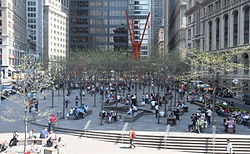
Joie de Vivre (English: Joy of Life) is an outdoor sculpture by Mark di Suvero, located at Zuccotti Park in the Financial District of Lower Manhattan, New York City. The 70-foot sculpture, composed of "open-ended tetrahedrons", was installed by the intersection of Broadway and Cedar Street in June 2006 and was previously located at the Holland Tunnel rotary (also named St. John's Park).
In October 2011, during Occupy Wall Street, a man climbed Joie de Vivre, where he remained for several hours until he was escorted down by police.

54 m
Occupy Wall Street
Occupy Wall Street (OWS) was a left-wing populist and progressive movement against economic inequality, capitalism, corporate greed, big finance, and the influence of money in politics. It began in Zuccotti Park, located in New York City's Financial District, and lasted for fifty-nine days—from September 17 to November 15, 2011.
The motivations for Occupy Wall Street largely resulted from public distrust in the private sector during the aftermath of the Great Recession in the United States. There were many particular points of interest leading up to the Occupy movement that angered populist and left-wing groups. For instance, the 2008 bank bailouts under the George W. Bush administration utilized congressionally appropriated taxpayer funds to create the Troubled Asset Relief Program (TARP), which purchased toxic assets from failing banks and financial institutions. The U.S. Supreme Court ruling in Citizens United v. FEC in January 2010 allowed corporations to spend unlimited amounts on independent political expenditures without government regulation. This angered many populist and left-wing groups that viewed the ruling as a way for moneyed interests to corrupt public institutions and legislative bodies, such as the United States Congress.
The protests gave rise to the wider Occupy movement in the United States and other Western countries. The Canadian anti-consumerist magazine Adbusters initiated the call for a protest. The main issues raised by Occupy Wall Street were social and economic inequality, greed, corruption and the undue influence of corporations on government—particularly from the financial services sector. The OWS slogan, "We are the 99%", refers to income and wealth inequality in the U.S. between the wealthiest 1% and the rest of the population. To achieve their goals, protesters acted on consensus-based decisions made in general assemblies which emphasized redress through direct action over the petitioning to authorities.
The protesters were forced out of Zuccotti Park on November 15, 2011. Protesters then turned their focus to occupying banks, corporate headquarters, board meetings, foreclosed homes, college and university campuses, and social media.

55 m
Singer Building
The Singer Building (also known as the Singer Tower) was an office building and early skyscraper at the northwestern corner of Liberty Street and Broadway in the Financial District of Lower Manhattan, New York City, United States. Serving as the headquarters of the Singer Manufacturing Company, it was commissioned by the company's leader Frederick Gilbert Bourne and designed by architect Ernest Flagg in multiple phases from 1897 to 1908. The building's architecture contained elements of the Beaux-Arts and French Second Empire styles.
The building was composed of four distinct sections. The original 10-story Singer Building at 149 Broadway was erected between 1897 and 1898, and the adjoining 14-story Bourne Building on Liberty Street was built from 1898 to 1899. In the first decade of the 20th century, the two buildings were expanded to form the 14-story base of the Singer Tower, which rose another 27 stories. The facade was made of brick, stone, and terracotta. A dome with a lantern capped the tower. The foundation of the tower was excavated using caissons; the building's base rested on shallower foundations. The Singer Building used a steel frame, though load-bearing walls initially supported the original structure before modification. When completed, the 41-story building had a marble-clad entrance lobby, 16 elevators, 410,000 square feet (38,000 m2) of office space, and an observation deck.
With a roof height of 612 feet (187 m), the Singer Tower surpassed Philadelphia City Hall to become the tallest building in the world from 1908 to 1909, when it was superseded by the Metropolitan Life Insurance Company Tower. The base occupied the building's entire land lot; the tower's floors took up just one-sixth of that area. Despite being regarded as a city icon, the Singer Building was razed between 1967 and 1969 to make way for One Liberty Plaza, which had several times more office space than the Singer Tower. At the time of its destruction, the Singer Building was the tallest building ever to be demolished by its owners, a distinction it held until 270 Park Avenue was demolished in 2019.